

%20(1).avif)


Recruiters aren't lacking tools. In fact, they're drowning in them.
Over the past few years, AI recruitment tools have exploded. You can now use ChatGPT to slap together some job descriptions, screening chatbots can tackle candidate qualification, and scheduling assistants for interview coordination. There are even candidate sourcing tools that promise to help you find those all-elusive purple squirrels.
This sounds like a great problem to have, but it results in tech stacks that look impressive on paper but create fragmentation in practice. Recruiters toggle between 8 to 12 different platforms per day, data gets trapped in silos, and hiring still moves at human speed. This means it’s constrained by whoever happens to be available when candidates apply.
This guide breaks down what AI recruitment tools actually are, how they've evolved, and – most importantly – how to think about them as part of a system rather than a collection of disconnected solutions.
What are AI recruitment tools
AI recruitment tools are AI-driven software applications that use artificial intelligence to automate repetitive tasks, optimize workflows, or enhance parts of the hiring process.
At the most basic level, AI algorithms enable three things that traditional software couldn't handle well:
- Automation of complex tasks: Not just "if this, then that" logic, but handling multi-step workflows that adapt based on context. An AI screening tool doesn't just ask pre-set questions; it can conduct genuine conversations, probe for clarification, and escalate edge cases to humans.
- Pattern recognition across large datasets: AI can analyze thousands of resumes, candidate profiles, or hiring outcomes to identify patterns humans would miss. This powers everything from candidate matching to interview intelligence to predictive analytics.
- Natural language processing and generation: AI can read unstructured text (resumes, emails, interview notes), understand intent, and generate human-quality responses. This is what makes conversational screening, automated outreach, and interview summarization possible.
Why recruitment is still broken (even with AI tools)
Most recruiting teams have adopted AI tools. That’s great. But the problem is that companies are increasingly adopting too many AI tools. And despite the bloated tech stacks, hiring is still getting stuck with manual bottlenecks. Here’s why:
- Too many tools create coordination overhead. When candidate data lives in your ATS, screening happens in a chatbot platform, interview notes sit in a separate tool, and scheduling requires yet another system – integration becomes the job.
- Workflows stay fragmented. AI tools solve one specific problem without connecting to the broader process. You get automated screening, but then manually copy data into your ATS.
- Manual admin persists. Despite automation promises, recruiters still spend 20-40% of their time on administrative tasks. The work hasn't disappeared – it's just shifted.
- ATS platforms remain constrained. Most applicant tracking systems were built for a pre-AI era. Even with "AI features," they can't coordinate across tools or operate autonomously.
The evolution of AI in recruitment
Understanding where AI recruiting software is headed requires understanding where it's been.
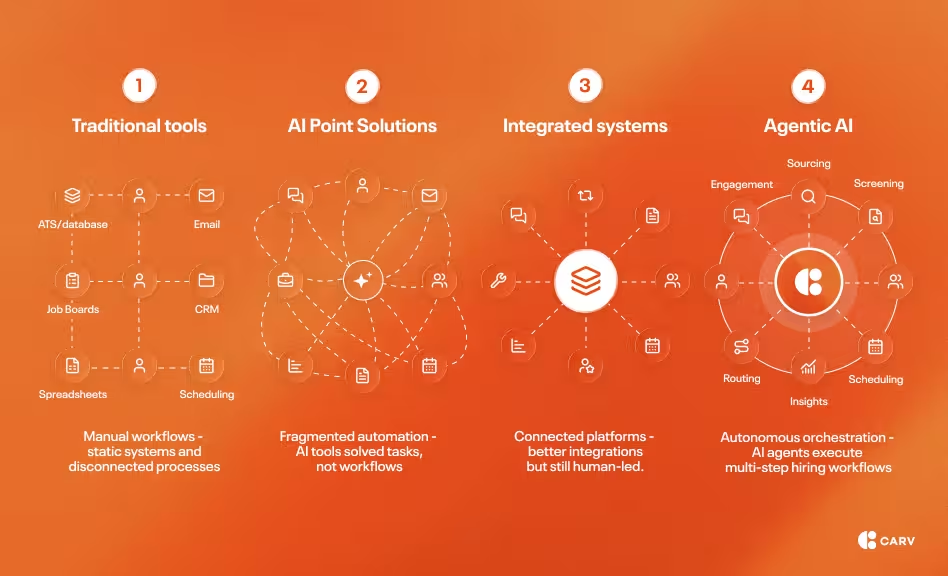
Phase 1: Traditional Tools (Pre-2020)
- Recruitment technology focused on digitizing manual processes.
- ATS systems stored candidate data.
- Job boards distributed postings.
- CRM tools tracked relationships.
- Email templates saved time on outreach.
These tools made information more accessible and workflows more consistent. But they were fundamentally passive – they required humans to execute every step, make every decision, and connect every handoff.
Phase 2: AI-Powered Point Solutions (2020-2023)
- The first wave of AI recruitment tools added intelligence to specific tasks.
- Resume parsers that could extract data automatically.
- Chatbots that could screen candidates with basic qualification questions.
- Sourcing tools that could identify candidates matching job requirements.
These tools delivered real value for their specific use cases. But they operated in isolation. Each solved one problem while creating integration challenges and workflow fragmentation.
Phase 3: Integrated Tools (2023-2024)
- Recognition of the fragmentation problem led to consolidation.
- ATS platforms acquired point solutions.
- Vendors built broader feature sets and expanded core functionality.
- Integration marketplaces connected disparate tools.
This reduced some complexity but didn't solve the fundamental constraint: human execution. Even with better tools working together, hiring still depended on recruiters to trigger actions, move information between systems, and coordinate across platforms.
Phase 4: Agentic AI Platforms (2024-Present)
The current shift moves from tools that assist to systems that execute.
Now, agentic AI platforms don't just automate individual tasks because they own multi-step workflows instead.
An AI agent doesn't just screen a candidate; it responds to their application instantly, conducts a qualification conversation, schedules an interview, updates the ATS, and re-engages them if they're a near-miss for another role.
This represents a fundamental architectural change. Instead of humans using tools to execute hiring processes, AI agents handle execution while humans focus on decisions and relationships.
Platforms like Carv operate at this layer, coordinating across the entire hiring workflow through specialized agents that handle engagement, screening, scheduling, routing, admin, and insights.
Types of AI recruitment tools
The AI recruiting software landscape includes dozens of tool categories, featuring some of the best ai recruiting tools designed to streamline the hiring process. Here are the main types and what they actually do.
1. Generative AI Tools
Large language models like ChatGPT and Claude generate text based on prompts. Recruiters use them to write job descriptions that reflect employer branding, create outreach messages, draft interview questions, and summarize candidate information.
Examples: ChatGPT, Claude, Gemini
Use case: Ad-hoc content creation and summarization. A recruiter can paste a job req and ask for a candidate-friendly description, or paste interview notes and request a summary.
Limitation: Purely reactive – they respond to prompts but don't integrate with workflows or take autonomous action. Every output requires human initiation and manual transfer to other systems.
2. AI Assistants & Workflow Automation
AI assistants sit inside the recruiter's workflow and handle administrative coordination. They attend interviews, capture notes, structure data, and automatically update the ATS. They eliminate the 20-30 minutes of post-interview admin that typically delays hiring.
This is where the shift from tool to system becomes visible. Instead of requiring recruiters to manually document conversations, update records, and trigger next steps, AI assistants handle this automatically.
Examples: Carv (full workflow automation across sourcing, screening, interviewing, and admin), specialized interview assistants
Use case: Removing administrative burden from the hiring process. An AI assistant joins every interview call, captures the conversation, generates structured summaries, updates candidate records in the ATS, and can even trigger next steps like scheduling follow-ups or sending rejections.
Why this matters: This category represents the bridge between disconnected point solutions and integrated systems. AI assistants don't just solve one problem; they connect across the workflow, eliminating the manual handoffs that slow hiring down.
Carv's approach extends this further – not just admin automation but full workflow orchestration, potentially bridging the gap into onboarding. AI agents handle candidate engagement from first contact through placement in real-time, with humans involved only for judgment and relationship-building.
3. AI Sourcing Tools
AI sourcing tools help hiring teams identify and rank candidates from internal databases, LinkedIn, GitHub, social media, and other platforms. Use AI to match candidates to job requirements and automate initial outreach.
Examples: SeekOut, HireEZ, Findem
Use case: Finding candidates for hard-to-fill roles or building pipelines proactively. Particularly valuable for technical recruiting where candidates aren't actively applying.
Limitation: Only as good as the data quality in your systems and the clarity of search parameters in your recruitment process. Mass outreach without personalization damages response rates.
4. AI Screening & Chatbots
AI screening and chatbot tools conduct asynchronous candidate screening through chat, SMS, or voice. Ask qualification questions, collect key information (availability, salary expectations, visa status), and provide structured summaries to recruiters.
Examples: Paradox, Humanly, Sense
Use case: High-volume screening where recruiters need to quickly filter hundreds of applicants. Works best when qualification criteria are straightforward.
Limitation: Basic chatbots follow rigid decision trees. Advanced systems (like Carv's conversational AI) can adapt to candidate responses and handle clarifying questions, but most tools in this category are limited to scripted flows.
5. AI Interview Intelligence Tools
AI interview and intelligence platforms record interviews, generate transcripts, extract insights, and provide structured feedback. Some analyze communication patterns, track key topics, or score responses.
Examples: Carv, Metaview, BrightHire
Use case: Improving interview quality and reducing post-interview admin. Particularly valuable for teams that conduct many interviews and need consistent documentation.
Limitation: Recording-focused tools create more content to review rather than reducing work. The most valuable systems (like Carv) automatically structure insights and update the ATS without requiring manual review.
6. AI Scheduling Tools
AI scheduling tools automate interview scheduling by integrating with calendars, offering available time slots to candidates, and handling coordination across multiple participants.
Examples: Calendly (with AI features), dedicated scheduling assistants
Use case: Eliminating the back-and-forth email coordination that typically delays interviews by days.
Limitation: Often operates as a standalone tool requiring manual triggers. More advanced systems embed scheduling within the broader workflow. When a candidate completes screening, they immediately book an interview slot.
7. AI-Enhanced ATS & CRM Platforms
Applicant tracking systems and candidate relationship management platforms with AI features added, including resume parsing, candidate matching, automated emails, predictive analytics.
Examples: Greenhouse, Lever, SmartRecruiters, Bullhorn
Use case: Central system of record for hiring. Most organizations already have one.
Limitation: Built as databases with workflows bolted on, not as intelligent systems. Even with AI features, they remain fundamentally passive, requiring humans to execute, not capable of autonomous coordination.
8. AI Assessment Tools
AI assessment tools evaluate candidates through AI-powered tests, simulations, or analysis. Can include technical assessments, cognitive tests, personality evaluations, or video interview analysis.
Examples: HireVue, Pymetrics (now Harver), Codility
Use case: Adding objective evaluation data to hiring decisions, particularly for roles with measurable skills.
Limitation: Candidate experience varies widely. Some assessments feel relevant and fair; others feel gimmicky or invasive. Black-box scoring systems that lack transparency can damage trust.
How AI tools fit into the recruitment workflow
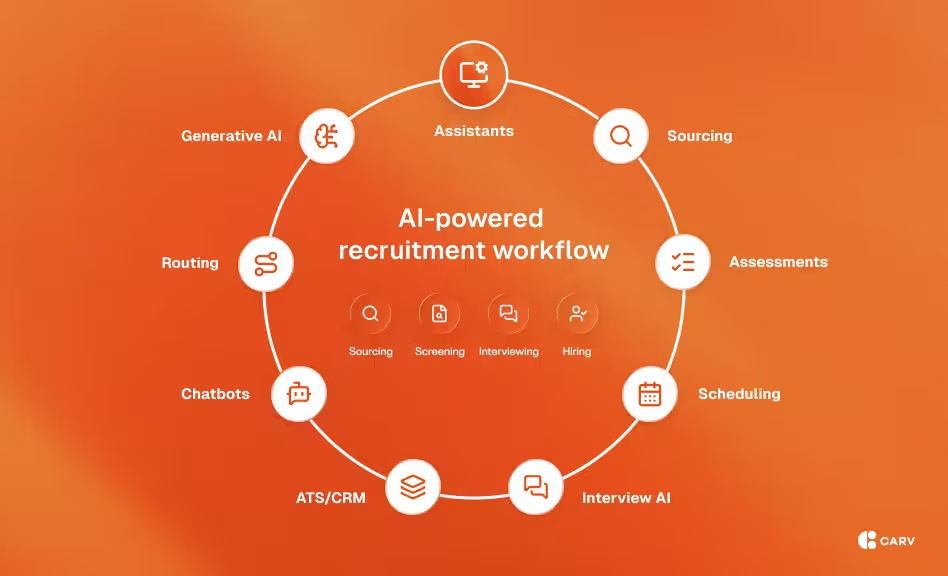
Understanding where different AI recruitment tools plug into the hiring process helps clarify which problems they solve (and which gaps remain).
- Sourcing: AI sourcing tools and talent pool systems identify candidates. This happens continuously (monitoring databases for new matches) or on-demand (searching when a role opens).
- Engagement: AI assistants and chatbots respond to applications, answer candidate questions, and keep passive talent warm. This is where speed matters most.
- Screening: AI screening tools and conversational systems conduct initial qualification. In basic implementations, this means knockout questions for rapid shortlisting. In advanced systems, it means adaptive conversations that probe for detail and escalate edge cases.
- Interviewing: Recruiters and hiring managers conduct interviews. AI interview intelligence tools capture notes, extract insights, and document decisions. Admin automation tools update the ATS automatically.
- Hiring: Final decisions remain human. But AI can inform those decisions with data-driven patterns, performance metrics, and insights that humans would miss.
The problem with using too many AI tools
More tools don't solve problems. They create new ones.
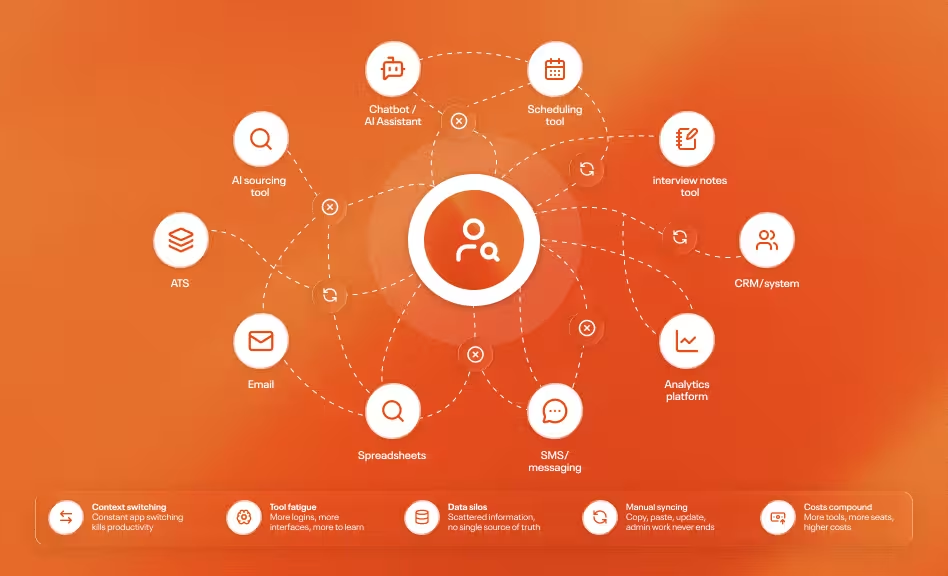
- Context switching kills productivity. When recruiters toggle between too many individual tools, they lose time and mental energy to constant app switching.
- Tool fatigue sets in. Every new platform means another login, another interface to learn, another set of workflows to remember. What was supposed to reduce cognitive load ends up increasing it.
- Data silos fragment truth. Candidate information lives in multiple places. Screening data in one tool. Interview notes in another. Communication history scattered across email, SMS, and the ATS. No single source of truth exists, so decisions get made with incomplete information.
- Manual syncing persists. When tools don't integrate seamlessly, someone has to move data between them. Copy-paste from screening tool to ATS. Manually log that an interview happened. Update candidate status in multiple places. The administrative burden doesn't disappear;it just shifts.
- Costs compound. Each tool has its own pricing structure, usually per-user or per-month. A stack of eight to 10 AI recruitment tools can easily cost more than an integrated platform while delivering a worse experience.
This is the paradox of AI recruitment tools: individually valuable, collectively overwhelming.
The shift toward AI recruitment platforms
Instead of assembling a stack of point solutions, leading organizations are adopting platforms that coordinate hiring as an end-to-end workflow.
The distinction matters:
Tools solve isolated problems. A scheduling tool handles calendar coordination. A screening tool asks qualification questions. An interview tool captures notes. But connecting them requires integration work, manual handoffs, and human coordination.
Platforms own workflows. An agentic platform handles candidate engagement from first contact through placement. It can respond to applications, screen qualifications, schedule interviews, capture feedback, update systems, and route candidates to appropriate roles. All automatically, with humans involved only for decisions.
This shift toward unified automation mirrors what happened in other industries. Marketing moved from fragmented tools (email platform, social scheduler, analytics dashboard, CRM) to integrated platforms (HubSpot, Marketo). Sales moved from disconnected tools to unified systems (Salesforce, Outreach).
Recruitment is in the middle of that same transition.
What this means practically:
- Fewer integrations to manage. One platform connects to your ATS, communication channels, and calendar systems instead of eight different tools each requiring their own integration.
- Consistent candidate experience. Every applicant goes through the same process, receives the same quality of communication, and benefits from the same level of responsiveness, regardless of when they apply or which recruiter they're assigned to.
- Data that flows automatically. Context from screening informs interviews. Feedback from interviews updates candidate records. Strong candidates who don't get one role automatically surface for others. No manual transfer required.
- Capacity that scales. When hiring volume spikes, the platform handles it without requiring proportionally more recruiter time or additional headcount.
How Carv fits into the AI recruitment ecosystem
Carv operates as an agentic AI platform – not a collection of disconnected tools, but a coordinated system of AI agents that handle hiring workflows end-to-end.
Instead of requiring recruiters to use multiple tools and connect the pieces manually, Carv's agents work together to execute the hiring process:
- Host agents respond to applications instantly, answer candidate questions, and keep talent engaged 24/7, across multiple channels.
- Screening agents conduct qualification conversations that adapt based on candidate responses, collecting structured data while maintaining a human-quality experience.
- Scheduling agents coordinate interview times automatically, integrating with calendars and handling the back-and-forth that typically delays hiring by days.
- Admin agents join interviews, capture insights, structure feedback, and update the ATS automatically, eliminating the 20-30 minutes of post-interview admin that slows recruiting down.
- Routing agents match candidates across roles and locations, ensuring strong candidates who don't get one position are automatically considered for others.
- Talent pool agents maintain relationships with passive candidates, re-engaging them when relevant opportunities open.
Carv also integrates with popular tools including ATS software, communication platforms, and scheduling tools rather than replacing them. It operates as an intelligence layer that makes the tools you already have work better together.
How to choose the right AI recruitment setup
The right setup isn't about picking the "best" tools. It's about matching your approach to your immediate hiring reality.
Consider team size:
- Small teams (1-5 recruiters): Prioritize platforms that handle multiple workflows over specialized point solutions. Every additional tool means more overhead relative to team capacity.
- Large teams (20+ recruiters): Can justify specialized tools for specific problems, but still need a strategy for integration and data flow.
Assess hiring volume:
- Low-volume hiring (< 50 hires/year): Basic ATS plus generative AI for content creation may be sufficient. Complex AI recruitment tools often don't justify the cost.
- High-volume hiring (500+ hires/year): AI automation delivers massive ROI. The difference between manual and automated screening becomes hundreds of hours saved.
Evaluate tech stack complexity:
- Already managing 8+ tools: Adding more creates diminishing returns. Consider whether a platform can replace multiple tools rather than adding to the stack.
- Starting fresh: Bias toward integrated platforms over assembling point solutions. It's easier to start integrating than to consolidate later.
Review workflow fragmentation:
- Data flows smoothly, handoffs work well: Targeted tools can enhance specific steps without creating problems.
- Struggling with disconnected systems: Adding more tools makes things worse. Focus on consolidation and automation.
The key question should always be: Does this tool reduce the work recruiters do, or just shift it to a different form?
True automation eliminates tasks, while pseudo-automation just moves them – from manual screening calls to reviewing chatbot transcripts, from writing notes to editing AI summaries, from email coordination to managing scheduling tools. Look for solutions that remove work entirely, not just transform it.
Ready to move beyond disconnected AI tools? Carv's agentic platform coordinates your entire hiring workflow – from first candidate contact through final placement. Book a demo to see how integrated AI automation transforms recruitment operations.
.avif)
.avif)
.avif)
