
.avif)


When you're hiring at volume, time works against you.
Candidates in retail, logistics, and hospitality won't wait around – but recruiters are still buried in admin, screening, scheduling, and chasing replies. That's up to 30% of the week gone before you even get to the part of the job that's actually about people.
Conversational AI is the specific technology category built to fix that piece of the problem: software that holds a real, two-way conversation with a candidate – over chat, SMS, WhatsApp, or via voice AI over the phone – instead of routing them through a form or an inbox.
That's a narrower category than "AI recruiting tools" broadly, and a different one than AI-powered screening or assessment tools that score a candidate's answers without holding a live conversation.
But "conversational" only describes the surface – how a candidate experiences the interaction.
It says nothing about what's actually running the conversation. Some of the tools below are conversational interfaces layered over a configured decision tree; others are conversational because there's an AI agent underneath deciding, in real time, what to ask next, how to score the answer, and when to hand off to a person.
That difference matters more than the channel, and it's the lens this list uses throughout.
Below are 7 tools that fit that definition – some scripted, some genuinely agentic – built to keep volume hiring fast, responsive, and on track.
What is a conversational AI platform?
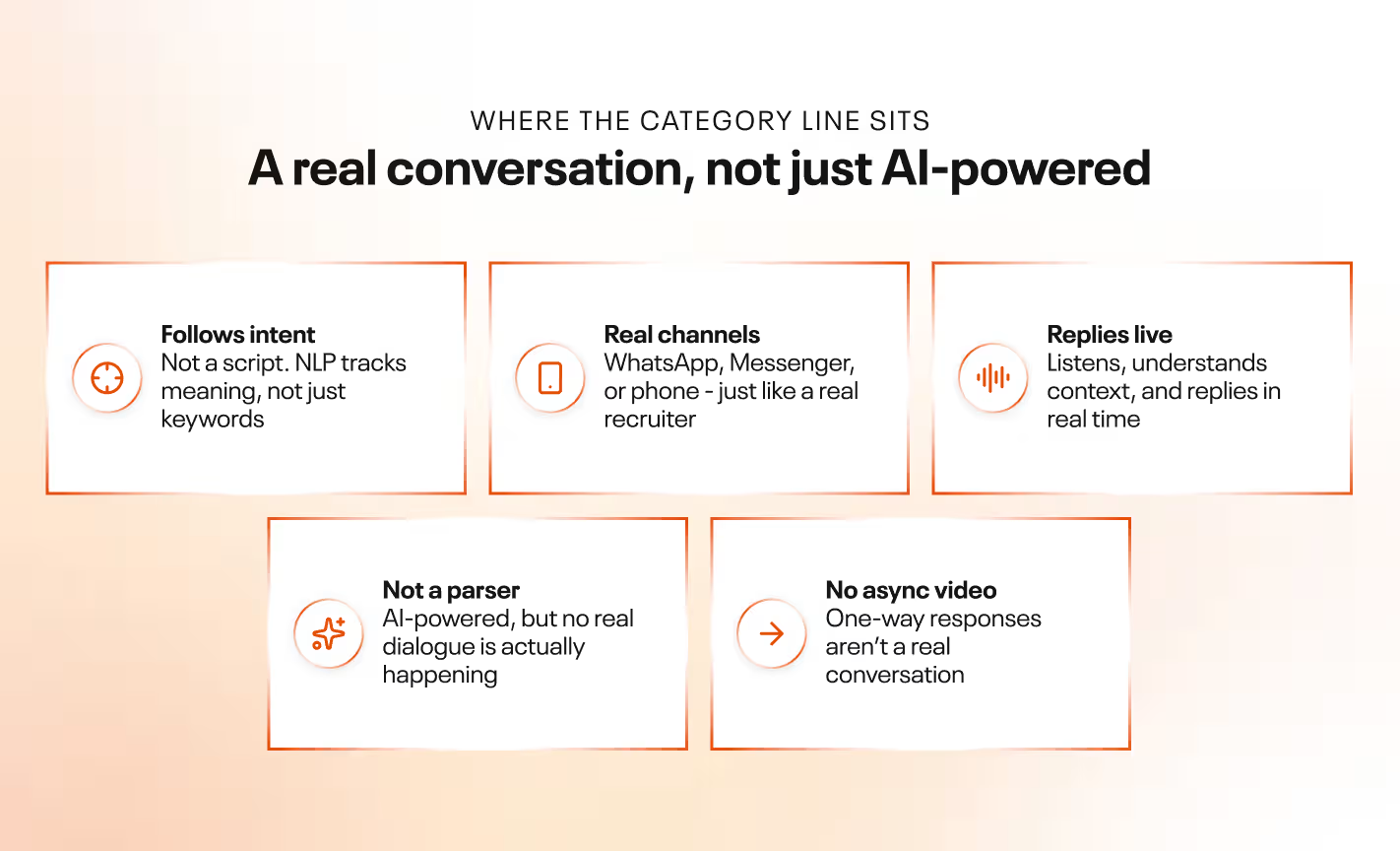
A conversational AI platform uses natural language processing (NLP) and natural language understanding (NLU) to hold a real conversation with a candidate, recognizing what they mean rather than just matching keywords.
Applicants interact with it directly over their preferred channel, the same way they'd talk to a recruiter, and the system listens, understands context, and replies in real time.
That's the line that separates the tools below from adjacent categories: a resume parser or an async video-assessment tool can be AI-powered without being conversational, because the candidate isn't actually holding a dialogue with anything. Every tool on this list does that specific job – screening, scheduling, or engaging candidates through live back-and-forth conversation.
Within that category, though, there's a second distinction worth making: "conversational" describes how the candidate experiences it, not what's deciding what happens next. Some platforms use NLU to recognize intent and route candidates through a pre-built flow configured in advance by a recruiter – reliable, but bounded by whatever was mapped out ahead of time.
Others put an actual AI agent behind the conversation: something that can decide in the moment how to phrase a follow-up, whether an answer clears the bar, or when to escalate to a human, without every path having been pre-scripted. That's the difference between a conversational interface and an agentic one, and it's worth keeping in mind as you compare the tools below.
1. Carv
Carv is built as an agentic recruitment platform first – conversation is simply the interface it uses to run the front end of the hiring process: every candidate touchpoint that doesn't require face-to-face contact with a recruiter, handled through real dialogue rather than static forms.
Carv's conversational AI agents work for high-volume hiring teams and enterprise staffing firms, because what matters isn't the size of the hiring team – it's the volume of applicants being screened and interviewed per role.
In volume hiring, where vacancies are typically blue-collar, recruiters end up processing hundreds of applications per role, and most only manage to screen a batch before shortlisting. Carv's conversational AI takes over that pre-screening and scheduling load entirely.
How it works
Feed Carv a vacancy – from your ATS, a career page, or a job board – and a Host agent automatically builds a conversation flow, then hands over to a Screening Agent who reaches out to candidates to ask questions personalized to your tone of voice.
Unlike traditional chatbot tooling, Carv doesn't require a recruiter to build the logic tree manually; the agent generates it within minutes and adjusts as it goes – deciding how to follow up on an unclear answer, when a candidate qualifies, and when a case needs a recruiter's judgment instead of another automated question.
Once a candidate applies and leaves contact details, Carv calls or messages them, scores the answers against your hiring criteria, and shortlists matching candidates for interviews. It can hold that conversation – voice or text – in 99 languages, 24/7.
Integrate Carv with your ATS to log screening data automatically, and connect it to your calendar so it can schedule interviews on your behalf – no change to your existing workflows required.
Use cases
Carv handles the volume when recruiters are screening hundreds or thousands of candidates a week, and fits roles across logistics, retail, contact centers, manufacturing, and hospitality, where speed matters most:
- Pre-screen blue-collar and frontline roles – warehouse staff, drivers, customer support – with no CV required
- Automate scheduling across shifts, teams, or locations without email back-and-forth
- Reach candidates on WhatsApp or by phone in real time, and keep them warm with updates and reminders
- Reduce no-shows by making rescheduling easy and keeping candidates in the loop
You can set knockout criteria and interview windows, and step in any time – but for most candidates, the process runs without manual input.
Results
Recruiters using Carv's AI assistant report, on average:
- 3x more hires per recruiter
- 60% shorter time to hire
- 70% fewer manual tasks during screening and scheduling
Book a demo to see specific use cases.
2. Paradox – Olivia Assistant
Olivia by Paradox is one of the longest-established conversational AI tools built specifically for high-volume hiring, chatting with candidates over text or chat, screening for basic fit, and lining up interviews. It's used mainly by teams in retail, contact centres, and logistics.
How it works
Olivia manages early candidate interactions – screening, scheduling, and common questions – through SMS, web chat, and voice, using NLU to interpret responses and move candidates through pre-built workflows to the right next step, giving teams a consistent, predictable experience across channels.
How to get started
Olivia connects to most existing ATS and calendar tools via API, plus platforms like Outlook and Gmail. Its no-code setup and pre-built templates make it fast to launch.
Results
- McDonald's used Olivia to automate screening and scheduling at scale, cutting time-to-hire by 60%
- Nestlé saved over 8,000 recruiter hours in a year using Olivia for initial candidate engagement
3. HireVue
HireVue combines structured, async video interviewing with AI models that evaluate both what candidates say and how they say it, used mainly by finance, retail, and tech recruiting teams. Worth a caveat here: HireVue's core product leans more toward AI-scored video assessment than live two-way dialogue, so it sits at the edge of the conversational category – included because its virtual-agent question flows and real-time candidate interaction still qualify, not because it's a pure chat/voice conversational tool like the others on this list.
How it works
Candidates complete structured interviews through virtual agents that ask questions and capture responses; NLU and computer vision assess communication skills and role fit, and recruiters review the results on their own schedule rather than live.
How to get started
Cloud-based with API connections to most ATS platforms, and a no-code setup for teams without heavy engineering support.
Results
- Globe Telecom cut time-to-offer from 16 to 7 days and raised its interview-to-offer ratio to 90%
- Lion reduced average time-to-hire by two weeks using AI-scored video assessments
4. hireEZ (formerly Hiretual)
hireEZ is primarily a sourcing platform – it searches over 800 million profiles across job boards and social sites to surface candidate matches, then automates outreach campaigns and follow-ups. Note: this is more AI-assisted outreach automation than live, two-way conversation, so it's the loosest fit for a strictly conversational AI list – it's here because its automated follow-up messaging does hold a limited back-and-forth with candidates, but teams looking for real-time screening dialogue should pair it with one of the tools above rather than relying on it alone.
How it works
hireEZ combines AI and machine learning to search large candidate pools, build outreach campaigns, and match candidates to roles using skill-based filters and real-time data.
How to get started
Integrates with 30+ ATS and CRM platforms, with real-time analytics to track sourcing performance.
Results
- WilsonHCG tripled response rates and cut spending on other sourcing tools after adopting hireEZ
- HatchWorks reduced LinkedIn Recruiter costs by 61% and cut time-to-hire by 40%
5. Amazon Lex
Amazon Lex brings the same conversational AI technology that powers Alexa into the recruiting stack, letting teams build chatbots and virtual assistants without building from scratch.
How it works
Lex uses speech recognition and NLP to build bots that screen applicants, answer FAQs, and schedule interviews on any channel, understanding intent rather than just keywords – though as a developer platform, the conversation flows and decision logic are what your team builds and configures, not something that ships pre-built or adapts autonomously. Multilingual support suits frontline hiring.
How to get started
Requires an AWS account and setup support. Conversation flows can be built through a drag-and-drop interface or via API into existing recruitment apps – a natural fit for teams already running on AWS.
Results
Morrisons and Connect Health use Lex to manage high volumes of candidate interaction without adding recruiter load, supporting self-service and faster response times.
6. Workday
Workday's conversational AI is built into its broader HR system, aimed at large organizations that want to move faster without overhauling their existing workflow.
How it works
Workday uses conversational AI, AI agents, and NLP to generate job descriptions, surface best-fit candidates from past applicants and talent pools using predictive models, and manage scheduling automatically – all through natural, human-like conversation with candidates.
How to get started
If your team already runs on Workday, its conversational AI features integrate directly into your existing setup with no separate rollout needed.
Results
Workday reports reduced recruiter workload and faster movement from job post to hire, though exact customer metrics aren't publicly available.
7. IBM watsonx Orchestrate
watsonx Orchestrate automates interview scheduling and candidate follow-ups through plain-language requests, integrating with tools like Salesforce, Workday, Outlook, and Gmail.
How it works
watsonx uses AI, machine learning, and NLP – with sentiment analysis – to draft job descriptions, publish roles, source profiles, and manage admin through a natural dialog flow, connecting tasks across your existing tools.
How to get started
Ready-made recruiting flows come out of the box and can be customized, with a live demo environment to test before launch – no need to rebuild your stack.
Results
IBM's own team used watsonx to manage internal learning programs and saw faster coordination; for hiring teams, the reported payoff is less time on admin and more time with candidates.
Choosing the right conversational AI tool for volume hiring
Not every tool above solves the same problem, and not every tool solves it the same way. Some run the conversation through a configured flow – a decision tree with a friendlier interface – while others put an AI agent behind the conversation that can decide, in real time, what to ask next, when to escalate, and how to move a candidate forward without a human rebuilding the flow every time a role or channel changes.
If you need end-to-end screening and scheduling handled by a real two-way conversation, Carv, Paradox, and Amazon Lex are the closest fits – of those, Carv is built agentic from the ground up, generating and adjusting the conversation itself rather than running a pre-built script. If you're already inside Workday or the AWS ecosystem, the built-in options remove a separate rollout.
Carv's agentic AI runs that same conversational experience candidates already expect. Request a demo to see how it fits your team.