





Every hiring team obsesses over quality of hire. Fair enough, it matters tremendously.
But long before anyone gets to debate whether a candidate is the right fit, something much more mundane is happening, and in high-volume hiring it's usually the thing that determines whether the process keeps moving or quietly grinds to a halt.
Applications arrive faster than recruiters can realistically work through them.
Each one needs the same handful of questions answered. Can this person actually work the shifts? Are they eligible? Is the location realistic? Are there any obvious dealbreakers that mean this conversation shouldn't continue?
None of these questions are particularly difficult, yet collectively they consume hours of recruiter time because every single candidate needs the same level of confirmation before anyone can confidently move them forward.
It's surprisingly expensive work, not because it's complex, but because it scales terribly.
You don't really notice the problem when thirty people apply for a role. You absolutely notice it when three hundred do. Candidates who would have looked promising on Monday are still sitting untouched on Thursday. Recruiters start making judgment calls simply because there's a queue to get through. The hiring team feels busy all day, but very little of that time is actually spent recruiting.
That's where Carv's Screening Agent comes in. It simply takes ownership of the repetitive qualification work that every hiring process depends on, doing it immediately, consistently, and for every single applicant the moment they enter the funnel. Hence, recruiters spend less time confirming the basics and more time having the conversations that genuinely influence hiring decisions.
This is what AI recruiting increasingly looks like for talent acquisition teams operating at volume: not a single tool bolted onto the process, but agentic AI in the form of AI agents that each own one task end to end.
What the Screening Agent actually does
The Screening Agent's scope is intentionally narrow: To confirm early whether a candidate can realistically do the job.
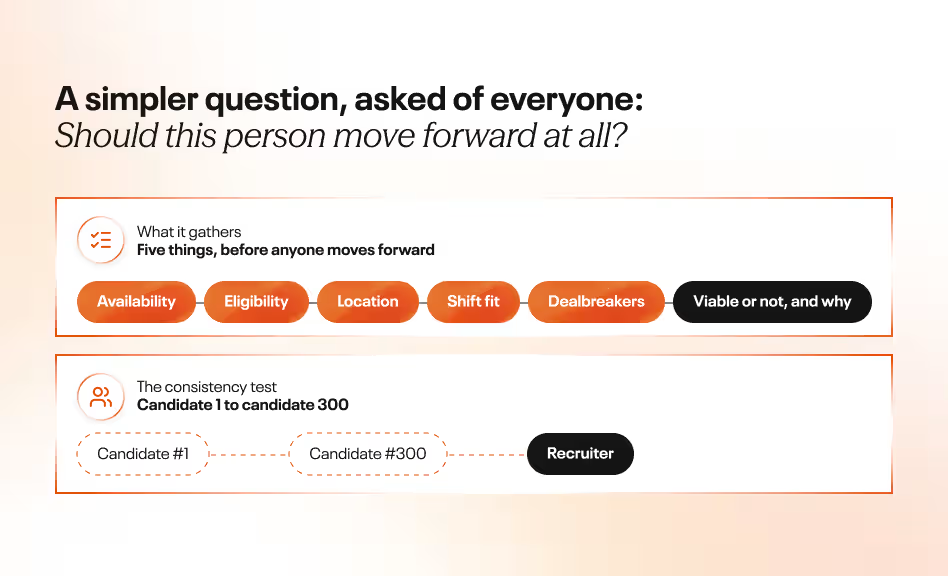
The moment a candidate applies, the agent engages – gathering the handful of things recruiters actually need up front to know if someone is viable:
- Availability
- Work eligibility
- Location
- Shift preferences
- Dealbreakers on either side
It gathers this information much like a recruiter would, using natural language processing and machine learning to understand a candidate's answers – typed or spoken – in real time.
It's not trying to assess whether someone is a great hire. It's answering a simpler, higher-leverage question: Should this person move forward at all?
That distinction matters more than it sounds. Screening is simply a filter, and filters are only useful if they run on everyone consistently before a human's time is spent.
A recruiter manually screening 300 applicants for one requisition will, without meaning to, screen the first 40 carefully and the rest less so as the queue builds.
The Screening Agent doesn't get tired or deprioritize candidate 41. It applies the same criteria from the first applicant to the last one.
Because every applicant is measured against the same job requirements in the same order, that consistency also supports bias mitigation – no candidate gets a more forgiving read simply because they landed earlier in the queue.
The output is a clear outcome: Viable or not, and why. Candidates who clear it move forward immediately.
That kind of consistent candidate communication also shapes candidate experience and employer branding.
How it fits into the system, not just the funnel
A screening agent that works in isolation is still just a faster version of a bottleneck. What makes it useful is what happens immediately before and after it – which is really a question of orchestration, not just automation.
In a Carv deployment, the flow typically looks like this:
- A candidate applies. The Host Agent picks up the application, engages the candidate, and identifies what happens next.
- The Screening Agent takes over, asking the qualifying questions, applying knockout logic, and updating the candidate's profile in real time.
- If candidate evaluation is finalized, and they still aren’t a fit for the original role but have real potential elsewhere, a rerouting step scans open requisitions and redirects them, instead of ending the conversation with a rejection.
- If the candidate is viable, the Scheduling Agent picks up from there and books the next step. No recruiter needed to manually coordinate calendars.
- A recruiter enters the process at the point their judgment is actually needed: The interview, the offer, the exception case the agent escalates because it doesn't fit the playbook.
Candidates can move through this flow over voice, text, or channels like WhatsApp, with interview scheduling handled automatically once they qualify, and every update synced back to the applicant tracking system so recruiters and hiring managers always see the same picture.
The Screening Agent has a defined playbook for how to handle a candidate going off-script, a defined set of tools it can act on (the ATS, the calendar, the routing logic), and a shared mission with every other agent in the stack – get the right candidate into the right role, reliably and efficiently.
Screening only works at scale because it isn't operating alone.
Why this matters specifically at high volume
Every hiring process needs screening. Not every hiring process needs to screen at speed and scale simultaneously – and that's where most manual and semi-automated approaches start to fray at the edges.
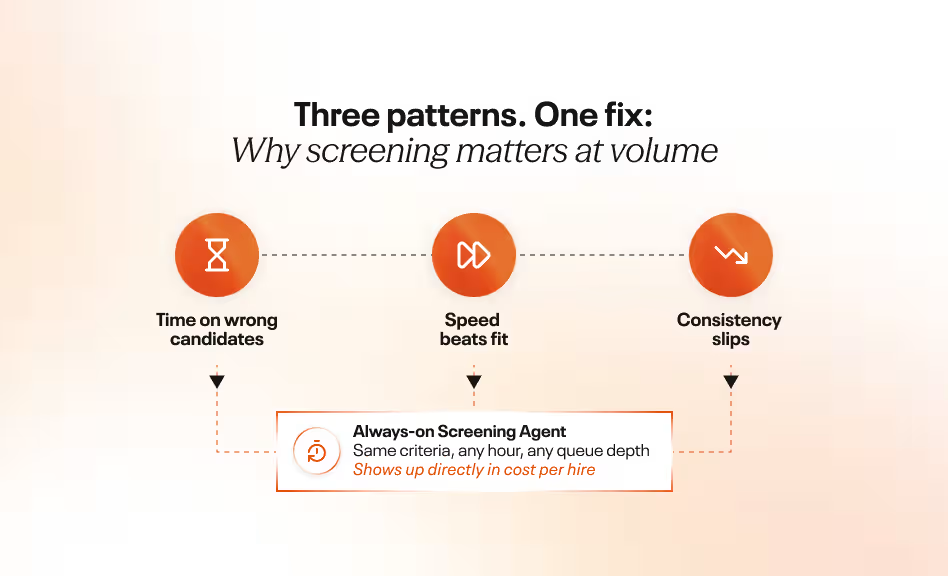
A few patterns show up consistently once application volume climbs into the hundreds or thousands per requisition:
- Recruiter time gets spent on the wrong candidates.
Without a fast, consistent filter up front, recruiters end up doing the qualifying work manually – the same handful of questions, over and over, for candidates who were never going to be viable in the first place.
- Response time becomes the deciding factor, not fit.
Candidates in high-volume, high-competition roles don't wait around. The recruiter who confirms viability and schedules an interview fastest tends to win the candidate, independent of who's the better long-term hire.
- Consistency degrades under load.
Manual screening quality is only as good as the recruiter's bandwidth on any given day. At volume, that bandwidth runs out, and the criteria applied to candidate 10 and candidate 400 stop being the same criteria.
An always-on Screening Agent addresses all three at once: Every applicant gets engaged and evaluated on the same criteria, the moment they apply, regardless of what hour it is or how deep the queue already is.
That kind of workflow automation shows up directly in cost-per-hire too, since fewer recruiter hours are spent re-running the same qualifying conversation for every applicant.
What this looks like in practice
Across Carv's customer base, screening is consistently one of the highest-impact agents in the stack:
- At DHL Express, deploying screening, routing, and scheduling agents together saved recruiters over 26 hours per hire and lifted hire rate by 33% – while handling over 1,000 candidate conversations a day.
- At Carrefour, automating screening and scheduling cut time-to-hire by 63% and raised candidate satisfaction from 67% to 82%.
- ORANJEGROEP used Host and Screening agents to process 15,000 candidates in six months, resulting in 500 additional hires and 3x more placements per recruiter – without adding headcount.
- What's more, independent recruiting teams using Carv's screening and admin agents reported 255+ hours saved per week and 98% screening accuracy, freeing up close to 45 minutes per candidate that used to go to manual qualification.
The pattern isn't limited to one sector, either – staffing agencies, retail chains, BPOs, and logistics operators all run into the same qualification bottleneck once volume increases.
None of these organizations are the same size, in the same industry, or hiring for the same roles. What they have in common, however, is volume. Enough applicants that manual screening was the constraint, not recruiter judgment.
Where humans still matter
None of this replaces a recruiter's judgment; it actually protects it. The Screening Agent handles the part of the process that was never really about judgment in the first place.
What it frees up is recruiter time for the parts of the job that actually require a person – assessing fit, building a relationship with a candidate, making the final call, and handling the exceptions the agent is specifically designed to escalate rather than guess at.
Screening is the first agent most organizations deploy, and for good reason, it's usually the highest-friction, highest-volume point in the process. It's also the clearest illustration of what an agent is supposed to do: Own a specific piece of the hiring journey end-to-end, so the humans around it can spend their time where it actually counts.
Want to see the Carv Screening Agent in action? Book a demo to see how it fits into your existing ATS and workflow.
This is one part in a series looking at each agent in Carv's stack and the specific problem it's built to solve. Next: the Scoring Agent, and why 'qualified' shouldn't be a yes/no answer.