





Every hiring process eventually clears a batch of candidates as "qualified." Then someone has to decide which of them is actually the right one.
In high-volume hiring, it's usually at this point that a genuinely rigorous process quietly reverts to gut feel.
A hiring manager sits down with forty candidates who all passed screening. Some were interviewed Monday, some Friday. Some have a line of typed notes; others have a paragraph. The candidate who's easiest to remember isn't necessarily the strongest one, they're just the one interviewed most recently, or the one who happened to have a recruiter take better notes that day.
All of this is a structural problem. "Qualified" was never supposed to be the end of the evaluation, it was supposed to be the start of a comparison. Without something holding every candidate to the same yardstick, that comparison collapses into whoever's freshest in memory, and quality of hire quietly starts depending on recruiter memory instead of the role's actual requirements.
In high-volume hiring, this is the daily reality once screening and sourcing are doing their jobs well enough to clear dozens of candidates for the same requisition. It's also exactly the kind of problem agentic AI is suited to fix, because it's a structural problem, not a talent problem. Candidate evaluation built into an AI recruiting stack looks very different from candidate evaluation bolted on through generic recruitment automation after the fact.
That's where Carv's Scoring Agent comes in. It takes the live interviews and assessments that already happen and turns them into something a recruiter or hiring manager can actually compare: a consistent, structured evaluation against the specific competencies that matter for the role – for every candidate.
What the Scoring Agent actually does
The Scoring Agent's scope is intentionally narrow: turn a candidate interaction into a structured, comparable read on fit.
Once a candidate has cleared screening and gone through a live interview or a structured assessment, the agent:
- Evaluates their responses against the specific competencies defined for that role – things like flexibility, problem-solving, cognitive ability, communication, or role-specific skills, not a generic personality read.
- Produces a candidate scoring breakdown for each competency, not just one blended number, so a recruiter can see where a candidate is strong and where they aren't.
- Generates a structured summary of the interaction – pulling on the same skills assessments and interview data already captured – so the read doesn't live only in one recruiter's memory or a half-finished note.
- Surfaces AI recommendations and flags points of attention – the things worth double-checking or asking about again – instead of burying them in a transcript nobody has time to re-read.
It's not deciding whether a candidate can do the job. Screening already answered that. Scoring is answering "Given everyone who's viable, who's actually the strongest fit, and why?"
That distinction is what makes scoring useful rather than redundant. A knockout filter and a ranking system are solving two different problems, and collapsing them into one step is exactly how "qualified" ends up meaning almost nothing by the time forty resumes hit a hiring manager's desk.
Because every candidate is scored against the same defined competencies in the same structured way, two candidates interviewed three weeks apart by two different recruiters still land on a shortlist that's actually comparable. Nobody's evaluation depends on how detailed someone's notes were that particular afternoon.
How it fits into the system, not just the funnel
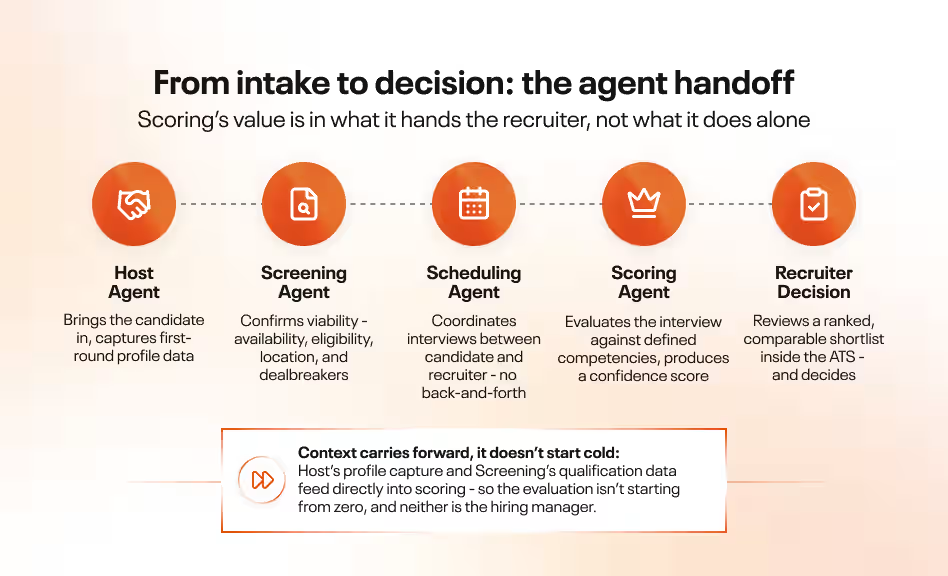
Scoring's real value shows up in what it hands the recruiter and what it hands off to next. In a Carv deployment, the flow typically looks like this:
- The Host Agent brings the candidate in and captures the first round of profile data, including basic resume parsing.
- The Screening Agent confirms viability – availability, eligibility, location, dealbreakers.
- The Scheduling Agent handles interview scheduling, coordinating calendars between candidate and recruiter without manual back-and-forth.
- The interview or assessment happens. The Scoring Agent evaluates it against the role's defined competencies and produces a confidence score and structured summary.
- The recruiter or hiring manager reviews a ranked, comparable shortlist inside their existing applicant tracking systems (instead of a pile of inconsistent notes) and makes the actual decision on who moves forward, who gets a second look, who's a pass.
Like every agent in Carv's stack, Scoring runs on a defined playbook (which competencies matter for this role, how to weigh them, what counts as a flag worth surfacing), a defined set of tools it can act on (the ATS, the assessment or interview record, the candidate profile), and the same shared mission as every other agent upstream of it: get the right candidate into the right role, reliably and efficiently.
That's also what real ATS integration is supposed to mean, agents reading from and writing to the same system of record recruiters already work in, as part of one workflow automation layer rather than a pile of disconnected tools.
Scoring is also where a lot of the earlier agents' work pays off. Host's early profile capture and Screening's qualification data feed directly into the context the Scoring Agent works from – so the evaluation isn't starting cold, and the hiring manager isn't either.
Not another point solution
A lot of what gets sold as AI interview technology today is a generic model wrapped around a fixed rubric – useful for structured assessments in isolation, but not built to sit inside a live hiring workflow. Point solutions like HireVue, Harver, Humanly, or Metaview each do a version of structured evaluation or interview intelligence well on their own; they just aren't built as one piece of an orchestrated system that also handles outreach, screening, and scheduling.
The Scoring Agent isn't a chatbot stitched together with a framework like LangChain and a prompt. It runs on natural language processing and machine learning models trained to evaluate structured competencies, calling the same tools every other agent in the stack uses through defined tool calls rather than a one-off integration. That's what lets it plug into the resume parsing and screening data that already exist on a candidate instead of starting the evaluation cold, and it's why the read a hiring manager gets carries effectively no latency once the interaction itself is finished.
Why "qualified" shouldn't be the end of the story
A few patterns show up consistently once a hiring team is comparing candidates at real volume instead of one at a time:
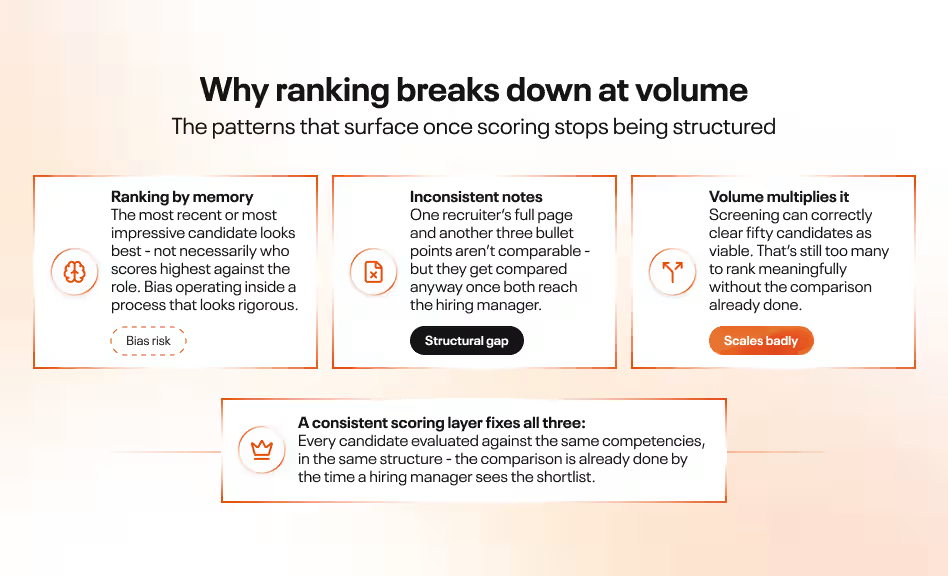
1. Ranking by memory doesn't scale – and it's a bias problem, not just a consistency one. Without structure, the candidate who interviewed most recently – or made the strongest immediate impression – tends to look like the best option, independent of whether they actually score highest against what the role needs. That's unconscious bias operating quietly inside a process that otherwise looks rigorous. Scoring every candidate against the same defined competencies is one of the more concrete ways to reduce bias in a step that's traditionally run almost entirely on gut feel.
2. Inconsistent notes produce inconsistent shortlists. One recruiter's thorough page of notes and another's three bullet points aren't comparable, but they get compared anyway once both candidates reach the same hiring manager.
3. Volume multiplies the ranking problem, not just the sourcing problem. Screening might correctly clear fifty candidates as viable for a role. Fifty is still too many for a hiring manager to meaningfully differentiate without something doing the comparison work first.
A consistent scoring layer addresses all three at once: every candidate is evaluated against the same competencies, in the same structure, regardless of who interviewed them or when. The comparison a hiring manager needs is already done by the time they see the shortlist.
What this looks like in practice
The clearest real-world anchor for this agent is ManpowerGroup Talent Solutions' custom deployment, which was co-designed with Carv across their full hiring journey. Their six-agent stack explicitly includes an interview-evaluation step – capturing insights from candidate interactions and updating the ATS automatically – sitting in the same position in their workflow that the Scoring Agent occupies here.
ManpowerGroup hasn't published hard numbers for this specifically, but the qualitative shift they've reported lines up directly with what structured scoring is supposed to do: recruiters freed up from re-reading and re-comparing notes by hand, a more consistent candidate experience across regions, and a unified view of the pipeline for operations leaders who previously had none.
That sits inside the same broader pattern this series has already cited – DHL Express's agent stack lifted hire rate by 33% and freed 26+ hours per hire, and Carrefour's automated screening and scheduling cut time-to-hire by 63% while also lifting candidate experience scores.
This reflects what happens when the steps around evaluation – engagement, qualification, and coordination – are already running cleanly. Scoring is the piece that keeps the decision itself from becoming the new bottleneck once everything upstream of it has sped up – the difference between improving time-to-hire (how fast one candidate moves through) and time-to-fill (how fast the whole requisition closes), since a shortlist nobody can act on quickly stalls the second number even when the first one looks great.
None of this replaces the discipline behind manual screening or scoring – it just stops the outcome from depending on how much bandwidth a recruiter happens to have left in the queue that day, which is the same problem this series covered in the Screening post, one step further down the funnel.
Where humans still matter
The Scoring Agent doesn't make the hiring decision, and it isn't supposed to. It removes the part of the job that was never really a judgment call in the first place – tracking, remembering, and manually comparing dozens of interactions – so the actual judgment call gets a hiring manager's full attention instead of whatever's left of it after an afternoon of re-reading notes.
The decision about who gets the offer, the conversation about what a borderline score actually means for a specific candidate, the exception where a strong score doesn't tell the whole story – that's still squarely a human call. What the agent changes is what that human is working from: a structured, comparable read on every candidate, instead of a memory of whoever interviewed best on a Friday.
Scoring is usually the point where a hiring process stops asking "is this person qualified" and starts asking "who's actually right for this" – and it's a much better question to be asking with structure behind it than without.
Want to see the Carv Scoring Agent in action? Book a demo to see how it fits into your existing ATS and workflow, as part of an AI hiring platform built to run the whole funnel, not just one step of it.
This is the third in a series looking at each agent in Carv's stack and the specific problem it's built to solve. Next: the Scheduling Agent, and why the last mile of coordination is where good candidates quietly disappear.
.avif)
