
.avif)

%20(1).avif)


Every ATS evaluation runs on the same assumption. The system you pick determines how good your hiring operation is. Better matching, better workflows, a cleaner interface, and recruiters will work faster and candidates will have a better experience.
That assumption made sense for a long time. The ATS was the one system with full visibility into the pipeline. Every decision got made by looking at it, and every process got designed around what the ATS could or couldn't do.
But with agentic AI and recruiting platforms moving from task execution to outcome ownership, the ATS's role is changing. And as that happens, which ATS you're on stops being the question that decides your outcomes.
The ATS is still the brain, for now
Walk into most recruiting organizations today and the ATS is where the operation actually runs. Recruiters live in it all day. Managers pull their numbers from it. When something breaks in the process, the ATS is the first place anyone looks.
For as long as recruiting has been a human-run process, the ATS has been the only system with a full view of it: every candidate, every stage, every note. Whoever owns that view effectively owns the operation, so the ATS ended up carrying more weight than a database was ever meant to carry.
It's also why "which ATS should we choose" has always felt like the highest-leverage technology decision a TA organization makes. If the ATS is the brain, then picking the right one is picking how well your entire operation thinks. That logic holds right up until something else starts doing the thinking.
The shift already in motion
As said in the beginning of this article, recruiting is moving from systems that execute tasks to systems that own hiring outcomes. An AI system gets handed a "mission" - for example, to fill twelve roles in this region by this date - and works out the sourcing, screening, and scheduling on its own. In other words, the AI does the whole orchestration and checks in with a human only when something needs a human call.
This shift is already underway. The organizations furthest along are running pieces of it today, and the rest of the market is closer behind than most leaders assume.
Once a mission-led system is making the calls, it doesn't care which ATS is underneath it any more than a driver cares which company paved the road. The road needs to be there, connected, and in good repair. The intelligence lives in the vehicle, not the surface it's driving on.
"Which ATS to choose" becomes the wrong question
If the ATS is the brain, replacing it feels like the obvious fix when something's not working. But most of what ATS vendors actually compete on falls into two buckets, and an AI orchestration layer running the process takes both off the table.
The first bucket is intelligence features: smarter matching, automated scoring, built-in candidate outreach. Once a mission-led system is sourcing, screening, and scheduling on its own, those features are redundant. The orchestration layer isn't consulting the ATS's scoring model to decide who gets screened next. It's making that call using its own read of the candidate and the role.
The second bucket is day-to-day usability: a cleaner interface, a nicer workflow builder. That mattered when recruiters spent their day inside the ATS moving candidates from stage to stage. It matters far less once recruiters spend their day on the conversations that actually need them, while the ATS updates itself in the background.
Strip both buckets out and there isn't much left to differentiate on. What's left is infrastructure, and infrastructure quality doesn't vary nearly as much across major enterprise ATS platforms as feature marketing suggests.
So the answer to "should we move to a different ATS" is usually no. The system you'd be evaluating is similar to the one you already have, and replacing it won’t make a difference.
What actually needs to hold up
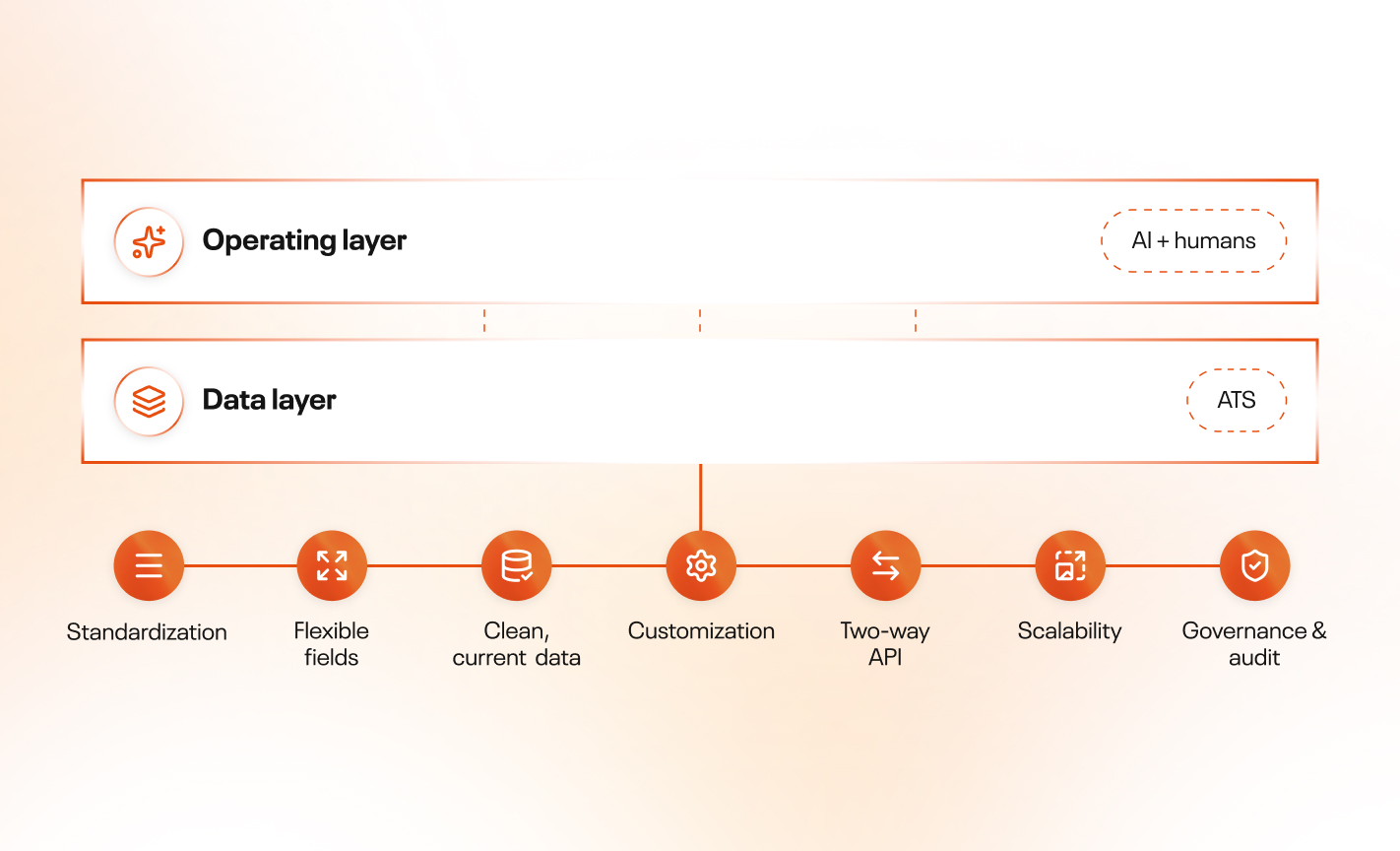
If your goal is to move to agentic recruitment, you should start thinking of your ATS not as a collection of features, but as infrastructure. And your main question should be whether this ATS can support an operating layer sitting above it that it doesn't control.
A handful of things determine that answer:
- Standardization: An orchestration layer working across accounts or regions shouldn't have to reverse-engineer a different configuration every time.
- Flexibility: Much of what predicts a good hire doesn't fit a clean field. A candidate open to relocating in six months isn't captured by a location field built for a single city. An ATS that only holds the tidy version of that information is quietly discarding the part that mattered.
- Clean, current data: Your ATS needs to allow and sustain constant machine write-back. Every conversation an agent has with a candidate needs to update the record immediately instead of waiting on a recruiter's availability and memory.
- Customization capability: The ATS needs to be configurable per account or region to reflect how your team actually works, without a custom build every time something changes.
- Open, two-way integration: Read access alone isn't enough. The ATS needs to let an outside system write back just as easily as it reads, and that capability varies more across platforms than most vendors advertise.
- Scalability: The ATS has to account for continuous, concurrent activity from an agent layer working around the clock, not just the login patterns of a recruiting team during business hours.
- Governance and audit integrity is the one job the ATS keeps no matter how much else moves up a layer. Compliance and traceability have to survive the transition intact.
Most enterprise ATS platforms can meet this bar already, or get there with the right integration work.
From brain to data layer
Once you put these pieces together, the trajectory is clear. As the orchestration layer takes over the running of the process, and increasingly the interactions with candidates and recruiters that used to happen inside the ATS, what's left for the ATS to own is the data itself: the accurate, current, well-governed record of what happened.
Being the system of record used to come bundled with a lot of other jobs - deciding what happens next, running the workflow, holding the interface to candidates and recruiters - that a database was never really built for. Strip those away and the ATS is finally left doing the one thing it was always suited for. The ATS becomes one layer in the recruitment stack rather than the whole stack.
.jpg)
The decision that matters today
With the move towards agentic recruitment, which ATS you're on is becoming a less consequential technology decision for a TA organization than it used to be. The decision that actually determines your hiring outcomes going forward is what you build on top of your ATS, and whether the system you already have can support that layer when it arrives.
That's the question worth answering now, while there's still time to close the infrastructure gaps before you need them closed. If you want a read on where your own setup stands, we're happy to help you work through it.
.avif)
