


.avif)


If you run hiring for a BPO or contact center, you already know the drill.
People quit constantly. Clients ask for twenty more agents next month, then ten fewer the month after. Busy season hits and suddenly you need bodies in seats now.
Most recruitment processes weren't built for any of that. They were built to open a role, run a campaign, fill it, close it, done. That model makes sense when recruitment happens in predictable cycles, but it falls apart when you're hiring constantly.
The BPO teams that handle this well stopped treating every open seat like a brand new project and switched to an agentic recruitment system that runs 24/7.
Let’s see what that looks like in practice, and how to bring always-on hiring to your operation in a way that delivers quick wins and doesn’t require a complete process overhaul.
Why traditional BPO hiring models don't work
The traditional recruitment funnel assumes a clear start and finish: post the role, collect applications, screen candidates, make offers, fill the seat, close it out.
That doesn’t hold up in high-volume hiring scenarios, especially those related to business process outsourcing (BPO). Contact centers alone see 30% to 45% annual turnover. A 500-agent call center needs to replace 150 to 225 people a year just to stay even. There's no real finish line to close out toward.
But most talent acquisition teams still run their processes as if there were one. Every open seat gets treated as a fresh start: recruiters repost roles they just filled, rebuild applicant pools that were warm a month ago, and restart work that never should have stopped.
The downstream effects of this model compound quickly. A slow time-to-fill means understaffed shifts. Understaffed shifts increase pressure on hiring managers, operations, and employees. That pressure pushes more of them out the door, which opens more seats, which starts the cycle again.
That’s why your talent pipeline must be continuous. If you run it any other way, you’ll doom your team to a cycle it can't escape, and your business will suffer.
.avif)
4 bottlenecks that slow BPO recruitment
Most BPO hiring teams fail because their tools and processes create friction at every stage of the candidate journey. Here are four bottlenecks that kill conversion rates and limit success:
1. Manual screening at scale
If your recruiters screen applications by hand, their speed and consistency will suffer.
Manual screening prolongs the recruitment process, which pushes candidates toward competitors who respond faster.
Good news: If you’re hiring at scale, you can avoid manual screening with Carv. Our screening agents gather key information about every candidate and conduct skill assessments. That way, hiring managers have the details they need to make better decisions.
2. Interview scheduling friction
If your recruiters schedule interviews on their own, they’ll provide a poor candidate experience to potential employees. This will lead to a poor employer brand and lengthy time-to-fill metrics.
Automated scheduling is the solution. Carv’s scheduling agent books interviews by coordinating availability between candidates and hiring teams. As such, our platform removes the back and forth, speeds up progression, and reduces drop-off, so your team spends less time on logistics and more time evaluating candidates.
3. A fragmented tech stack
If your applicant tracking system (ATS), scheduling tool, and screening tool don't talk to each other, your team is stitching the process together manually.
That means recruiters re-entering the same candidate data in three places, chasing updates across tools, and losing track of where someone actually is in the pipeline.
Some teams patch this with an RPO provider to absorb the extra admin. It helps in the short term, but it doesn't fix the fragmentation. It just adds a team managing the gap between tools that were never built to work together.
4. Late-stage candidate drop-off
If you lose a candidate between the offer acceptance stage and their first day on the job, your cost-per-hire metrics will skyrocket. Worse, team morale will plummet.
While you won’t be able to eliminate late-stage candidate drop-off, a strong, high-volume recruitment process that provides an enjoyable candidate experience and builds your talent pool will help you avoid this scenario (and make it easier to recover from).

What winning BPO hiring teams do differently
The BPO teams pulling ahead share one underlying shift. They stopped treating recruitment as a set of separate tasks and started treating it as one system.
They treat recruitment as a system, not a series of tasks
Most hiring teams still think in steps: source, screen, schedule, assess, offer, onboard. Each step gets its own tool, its own owner, its own bottleneck. When one step slows down, the rest of the pipeline waits on it.
The teams doing this well stopped optimizing steps in isolation. They look at the whole pipeline as one connected system, where a candidate moves from first contact to hire without getting stuck waiting on a person to move them to the next stage.
Sourcing, screening, and scheduling stop being handoffs between separate tools and separate owners. They become one continuous flow.
They redistribute work between humans and AI to stay always-on
Once recruitment is one system, the next question is who runs which part of it.
The old model puts a human at every step. That works fine when hiring happens occasionally. It breaks down when a role never really closes and a recruiter can't be reaching out, screening, and scheduling around the clock.
So winning teams hand the repeatable, always-on parts to AI agents: initial outreach, screening, scheduling, keeping the talent pool warm between roles. Recruiters and hiring managers keep the parts that need a person: reading a borderline candidate, deciding who actually fits a client account, handling the exceptions.
The system runs continuously because the always-on work is finally being done by something that can actually run continuously.
They focus on outcomes, not process steps
Most hiring teams measure themselves on the steps: how many candidates were screened, how many interviews were scheduled, how fast time-to-fill was. Those are useful signals, but none of them are the actual goal.
The teams pulling ahead measure what they're actually there to do: hire the right people, and keep them. That shift in what gets measured also builds in the flexibility BPOs need.
When the goal is "screen X candidates" or "fill Y seats," growth means adding more people to do more of the same steps. When the goal is "hire outcomes," a client asking for forty more agents next week doesn't mean hiring forty more recruiters.
It means the same system produces more hires, because the AI layer scales with demand and the humans stay focused on judgment calls, not throughput.
What this looks like day to day
Take a single applicant moving through the pipeline.
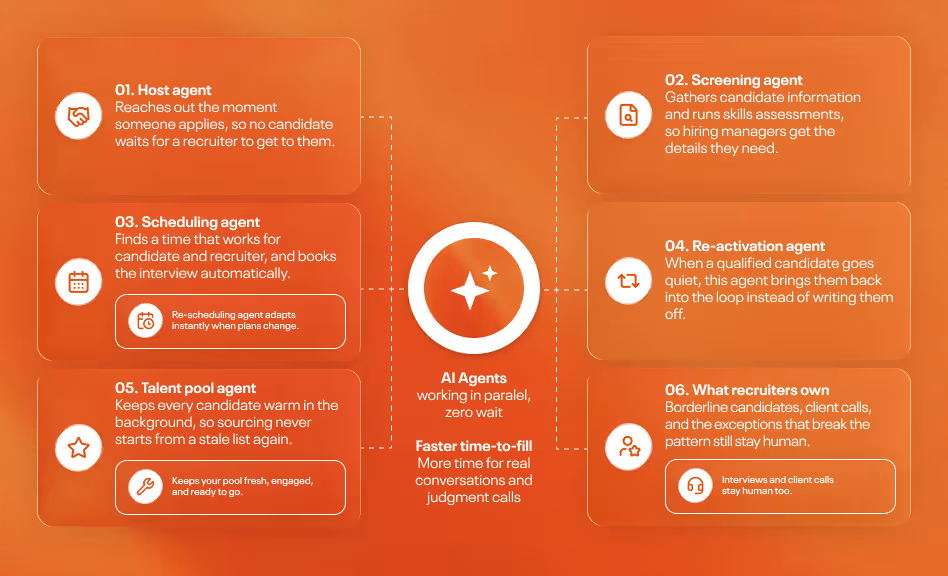
This is where agentic AI actually shows up, not as one tool, but as a set of agents each handling a specific job. An agent reaches out the moment someone applies, so no candidate waits for a recruiter to get to them.
Another agent does the screening, gathering their information and running skills assessments. A scheduling agent finds a time that works for both the candidate and the recruiting team, and books the interview.
If something changes, a rescheduling agent handles it, so recruiters no longer have to waste time chasing candidates or calendars.
If a qualified candidate goes quiet, a re-activation agent brings them back into the loop instead of writing them off. And a talent pool agent keeps every candidate warm in the background, so recruiting never starts from a stale list again when a new role opens.
That's the agentic layer: always running, never waiting on a person, handling the parts of the pipeline that don't need judgment.
Recruiters still handle what agents can't: the borderline candidate who doesn't fit a standard read, the client who needs to know why someone's right for their account, the exception that breaks the pattern. Interviews and client calls stay human too, since those are the steps that were never meant to be automated.
Build the hiring operation your BPO actually needs
The old BPO hiring model can't keep up with today's reality, and no amount of faster tools or extra RPO support changes that. Agentic AI can; it runs continuously because your demand is continuous, and it scales up or down with that demand instead of falling behind it.
The BPO teams switching to agentic AI now will be the ones still hiring at pace a year from now. The ones still running the old model will still be playing catch-up.
Ready to make the switch? Request a demo of Carv and see what always-on hiring looks like for your operation.
.avif)
.avif)