

.avif)


If you're screening at real high volumes, you already know the honest version of this problem: it's not that screening is hard, it's that it's repetitive in a way that wears down even good recruiters.
The same qualifying questions, the same resume checks, the same "are you legally able to work here" back-and-forth, a hundred times a week.
Automated candidate screening methods exist to take that repetition off your plate – not to replace the judgment calls, just the parts that don't need judgment.
That's a good pitch. It's also one you've probably heard oversold before, usually by a vendor who skips straight to the benefits and never mentions where this goes wrong. This is the fuller version: how it actually works, what it's good and bad at, and a rollout plan that won't blow up your candidate experience in month one.
How automated candidate screening actually works
Underneath the marketing language, automated screening is doing three things: reading unstructured information (resumes, cover letters, call transcripts, chat responses) comparing it against what the role actually needs, and deciding what happens next, whether that's ranking candidates, flagging an imperfect-but-promising match for a second look, or routing different people down different paths instead of a static pass/fail. (For the fuller breakdown of the underlying technology – resume parsing, chatbot and voice screening, video interview analysis, and where fully agentic systems fit in – see Carv's guide to AI candidate screening tools.)
What actually matters is what changes once you commit to using this at a real stage of your process, which is what the rest of this guide is about.
Where automation actually shows up in your process
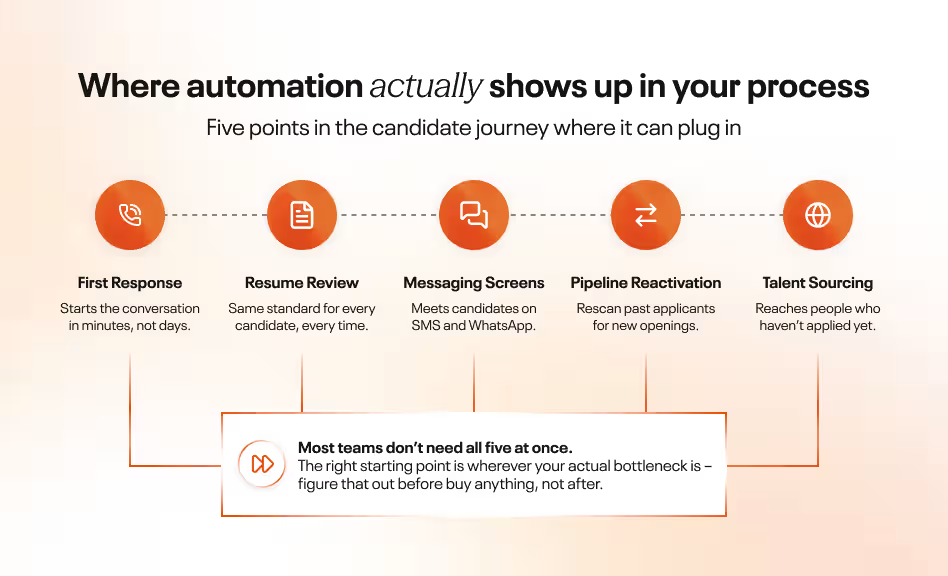
In practice, automated screening isn't one tool bolted onto your ATS – it shows up at several distinct points in the candidate journey, and it's worth knowing which point you're actually trying to fix, because they're different problems.
The first response. For a lot of teams, this is where automation earns its keep fastest, because it's pure latency: a candidate applies, and nothing happens for a day, two days, sometimes longer. An AI-run initial screen – a phone call, a chat conversation, or a short structured video interview – can start that conversation within minutes, asking about experience, availability, and the basics that would otherwise sit in a recruiter's queue. In high-volume environments like retail and contact centers, this alone is often the single biggest lever, because the candidates most likely to have other options are also the ones least willing to wait.
Resume and application review. This is the closest to what people picture when they hear "AI screening" – parsing resumes and applications for skills and experience and matching them against the role. Done well, this is also where automation can outperform manual review, because it can hold every candidate to the same standard instead of drifting based on who's reviewing on a given day.
Screening conversations over messaging. For roles where email response rates are poor – again, high-volume and frontline hiring – a lot of screening now happens over channels candidates actually check, like SMS or WhatsApp, with an AI assistant conducting a structured conversation and logging the results directly into the ATS.
Reaching into your existing pipeline. Automated screening isn't limited to new applicants. It can scan your ATS or talent database for people who already match a new opening – candidates who applied for something else, or who went quiet six months ago – and start a personalized outreach conversation, which is a meaningfully different use case from screening a fresh applicant.
Sourcing from talent pools and public profiles. The most advanced version of this reaches outside your own database entirely, evaluating candidates in talent pools or on platforms like LinkedIn against your current needs, and initiating contact with people who haven't applied anywhere yet.
Most teams don't need all five at once. The right starting point depends on where your actual bottleneck is – which is worth figuring out before you buy anything, not after.
What it's genuinely good at
Done well, automated screening delivers on a few things reliably:
It's fast. The main constraint on candidate experience in high-volume hiring is almost always response time, and automation removes the "waiting on a human to have bandwidth" problem entirely.
It's consistent. A human recruiter's fiftieth screening call of the week is not identical in rigor to their fifth. A well-configured screening system applies the same standard to every candidate, which is a real, measurable improvement over manual screening's natural drift – though "consistent" and "fair" aren't automatically the same thing, which is the next section.
It widens the funnel. Because it can evaluate candidates in your existing database and in public talent pools, not just people who happened to apply this week, it surfaces people manual screening would never reach.
It frees up recruiter time for the part of the job that actually needs a person – the judgment calls, the persuasion, the relationship-building with a strong but undecided candidate.
Where it goes wrong if you're not careful
This is the part most vendor content skips, and it's the part that actually determines whether this works for you.
Bias doesn't disappear, it can just move. A model trained on historical hiring data will learn whatever patterns are in that data, including the ones you'd never sign off on if you saw them written down. Automated screening can reduce one kind of inconsistency (a tired recruiter judging candidate 50 more harshly than candidate 5) while quietly introducing another (a model that's learned to favor whatever traits your past "successful" hires happened to share). This is a real, documented risk category for automated hiring tools generally, not a hypothetical — it's exactly why regulations like NYC's Local Law 144 exist, and why bias and compliance requirements are worth building into your evaluation of any vendor from day one, not retrofitting later.
Over-reliance produces false negatives you'll never see. If a screening system rejects a candidate automatically, nobody reviews the ones it got wrong – they're just gone. The failure mode isn't dramatic; it's quiet. A candidate with unconventional but real experience, described in language the model doesn't weight correctly, disappears from your pipeline without anyone noticing they were ever a good fit.
It can make your hiring process feel worse, not better, if it's poorly built. A screening chatbot that can't answer a real question, or a video interview that feels like talking to a wall, does more brand damage than a two-day response delay ever would. Speed without quality isn't actually a win.
It's easy to over-automate the wrong stage. Automating the first response is usually low-risk and high-reward. Automating the final decision on a borderline candidate is a different risk profile entirely, and treating every stage of screening as equally safe to hand off is how teams end up with a process that's fast and wrong.
Doing it fairly: what actually holds up
None of the risks above are a reason not to automate screening – they're a reason to do it deliberately. A few practices worth building in from the start:
Define your qualifying criteria explicitly, in writing, before you automate anything. If a human recruiter can't articulate why a criterion matters, a model shouldn't be scoring against it either.
Keep a human in the loop for anything borderline or high-stakes. Automation should narrow the field and surface reasoning, not make the final call alone on close cases.
Audit outcomes periodically, not just once at rollout. Check who's getting screened out and why, especially by demographic patterns you can measure – this is the only way to catch the "bias moved, it didn't disappear" problem before it becomes a legal or reputational one.
Be upfront with candidates that AI is part of the process. This isn't just good practice – in a growing number of jurisdictions, it's a legal requirement, and it costs you nothing to be transparent about.
Treat bias and compliance requirements as a vendor selection criterion, not an afterthought – ask specifically how a tool was tested for disparate impact before you buy it, not after you've deployed it.
How to actually roll this out
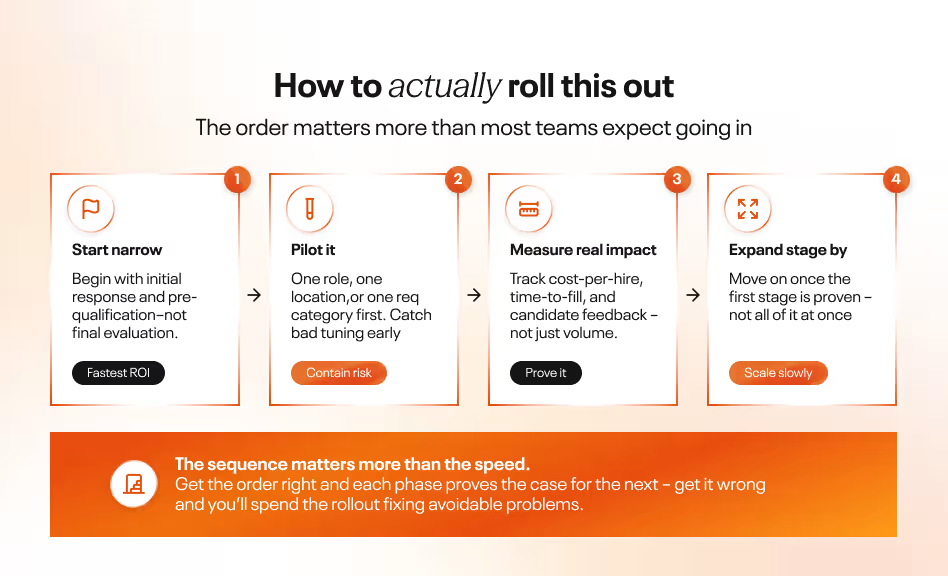
The teams that get this right almost never start with everything at once. A sequence that works:
Start with the highest-volume, lowest-risk stage – for most teams, that's the initial response and pre-qualification, not the final evaluation. This is also usually where the ROI is most obvious and fastest to prove, which matters for getting buy-in for the next phase.
Pilot it on one role type, one location, or one requisition category before rolling it out everywhere. You want to catch a badly tuned qualifying question on 50 candidates, not 5,000.
Measure before and after on the metrics that actually matter – not just "candidates processed," but cost-per-hire and time-to-fill, and candidate feedback if you can get it. A faster process that candidates hate isn't actually a win.
Expand stage by stage once the first one is proven, rather than automating your entire funnel in one deployment. The sequencing of which stage to automate first matters more than most teams expect going in – get that order wrong and you'll spend your rollout fixing avoidable problems instead of proving the case for the next stage.
Where Carv fits
This is the part where, as the people who built a screening product, we'd tell you to buy it – so take that for what it's worth. What we'd actually say is narrower: the principles above are the same ones we built Carv's Screening Agent around, specifically so that automated screening stays consistent and auditable rather than a black box. It doesn't work alone, either – in most deployments, the Host Agent picks up that first response the moment someone applies, and hands a qualified candidate to Screening rather than starting cold.
The bottom line
Automated screening is genuinely one of the highest-leverage places to apply AI in recruiting – the volume is high, the task is repetitive, and the upside in speed and consistency is real. It's also not something to deploy and walk away from. The teams that get real value from it are the ones who treat it the way you'd treat any hiring decision: define your criteria, check your outcomes, keep a person accountable for the close calls, and expand carefully once you've proven it works. AI shouldn't replace your judgment here – it should give you back the time to use it on the candidates who actually need it.
If you want to see how this looks in practice, request a demo and we'll walk through it against your actual hiring volume, not a generic pitch deck.
.avif)
.avif)
.avif)