
%20(1).avif)


There's a pattern in how companies try to fix hiring.
It usually starts with friction building up over time: pipelines aren't strong enough, teams are stretched thin, and candidates drop off somewhere between applying and actually getting hired.
At some point, all of that gets traced back to the same conclusion: we've outgrown our ATS.
So the overhaul kicks off: evaluations, demos, internal alignment. A new system gets selected, rolled out, and adopted, and for a while, things feel better. The workflows are cleaner, the UI looks better, and you have new functionalities.
It feels like progress.
But then, gradually, the same issues start to creep back in. Not because the new ATS is worse, but because it was never designed to solve the actual problem in the first place.
The false diagnosis
When hiring starts to feel broken, the instinct is to look for something visible to fix. And nothing is more visible than the system everyone uses every day.
The ATS becomes the focal point not necessarily because it's the source of the problem, but because it's the most tangible thing in the room. It has a name, a contract, a renewal date, and it can be replaced.
What's harder to see is the limitations baked into the category itself: pipeline quality is a data problem the ATS doesn't touch, manual work exists because the system only captures what recruiters enter, and conversion remains inconsistent because the signal that would explain it never gets recorded.
In other words, the symptoms are unrelated to the system. They live in everything the ATS was never built to capture.
And that's a much harder problem to solve.
Correctly diagnosing it means sitting with messy, structural questions. A new platform, on the other hand, is clean and contained.
So when the evaluation begins, the process is shaped less by a clear articulation of what's failing and more by a search for what feels or looks better. Buying committees coalesce around the option that feels most like a step forward, even when no one has clearly defined what "forward" means in terms of outcomes.
The result is a decision optimized for confidence, not for fit. The new system gets selected because it reduces the discomfort of the status quo, not because it directly addresses the core of the problem.
What an ATS was actually designed to do
To understand why switching systems doesn't fix the problem, it helps to be precise about what an ATS was actually built to do.
At its core, an ATS does three things: stores candidate data, tracks applicants through stages, and filters at scale. That's it. It was designed to bring order to inbound volume: to make sure applications don't get lost, decisions get documented, and hiring teams stay compliant.
It is a system of record. It was never meant to be a system of intelligence.
And the distinction matters, because the three things an ATS doesn't do are exactly where hiring tends to break.
- It doesn't source proactively. The ATS sits at the receiving end of your pipeline. It processes who applies, but has no mechanism to go and find who should. When inbound is weak, the system has nothing to work with.
- It doesn't capture conversation data. What a recruiter learns on a screening call, what came up in a video interview, what made a candidate compelling beyond their CV – none of that was ever part of the brief. If it gets recorded at all, it lives in someone's notes or memory.
- It doesn't re-engage the candidates already in it. Most ATSs hold years of candidate data: people who were strong but not quite right, or not ready at the time. But there's no mechanism to go back to them. So recruiters start every search from scratch, manually, outside the system.
The ATS didn't create these problems, and it was never going to solve them either. It’s a system built to manage applications, not to prioritize hiring outcomes.
“But ATSs have AI now”
This is a fair objection, and it deserves a direct answer.
Modern ATSs have invested heavily in AI, and it shows. Resume parsing and matching are faster and more accurate. Candidate scoring and ranking reduce manual screening time. Some platforms can now trigger automated outreach to matched candidates, re-engage talent pools, and even handle basic screening conversations.
These are real improvements, and they're worth taking seriously.
But there are two constraints that none of it moves.
The first is data quality.
Every AI feature in an ATS operates on the data that's already in the system. And that data is only as good as what was entered. If the signal from interviews was never captured, if candidate profiles were never enriched beyond a submitted CV, if the context from recruiter conversations never made it in, the AI is pattern-matching against an incomplete picture.
The second is scope.
ATS AI can execute tasks within the funnel – but it can only work with what's already inside it, at the stage it's already at, triggered by conditions that were predefined.
It can reach out to a candidate who's been tagged as a match, but it can't find someone who isn't in the system yet. It can automate a follow-up but it can't handle a nuanced conversation across forty candidates simultaneously, adjust based on what it learns in each one, manage six open roles at the same time, and know when to escalate to a human – all while keeping the ATS updated in real time.
In other words, ATS AI can act, but it can't own the process. It still depends on recruiters to set the conditions, handle the complexity, and absorb the pressure when volume spikes or hiring suddenly accelerates.
ATS AI made the funnel smarter but didn't put anyone in charge of running it end-to-end.
That's still the constraint.
Add intelligence, don't replace the system
If the problems don't live inside the ATS, the solution shouldn't start there either. So instead of asking which system should you replace the ATS with, ask what's missing that your ATS was never designed to provide.
The answer will never be another system of record. It's a system of intelligence – a layer that sits on top of what you already have and changes how it gets fed and used.
The current ATS model is linear by design: someone applies, gets processed, and either moves forward or gets stored. Everything starts with an inbound action. The pipeline is whatever arrives.
Add an intelligence layer, and that changes.
Apply → process → reject or store becomes discover → engage → qualify → enrich → store.
The ATS doesn't get replaced in that model. It becomes the endpoint of a richer upstream process, which is exactly what it was designed to be.

What a system of intelligence actually looks like
The concept of an "intelligence layer" is only useful if it's concrete.
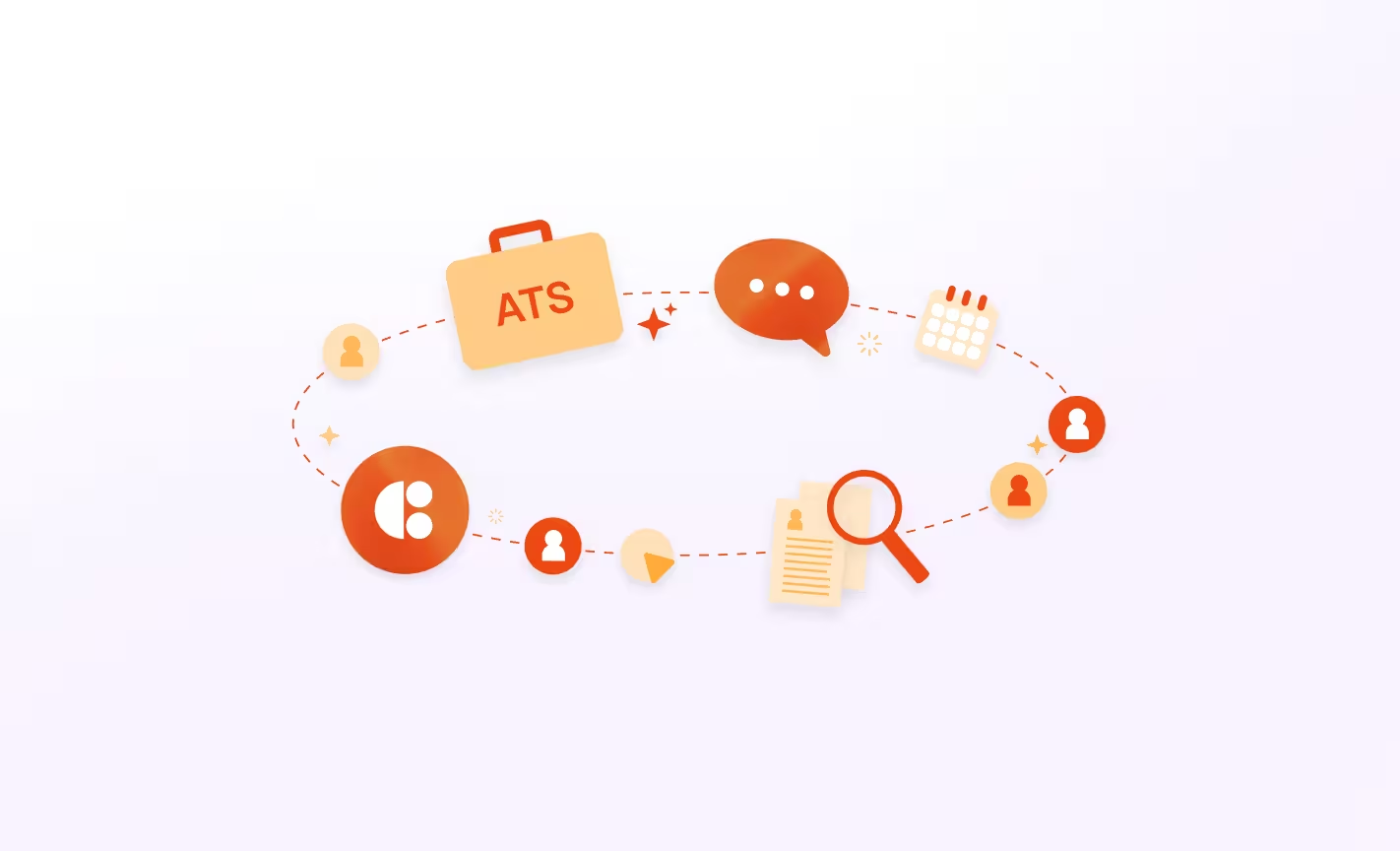
In practice, it means a network of specialized AI agents, each owning a different part of the recruitment process, coordinated by an orchestration layer that keeps them working in sync – sitting on top of your existing ATS and handling the work that was never supposed to be done in the ATS in the first place.
On the sourcing side, it doesn't wait for applications. Instead, it identifies and reaches out to relevant candidates proactively, building the pipeline rather than waiting for it to arrive. Weak inbound stops being a capacity problem.
Across the pipeline, it engages every candidate continuously. Outreach, follow-ups, status updates – handled without a recruiter manually working through a list, one conversation at a time. No candidate falls through the cracks because someone ran out of bandwidth.
On the data side, it captures what actually happens in interviews. Not just that a call took place, but what was said, what stood out, what the recruiter learned. All this is structured and pushed directly into the ATS so the signal is there when it matters, not lost to memory or a calendar note.
And it looks backwards too. When a new role opens, the intelligence system surfaces the right past candidates automatically, re-engages them, and finds out where they are now, without anyone having to go searching.
What makes this different from any ATS, AI-first or otherwise, is that the system has full context across everything at once. And the process doesn't degrade when volume spikes or a key person is out, because the intelligence layer doesn't have a bandwidth ceiling the way a team of recruiters does.

One of the hardest things to achieve in recruitment is predictability – a consistent pipeline that doesn't depend on who had a good week or how many roles opened at once. A network of agents working in sync, with full context and no linear constraints, is what makes that kind of predictability structurally possible for the first time.
Before you replace your ATS
Come back to the moment this started, the sense that the system is holding you back.
Most of the time, it isn't. The system is doing exactly what it was designed to do: receive applications, track candidates, and store records.
So, if what you're trying to solve is pipeline quality, candidate engagement, or recruiter efficiency, a new ATS won't move those numbers. You'll spend 6 to 12 months on implementation, absorb the organizational cost of migration, and arrive at the other side with the same upstream constraints and the same incomplete data flowing in.
The question worth asking isn't "which ATS should we move to?" but "do we actually have an ATS problem, or an intelligence problem?"
Don't replace your ATS to fix a problem it was never designed to solve.