





Let me set the scene: A candidate applies for a role at 11 pm on a Sunday.
In most hiring processes, nothing happens until Monday morning, and even then, only once a recruiter works down far enough in the queue to reach them.
By then, that candidate has probably applied somewhere else too. Maybe several places. The job market doesn't run on business hours, even if recruiting teams do.
This is the gap Carv's Host Agent is built to close. Honing in on the first, most basic thing every candidate is owed the moment they show interest: Someone (or something) actually there to engage them.
This is what candidate engagement looks like as part of an AI-powered recruitment platform: Agentic solutions where each AI agent owns one moment of the journey, starting with the very first one.
What the Host Agent actually does
Think of the Host Agent as the front door. AI candidate engagement means making sure every applicant gets an immediate, useful response the moment they show interest – regardless of the time, channel, or volume of applications coming in. It's the layer that decides whether a candidate feels seen or ignored in the first sixty seconds after applying.
In practice, that means:
- Responding the instant a candidate applies or reaches out, any hour, any day.
- Answering the questions candidates actually ask first (what's the pay, what are the shifts, what happens next).
- Clarifying intent when someone isn't sure what role or step they're looking for.
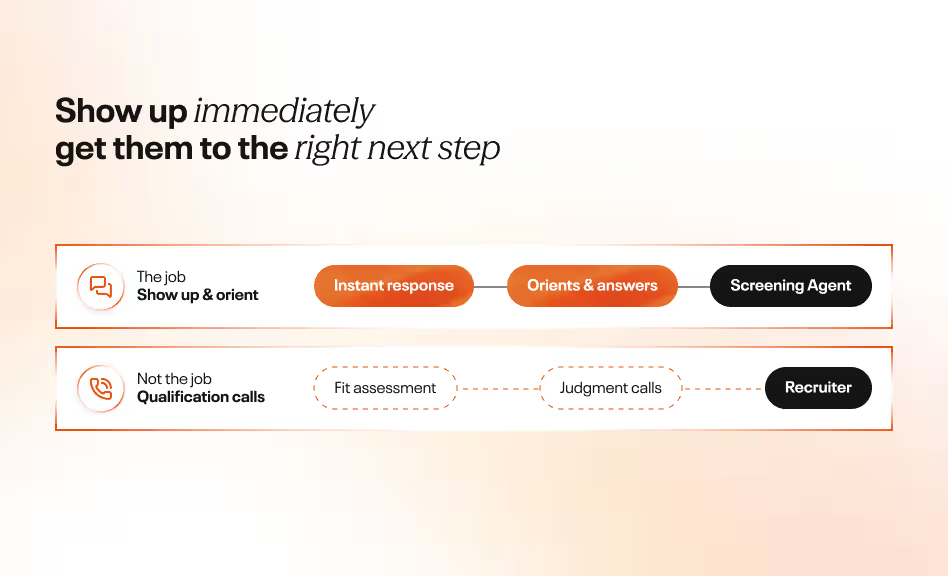
- Handing off cleanly to the next stage – usually the Screening Agent – once the candidate is oriented.
Every one of those interactions also becomes a candidate profile update, capturing candidate data like availability and intent as it's shared, so the Screening Agent isn't starting from zero when it begins pre-screening candidates.
Notice what's missing from that list: Qualification. The Host Agent isn't deciding whether someone is a good fit. It's making sure no candidate is left waiting to find out what happens next, and no recruiter is fielding the same five orientation questions for the thousandth time.
That alone removes a meaningful share of the administrative tasks that used to eat into a recruiter's day, without touching the parts of the recruitment workflow that actually require judgment.
The real cost of a slow first response
There's a quiet assumption in a lot of hiring processes that a strong candidate will wait around for a reply. They won't, especially not in high-volume roles where the same person is often one of several applications a candidate has open at once.
Response time is a competitive metric. The organization that replies first (with a real answer is frequently the one that gets the candidate, independent of whether it's the better long-term fit.
Candidates read a fast, clear response as a signal about what it's like to work somewhere. They read silence the same way.
In volume hiring especially, that signal shapes candidate experience just as much as pay or role details do.
And the silence compounds. A candidate who doesn't hear back doesn't just disengage quietly. They tell other candidates. In tight labor markets for frontline, hourly, and seasonal roles, that reputation moves faster than most hiring teams realize.
An agent that never clocks out removes the variable entirely. It doesn't matter if the application comes in at 2 pm on a weekday or 2 am over the weekend – the response time is the same.
None of this comes at the expense of quality of hire – the Host Agent isn't making hiring decisions, it's just making sure candidates don't disappear before anyone gets the chance to.
How it fits into the system
The Host Agent's value isn't really about answering fast in isolation. It's about what that speed enables downstream.
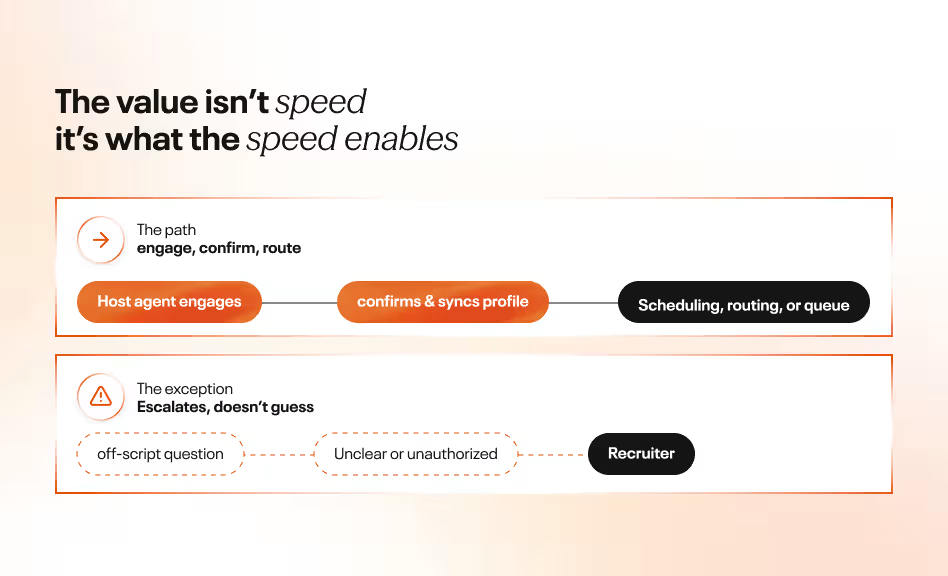
Once the Host Agent engages a candidate and understands what they need, it hands them to the Screening Agent to confirm the basics – availability, eligibility, location, dealbreakers – and from there into scheduling, routing, or a recruiter's queue, depending on outcome. None of that can start until someone (or something) has actually greeted the candidate and pointed them in the right direction.
Behind the scenes, that also means updating the ATS and syncing with the CRM or talent pool automatically, so a candidate who isn't right for this role today isn't lost for the next one.
The Host Agent isn't the most complex agent in Carv's stack, but it's the one everything else depends on being fast.
It also carries a defined playbook for handling the unpredictable parts of a first conversation – a candidate who asks something off-script, someone who's clearly confused about which role they applied for, a question the agent isn't authorized to answer. In those cases, it escalates rather than guesses. The goal isn't to handle every possible conversation. It's to handle the ones it should, immediately and consistently, and hand off the rest.
For a talent acquisition team running an AI recruitment platform across multiple roles and locations at once, that consistency is what makes the rest of the system trustworthy – candidates get the same standard of engagement regardless of which recruiter, site, or shift they're applying into.
What this looks like in practice
- At Pathé, candidates used to get lost in phone tag – recruiters calling from no-caller-ID numbers that candidates wouldn't pick up. Moving first contact to WhatsApp, where an agent engages the moment a candidate enters their number, helped cut time-to-hire from 32 days to 14.5 days (a 54% reduction) and cut recruitment costs by 50%.
- At Carrefour, always-on, multilingual engagement was central to raising candidate satisfaction from 67% to 82% – instant response was treated as a brand promise, not just an operational fix, since "candidates should expect the same experience as customers."
- ORANJEGROEP ran candidate conversations across 10 languages with a small recruiting team, using Host and Screening agents together to process 15,000 candidates in six months without adding headcount.
- At DHL Express, agents now handle over 1,000 candidate conversations a day – a volume of first contact that would be structurally impossible to sustain with a human-only front line.
Across all four, the constant is candidate communication that doesn't depend on a recruiter's availability – which is really what AI in talent acquisition changes first, before it changes anything else.
Where humans still matter
The Host Agent's entire purpose is to protect the moments where a human is actually needed by making sure candidates aren't lost before they get there. It ensures that any relationship gets the chance to start, instead of dying in an inbox.
Recruiters still own the conversations that require judgment: The ambiguous case, the candidate with a complicated question about the role, the moment where trust actually gets built. What the Host Agent removes is everything standing between a candidate's first message and that moment – the wait, the inconsistency, the version of "we'll get back to you" that quietly costs hiring teams their best candidates.
That's a fairly unglamorous use of artificial intelligence compared to what most of the industry likes to talk about, but it's the one that determines whether everything built after it even gets the chance to work.
It's the first agent a candidate meets, and often the reason there's still a candidate left to hand off by the time a recruiter gets involved.
Want to see the Host Agent in action? Book a demo to see how it fits into your existing ATS and workflow.
This is the first in a series looking at each agent in Carv's stack and the specific problem it's built to solve. Next: the Screening Agent, and why the busiest stage in your funnel is also the easiest to get wrong.
.avif)
