




Everyone in hiring is talking about AI agents.
Vendors are leading with them. Conferences are themed around them. Buying committees are being asked to approve budgets for them.
And yet, if you asked ten people in a room to explain what an AI agent actually is, you would get ten different answers, most of them vague.
That vagueness is harmful, especially when you’re deep in the process of considering AI-powered solutions. It leads to poor vendor evaluations, misaligned implementations, and AI projects that never move beyond the pilot stage.
In high-volume hiring environments, where hiring workflows, candidate experience, and time-to-hire directly impact performance, misunderstanding AI agents becomes a business risk.
So let’s close the gap.
What is an AI agent?
An AI agent is a system that can take action on behalf of a user. Not just generate output, but execute tasks, support decision-making, and move work forward without constant human input.
Unlike traditional AI tools or standalone chatbots, an AI agent is designed to own a specific responsibility within a hiring process. It can understand context, apply logic, and act based on real-time signals, whether it’s engaging a candidate, screening candidates, scheduling interviews, or updating systems.
At scale, this matters.
Modern talent acquisition isn’t a single workflow. It’s a continuous stream of repetitive tasks: outreach, qualification, scheduling, follow-ups, and system updates. Most of these don’t require human judgment; they require consistency, speed, and the ability to operate in real time.
As it is, an agent is primarily made up of three things: tools, playbooks, and a mission. Understand those three concepts, and you can cut through the noise, evaluate AI recruiting platforms properly, and determine whether they will actually work in your environment.
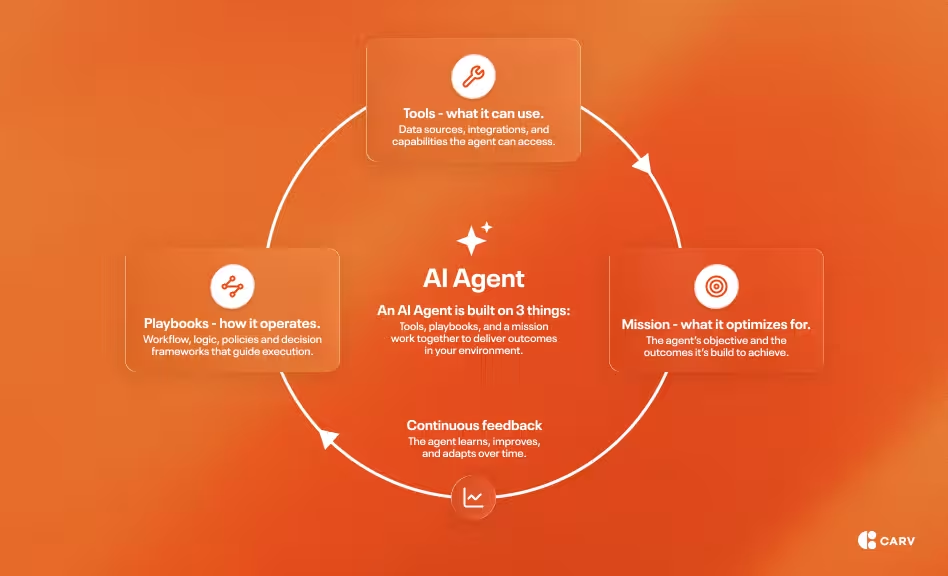
Tools: What an agent can act on
Think of tools as the hands of an agent. They are discrete connections to external systems (your ATS, job boards, scheduling tools, or internal databases), and they work in a straightforward manner: you send an input, you get an output. The agent decides what to ask for and what to do with the answer. The tool handles the transaction.
A useful way to think about it: a tool is not intelligent. It does not make decisions. It executes reliably and consistently, every time. The intelligence sits in the agent. The execution sits in the tool.
That separation is what makes agent-based systems auditable and trustworthy at scale. You can always trace what happened, which tool was called, what it returned, and what the agent did next. This is critical in environments that require human oversight, compliance, and clear hiring decisions.
In a hiring context, tools might look like the following:
- One type of tool reads a candidate’s application directly from the ATS. Before an agent can do anything useful, it needs to understand who it is dealing with, such as background, role applied for, and the current stage in the process.
- Another tool updates a candidate’s profile based on what the agent learns during a conversation. If availability changes or new qualifications surface, that data is written back into the system so every downstream agent works with accurate information.
- A third tool returns a list of relevant roles. Not every candidate is right for the role they applied for. This tool enables the agent to match top candidates to better opportunities, supporting sourcing and rediscovery of top talent.
- A fourth tool outputs an assessment score based on structured, comparable signals through the interaction with a candidate. This is not a gut feeling, but a consistent evaluation that supports both the agent and the recruiter in decision-making.
Each tool performs a single function. The agent decides how to orchestrate them. That design is what makes agentic systems scalable across complex hiring environments.
Playbooks: How an agent thinks and behaves
If tools are the hands of an agent, a playbook is its judgment. It defines how the agent handles a situation: What it asks, in what order, how it responds when a candidate goes quiet, and what it does when the response doesn’t fit a predefined path.
A playbook is not a prompt or a static script. It’s closer to an operational framework that an experienced recruiter would follow, refined over hundreds of interactions, and then applied consistently across every agent in the system. This is what allows AI to move beyond experimentation into production.
Playbooks are configurable, meaning hiring teams can adapt workflows without rebuilding the system. Whether you prioritize qualification first or logistics first, the behavior of the agent can be adjusted without changing the underlying infrastructure. Without a well-defined playbook, an AI system becomes inconsistent. With one, it becomes reliable.
Mission: Where tools, playbooks, and agents converge
A single agent, equipped with the right tools and a well-defined playbook, can handle a specific set of tasks reliably. But a single agent is not what transforms a hiring operation. What transforms a hiring operation is a group of agents working together toward a shared mission.
The mission is the outcome that the system is collectively working to achieve.
In hiring, that mission is straightforward: get the right candidate into the right role, as reliably and efficiently as possible. Every agent in the system exists to advance that outcome. The tools they use and the playbooks they follow are all in service of the same end.
Here’s what it looks like in practice.
A candidate applies for a role through a job board or career site. A host agent picks this up. It uses its tools to retrieve the candidate's application and existing profile from the ATS in real time. Its playbook tells it what to do with that information: Understand what the candidate is there for, identify what is missing, and determine which agent should handle them next.
It hands off. A screening agent takes over. It uses its tools to engage the candidate, ask the right questions, and update the profile with what it learns. Its playbook governs the conversation: What qualifies, what disqualifies, how to handle ambiguous answers, and when to escalate to a recruiter.
If the candidate meets the bar, it hands off to the next agent. If they do not, it does not drop them from the funnel. A rerouting agent picks up candidates who were not right for the original role or its job description. It uses its tools to scan open positions and its playbook to assess fit. In this way, the candidate does not hit a dead end. They are redirected toward an opening that may actually be a better match.
If they do progress, a scheduling agent handles interview coordination without manual back-and-forth, including availability, reminders, and reschedules. An interview gets booked. The recruiter is notified. And the candidate moves forward.
Throughout the process, the system continues running. There are no gaps between steps. No delays waiting for human intervention. The tools handled the execution. The playbooks handled the judgment. The mission kept every agent oriented toward the same outcome. The handoffs were not manual coordination tasks; they were the system doing exactly what it was designed to do.
The recruiting team and hiring managers are still involved, but only where it matters: Reviewing, making final decisions, and building relationships with candidates.
What does this mean when you are evaluating AI for hiring
The next time a vendor tells you they have AI agents, you have three questions worth asking.
- What tools do your agents have access to, and what systems do they connect to? A vendor who cannot answer this in concrete terms does not have agents; they might just have advanced bots. They have a chatbot with ambitions.
- How are your playbooks defined, and can they be configured for our specific workflows without a development project every time? If the answer involves a long implementation timeline every time your process changes, the system will not keep pace with your business.
- How do your agents hand off to each other, and what is the shared mission that connects them? A collection of individual agents that do not coordinate is not a hiring system. It is a set of features. Features do not compound; systems do.
The firms that are pulling ahead in high-volume hiring right now are not the ones with the most AI algorithms. They are the ones who understand what AI agents actually are, ask the right questions, and deploy systems coherent enough to run at the scale their business demands.
That starts with understanding the anatomy: tools, playbooks, and mission.
If you’re operating at high volume, the question is how to design a system that can execute reliably at scale.
That’s where agentic infrastructure makes the difference. If you want to explore what that could look like in your hiring workflows, book a demo to see how Carv’s agents are deployed across real-world processes – from first application to final placement.