.avif)

.avif)


There’s nothing traditional about hiring at scale in retail. Yet most retailers still rely on traditional workflows built for predictability.
Those workflows assume candidates apply during business hours, that someone is always available to respond, and that demand stays stable long enough to move through a linear process. But in reality, none of that holds.
Hiring runs across dozens (sometimes hundreds) of locations simultaneously, each with its own urgency, time zone, and store manager capacity. Candidates apply at night because they work during the day. Demand at store #47 might spike this week, disappear next Monday, and surge again two weeks later.
The result is a hiring system that’s perpetually reactive, always a step behind, and constantly racing not to lose good candidates to whoever responds first.
That’s why “always-on” has become a non-negotiable in retail hiring.
But keeping hiring live 24/7 without exhausting your team takes more than basic automation. It requires intelligent agents that engage like humans, adapt in real time, and maintain momentum even when no one is logged in.
So what does that actually look like in practice – and how do you implement it without disrupting store operations?
Why most AI tools underperform in retail
If you’re recruiting in the retail space and you’ve been feeling underwhelmed by the impact artificial intelligence is having on your process, there will be a clear reason for that.
There’s an understandable urgency across the sector to start using AI-powered recruitment tools in any way possible to keep up with the competition. But adding AI tools is not the same thing as AI transformation.
You might find an AI assistant that allows you to optimize one stage of the hiring process, but what impact does that tool have on workload later in the funnel? Streamlining one stage often just leads to bottlenecks, as store managers can’t keep pace with the tech.
What you need is for AI to be embedded deeply into workflows so it owns them end-to-end. That way, your managers have no admin, fewer low-impact decisions to make, and far fewer handoffs to deal with.
Essentially, you need a full system-level redesign of your hiring operations that’s aligned with your business goals in order to see a real transformation. And that’s where agentic AI comes in.
What is agentic AI in retail hiring?
Agentic AI is an AI system that uses large language models (LLMs), machine learning, and orchestration to perform multi-step tasks autonomously. Put simply, an agentic system is like a digital extension of your recruitment team – a coordinated set of AI agents that can run defined parts of your hiring process from start to finish.
So in the context of retail hiring, this means allowing an agentic system to completely take over the core of your hiring operations – from sourcing to interview – with intervention from hiring managers only in special circumstances.
Your agentic hiring process will likely be made up of several AI agents, with each agent designed to take responsibility for a defined job end-to-end. These agents work continuously 24/7 without needing to wait around for human prompts.
Agentic AI involves a key shift from using AI models to assist with hiring tasks to allowing the technology to own processes end-to-end. It’s this shift that makes always-on hiring possible for scaling retail organizations.
So what does the ideal agentic AI setup look like in retail hiring? Let’s take a look.
The ideal agentic setup for retail volume hiring
Retail hiring looks chaotic from the outside, but stabilizing the system doesn’t require dozens of tools.
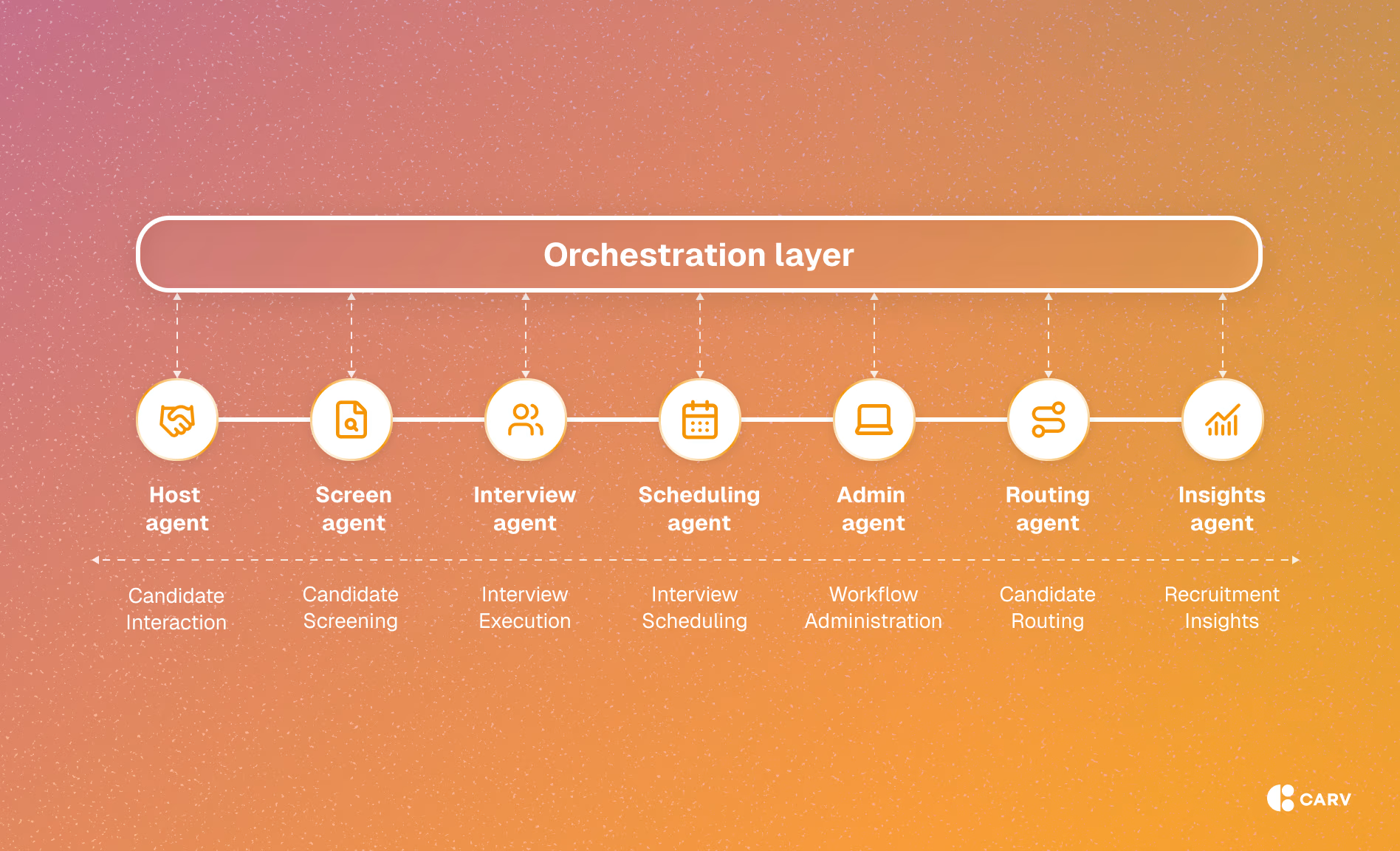
A selection of clearly defined agents, each with strict ownership and clean handoffs, coordinated through an orchestration layer, can ensure momentum never stalls.
But which agents should you use?
1. Host Agent
Retail candidates don’t apply during office hours. They apply after a shift, on Saturday morning, or while standing in another store. The Host Agent ensures your hiring process meets them there.
It welcomes every candidate instantly, across channels – whether it’s a career site, job board, or WhatsApp message. It answers questions, clarifies expectations, and guides candidates into the process without delay.
This isn’t a static chatbot. It’s a contextual front-of-house presence that adapts to questions in real time and escalates only when human intervention is truly required.
Impact:
- Response time drops from days to seconds
- Candidate drop-off decreases dramatically
- Brand perception improves immediately
- Hiring momentum begins the moment interest is shown
2. Screening Agent
Retail hiring struggles with inconsistency. Different stores screen differently, managers apply different standards, and decisions vary by mood and time pressure. The Screening Agent eliminates that variability.
It evaluates candidates against predefined eligibility and policy criteria, applying the same standards across every store while respecting role-specific nuances. Knockout questions, availability, compliance requirements – all handled consistently.
But screening doesn’t mean rejection. If a candidate doesn’t fit one role or one location, the agent doesn’t simply disqualify them. It flags an opportunity for Routing (Agent 6) to evaluate alternative matches.
Impact:
- Fair, consistent screening across all locations
- Fewer good candidates lost due to local demand shifts
- Reduced manual review time
- Improved compliance and auditability
Screening becomes a scalable system, not a store-by-store judgment call.
3. Interview Agent
Retail managers are experts at running stores, but structured interviewing isn’t always the part they enjoy most.
The Interview Agent supports consistency at the most important decision stage.
It can:
- Guide structured interview flows
- Capture and summarize interview notes
- Ensure standardized evaluation criteria are applied
- Provide hiring recommendation support
Importantly, it does not replace judgment. It supports it. Managers still make the call; the agent simply ensures that decisions are documented, structured, and aligned with policy.
Impact:
- More consistent hiring decisions
- Reduced bias risk
- Faster post-interview processing
- Better quality-of-hire documentation
4. Scheduling Agent
Interview scheduling is deceptively expensive. The Scheduling Agent owns this coordination end-to-end.
It offers live availability, confirms bookings, sends reminders, handles rescheduling, and escalates only when necessary. Candidates schedule on their timeline, and managers don’t chase confirmations.
Impact:
- Faster time-to-interview
- Significant reduction in no-shows
- Zero manual scheduling coordination
- Reduced time dependency on store managers
In high-volume retail, scheduling friction is one of the biggest hidden delays. Removing it materially improves throughput.
5. Admin Agent
Retail managers tend to lose time because of everything that happens around the process.
The Admin Agent quietly handles the administrative layer behind the scenes. It updates records automatically, syncs screening outcomes, captures interview data, and maintains CRM hygiene without managers lifting a finger.
Data flows cleanly between systems. Nothing gets lost in inboxes. Reporting remains reliable.
Impact:
- Dramatic reduction in manager admin burden
- Clean, reliable data across the organization
- Better forecasting and reporting
- More time spent running stores, not managing systems
6. Routing Agent
Retail demand fluctuates constantly. One store overstaffed this week may be understaffed next week.
The Routing Agent protects against unnecessary rejection.
If a candidate is screened out due to demand at one location, this agent proactively evaluates alternative stores or roles where demand still exists. It also supports internal mobility and redeployment where relevant.
Instead of losing qualified candidates to competitors, you redirect them intelligently.
Impact:
- Improved talent utilization across locations
- Lower external advertising costs
- Reduced time-to-fill
- Fewer unnecessary rejections
7. Insights Agent
Most hiring teams measure outcomes after the fact. The Insights Agent makes hiring visible in real time.
It aggregates activity across all other agents and surfaces:
- Where candidates are stalling
- Drop-off patterns
- Store-level inconsistencies
- Show rates
- Funnel health
Retail leaders gain live visibility into pipeline flow instead of waiting for monthly reports.
Impact:
- Early detection of bottlenecks
- Data-driven workforce planning
- Store-level accountability
- Continuous optimization
The orchestration layer: What turns agents into an autonomous system
There’s one thing you need to know about these agents: They don’t deliver the same value when used as standalone tools.
In the same way, your real-world shopping assistants and checkout staff can only provide a good customer experience if they work together as a team; your virtual agents can only deliver real value when they’re brought together and orchestrated correctly.
The orchestration layer is essentially the team manager of all your AI agents. Its role is to adapt agent behavior to meet your guardrails, your brand tone of voice, SLAs, and compliance.
Generally, it ensures everything runs according to plan and makes the setup work end-to-end.
There are a few core ways the orchestration layer governs the hiring ecosystem:
- Triggers: when agents engage, screen, schedule, or re-engage, the orchestration layer sends triggers to the next agent in the workflow
- Routing: it establishes which role, store, or location comes next
- Escalations: it decides when and how humans step in, sending notifications to store managers in the rare cases they’re needed
- Policies & controls: it ensures your organization’s tone, compliance, and guardrails are respected throughout the process.
The orchestrator ensures agents can act autonomously across high-volume, decentralized retail environments without any hiccups.
Without this layer, you’re just dealing with another bunch of bots or gen AI tools that might bring interesting results, but they won’t impact business-level operational efficiency or give you any sort of competitive advantage. That comes with the parts working together as a whole.
Where humans stay in control (and why this scales)
Agentic hiring removes the need for humans to perform all the low-impact tasks in the process, but it still relies crucially on human judgment to perform effectively.
Even with a fully AI-driven recruitment workflow, your store managers will still be needed for the following:
- Final hiring decisions
- Sensitive, nuanced, or borderline cases
- Any push-backs, including salary, location, and policy exceptions
- Relationship-driven conversations where context and trust matter, and generative AI doesn’t go far enough.
By preserving store manager input in these situations, the hiring process can scale because agents can continue hiring with minimal decision bottlenecks. Store managers can stay focused on employee and customer engagement instead of worrying about recruitment.
How retail teams roll this out without disruption
Always-on hiring doesn’t require a dramatic overhaul of your systems or store operations. In fact, the fastest way to fail with agentic AI is to attempt a big-bang rollout across every region, role, and function at once.
Retail environments are operationally sensitive. Store managers are busy. Hiring cannot pause for transformation projects.
The most effective rollouts are incremental, controlled, and highly visible.
Rather than “implementing AI,” high-performing teams introduce continuity into specific pressure points first – prove value quickly – and expand deliberately.
Here’s what that looks like in practice.
A 5-step rollout model for agentic retail hiring
Start small. Choose one job family in one region where hiring volume is high and coordination friction is visible. Then move through the following sequence.
Step 1: Map the Real Hiring Flow
Before deploying anything, map how hiring actually happens today.
Not the documented process – the lived one.
- Where does momentum stall?
- Where do managers feel friction?
- Where does candidate drop-off consistently occur?
- How long does each stage actually take?
This baseline matters. It defines your “before” state and ensures the impact of each agent is measurable.
Without this step, you’re optimizing blind.
Step 2: Stabilize momentum
Once the friction points are clear, begin with the agents that directly influence speed and throughput:
- Host Agent – instant engagement
- Screening Agent – standardized qualification
- Scheduling Agent – interview coordination
This combination removes the most visible delays: slow responses, inconsistent screening, and manual calendar back-and-forth.
Candidates receive immediate engagement. Screening becomes consistent across stores. Scheduling no longer depends on managers checking inboxes between shifts.
This is typically where internal perception shifts first – because relief is felt immediately.
Step 3: Remove Invisible Friction
With momentum stabilized, eliminate the hidden operational drag.
The Admin Agent handles:
- ATS updates
- Status logging
- Data synchronization
- Compliance documentation
Quietly and continuously.
Managers stop spending time maintaining systems. Data remains clean without manual effort. Reporting improves without additional admin hours.
Step 4: Optimize Talent Flow
Now that the system moves reliably, expand into optimization.
Introduce:
- Routing Agent – cross-store and cross-role mobility
- Interview Agent – structured evaluation support
- Talent Pooling Activation – re-engaging qualified past applicants
At this stage, hiring doesn’t just move faster, it becomes smarter.
Qualified candidates are redirected instead of rejected. Interviews become consistent and auditable. Existing talent pools reduce reliance on new advertising spend.
Throughput increases. Cost-per-hire decreases.
Step 5: Scale With Visibility
The final step is replication – but only after value is visible.
The Insights Agent provides real-time visibility into:
- Funnel health
- Store-level inconsistencies
- Drop-off patterns
- Show rates
- Throughput performance
When leadership can see, in real time, that response times are down, no-shows are reduced, and manager hours are freed, scaling becomes a strategic decision – not a leap of faith.
From there, the model can be extended confidently across additional regions, job families, and store networks.

The future is already here, and you can’t afford to wait
Candidate behavior is already 24/7 in retail, so it’s time we provided a candidate experience that aligns with that. AI-powered “always-on” recruitment is a hiring system that keeps running when humans can’t, meaning you can meet candidate needs without burning out your hiring staff.
If you’re reading this, thinking this is just something to bear in mind for the future, you need to know that agentic hiring systems just like this one are already being deployed in live retail environments globally.
Take a look for yourself: Multinational retailer Carrefour has already cut its time-to-hire by 63% using Carv’s agentic AI platform.
If there’s one thing to take away, it’s that the gap between retailers who adopt always-on hiring and those who don’t is widening. Which side of the gap do you want to be on?