


.avif)


At the start of any new year, it’s always worth it to pause for a minute and look at where things are headed next.
With AI innovation in full swing, understanding the shifts on the horizon has never been more important.
If 2025 was the year organizations began experimenting with AI point solutions to streamline parts of their hiring process, then 2026 will be the year they realize those early wins only scratch the surface of what AI can unlock.
Last year proved that AI can reliably support sourcing, content creation, scheduling, and other task-level improvements. But it also revealed something more important: the biggest opportunities emerge not from isolated tools, but from rethinking the entire system they operate within.
This is the moment AI shifts from being an add-on to becoming the underlying infrastructure of volume hiring. Recruiters move from task execution to system orchestration. Candidate journeys become more dynamic and responsive. And organizations begin aligning their people, processes, and governance around workflows designed for AI from the ground up.
Here are the 9 trends that we see at the basis of this AI transformation.
#1. AI Transformation goes mainstream
Most organizations have already tested AI at some point in the workflow. The problem is that experimentation rarely changes outcomes at scale.
It creates pockets of progress, but the underlying operating model stays the same.
AI transformation is what happens when you move beyond tools and start redesigning the system entirely. In practice, that looks like:
- A single source of truth for candidate and hiring data (instead of silos and duplicates)
- Clear handoffs and decision points (so humans stay accountable)
- AI embedded into the steps that actually create friction (not just the easy ones)
- Change management that makes adoption consistent across teams
This is the shift that will separate “AI-enabled” hiring from the truly intelligent kind. And it’s the reason agentic systems, recruiter upskilling, candidate experience redesign, and compliance governance are all about to collide in the same year.
#2. Agentic AI becomes mission-critical
Agentic AI (systems that can plan, act, reason, and improve autonomously) will become the foundational operating system of recruitment.
Instead of asking recruiters to constantly switch between and use AI tools in one-off moments, AI agents will become fully embedded into workflows and execute in the background.
Right now, we’re still seeing teams use AI on small tasks: Writing job descriptions, summarizing notes, or helping with outreach. That era is over.
The real competitive advantage will come from embedding AI agents directly into core recruitment processes, where they can orchestrate sourcing, screening, rediscovery, scheduling, and communication without waiting for human prompting.
The firms that outperform will be the ones that start redesigning processes around autonomous, continuously improving, data-driven systems.
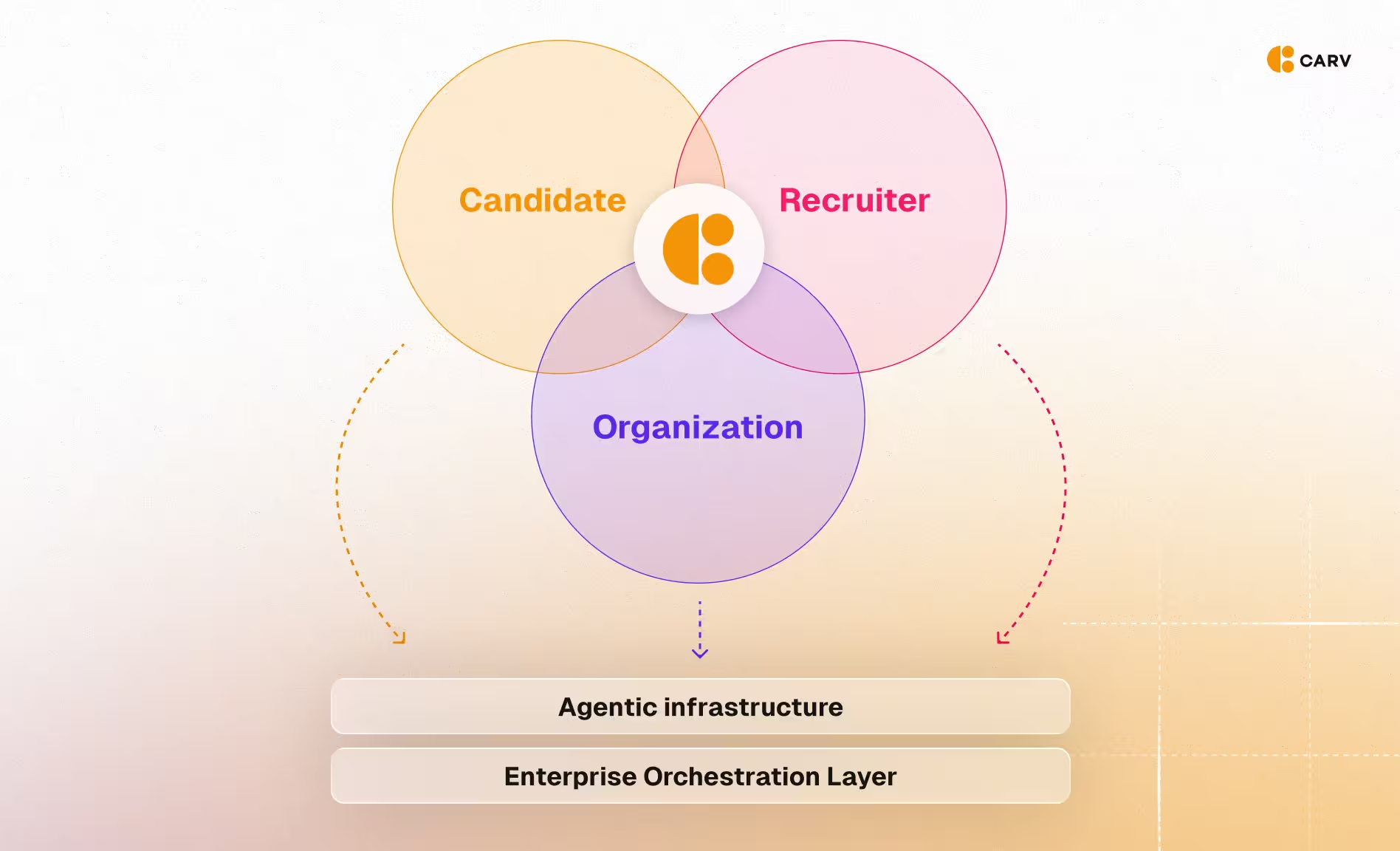
#3. Recruiters evolve into orchestrators
AI isn’t replacing recruiters, but it is redefining what the recruiter role actually is.
For years, recruiters have been pulled into a vortex of administrative work. With agentic AI taking over this operational drag, the recruiter’s job shifts upward.
Instead of manually shepherding every step of the process, recruiters will operate more like managers of intelligent systems, guiding AI agents rather than doing the work themselves – so that they can put their attention on the candidate.
As such, recruiters become the people who interpret insight, shape decisions, and steer the process. In practice, their role expands into a richer blend of:
- Interpreting signals and patterns in AI
- Advising hiring managers with deeper, data-backed confidence
- Nurturing long-term relationships with candidates and clients
- Orchestrating an AI-driven workflow with precision
The most successful recruiters in 2026 won’t be those who “work around” AI. They’ll be the ones who know how to work with it – directing, challenging, and leveraging intelligent systems to deliver better outcomes than any human or machine could achieve on its own.
That also changes what great looks like. Upskilling becomes non-negotiable, and the best teams will actively develop new recruiter skill sets.
#4. AI places candidates at the center
Candidate expectations are rising faster than most hiring teams can keep up with. Today’s job seekers expect the same immediacy and clarity they get from consumer apps – not a linear hiring process that moves at the recruiter’s pace.
In 2026, this gap becomes a differentiator. Candidate experience won’t be a “nice to have”, but a deciding factor.
AI fundamentally changes this relationship by shifting control to the candidate. Instead of waiting for recruiter availability, candidates can progress through the journey on their schedule. Whether that involves asking questions at 2 a.m., getting instant clarity on next steps, rescheduling interviews, or receiving guidance the moment they need it.
Intelligent, conversational agents adapt to each candidate’s preferences, needs, and timing – making the process feel personal, responsive, and way more human. The experience becomes continuous instead of episodic, and centered on the candidate rather than the workflow behind the scenes.
#5. AI success will depend on partnership, not just software
As AI moves towards becoming infrastructure, hiring teams are realizing something important: you can’t buy transformation, you have to build it with the right partner.
Volume hiring is too complex, too interconnected, and too high-stakes to be solved by another plug-and-play tool. Recruiters need a partner who can help redesign workflows, integrate AI responsibly, and align people, data, and processes around a new operating model.
In 2026, the winners will be the ones working with partners who can:
- Adapt AI to their unique hiring models
- Rethink processes instead of automating broken ones
- Embed AI directly into recruiters’ flow of work, not beside it
- Support change management so adoption sticks
- Stay ahead of evolving regulatory and compliance standards
As AI becomes mission-critical, the relationship between staffing teams and their AI partner becomes strategic, not transactional. The future of hiring will be shaped by long-term partnerships built on expertise, co-creation, and operational trust.
#6 Compliance becomes non-negotiable
As AI becomes more deeply embedded in hiring, compliance is shifting from a technical concern to a strategic requirement – especially when selecting long-term partners. With the introduction of the EU AI Act, organizations face new expectations around transparency, oversight, and documentation.
This isn’t just about satisfying regulators. It’s about meeting the standards of procurement, legal, clients, and internal governance teams who increasingly ask: How was this candidate evaluated? What data contributed? What guardrails are in place? Who approved the final decision?
In 2026, compliance becomes a defining factor in vendor selection.
Organizations that can demonstrate control, traceability, and defensible decision-making will move faster in RFPs, client audits, and enterprise procurement cycles. Those relying on black-box algorithms or ad hoc generative AI will struggle to pass the first review.
To operate confidently in this new environment, volume hiring teams will need frameworks that can:
- Generate transparent, explainable AI outputs recruiters can stand behind
- Maintain real-time audit logs for every AI-powered action
- Demonstrate bias monitoring, detection, and mitigation over time
- Provide clear documentation on model behavior and data usage
- Embed human oversight into critical decision points
- Align with ISO 42001 (AI governance) and maintain ISO 27001-level security
- Support robust vendor governance: access control, retention rules, incident response, and third-party risk management
The firms that invest in responsible, auditable intelligence won’t just be compliant – they’ll be the ones able to scale AI confidently, win more enterprise business, and build lasting trust with candidates, clients, and partners.
#7. From separate point solutions to a singular platform
Recruitment also seems to be moving towards a tipping point where too many disconnected tools stop being helpful and start being a burden.
For nearly a decade, teams have stacked point solutions on top of each other: one for sourcing, another for scheduling, another for outreach, another for analytics.
In 2026, many of these tools either consolidate into larger ecosystems or get absorbed by bigger providers.
The truth is, intelligent systems can’t operate inside fragmented environments. For AI to perform at the level organizations now expect, it needs something point solutions can’t offer – shared data, shared context, shared workflows, and unified orchestration. Without that, AI agents operate like isolated bots.
Expect the industry to move toward AI-native platforms. All built around connected agentic ecosystems from day one, not retrofitted tools with an “AI feature” bolted on.
#8. Orchestration becomes the new battleground
For the past decade, the recruitment landscape consisted of more tools, incremental automation, and underutilized data. In 2026, that battleground will shift entirely.
The next competitive differentiator is orchestration: how fast and coherently an organization can move information across candidates, recruiters, and systems.
The best teams will use orchestration to run real-time operations – and to generate forecasts from pipeline signals. This also pushes organizations toward clear governance frameworks for how systems act.
Where traditional tech stacks create silos, agentic systems act as connective tissue, unifying everything into a single flow.
In practice, this means systems that:
- Trigger simultaneous updates upstream and downstream
- Ensure context follows the candidate automatically
- Eliminate handoff delays that slow hiring
- Monitor pipeline health in real time
- Surface next-best actions before humans request them
#9. AI as the backbone for human-centric hiring
The final (and arguably most important) shift in 2026 has nothing to do with algorithms. It has to do with people. After years of chasing automation and efficiency, organizations are realizing that technology alone doesn’t create a competitive advantage. How humans use that technology does.
Agentic AI can move information, coordinate tasks, and highlight decisions at a speed humans can’t match. But the direction, the nuance, the priorities – those still come from humans. And this interplay is where the real transformation lies.
Leaders are beginning to understand that the goal isn’t to replace human judgment, but to augment it.
Deloitte’s 2025 Human Capital Trends report captured this perfectly: 83% of executives want to design work around the combined strengths of humans and machines, not treat them as separate entities.
In practice, that means building environments where AI takes on the cognitive load so people can focus on what they do best.
That’s the real future of work in recruiting: human-centric systems where AI carries the burden, and people set direction.
Organizations that embrace this shift will look different. Their workflows will be co-designed with AI in mind. Their teams will make decisions supported by real-time intelligence. And their operations will run as coordinated ecosystems rather than disconnected activities.
2026 will reward the firms that transition to intelligence
As we look toward the future of work, one truth stands out: artificial intelligence has become a structural necessity. But technology alone won’t define the next 12 months and beyond.
The real transformation begins when AI is applied with purpose – when AI-powered systems operate responsibly, transparently, and in harmony with human-centric judgment.
If you’re ready to move from experiments to transformation, Carv is built to be your partner. We help volume hiring teams optimize operations with an orchestration layer that turns messy systems into connected ecosystems – so recruiting runs faster, cleaner, and more consistently.
Watch this webinar to see how ManpowerGroup Talent Solutions is completely transforming its operations using Carv’s agentic platform, or request a demo to see what we can do for you!

.avif)
