

1. A new era of transformation
Every industrial innovation cycle reaches a point where efficiency gains begin to level off, and the tools that once drove progress hit their limits. Within the staffing industry, that moment is now, and the consequences of failing to act are more than operational. They are existential.
Over the past decade, the concept of digital transformation has reshaped how large staffing firms function. Systems became connected, workflows were automated, and data became more accessible.
Yet despite these advancements, core challenges persist: recruiters remain buried in administrative work, candidates experience silence at critical moments, and leaders continue to lack real-time, end-to-end visibility of their business.
In short, digital transformation delivered important progress, but its impact has reached a plateau.
“The next leap forward isn’t merely another wave of digitization, it is about adding intelligence to a digital process.”
The industry now stands at a crossroads. The advent of AI is ushering in a second era of transformation, one where operations evolve from digital to intelligent.
At the center of this transformation are agentic AI systems that can plan, act, learn, and improve autonomously. When implemented correctly, they have the power to enhance KPIs across the board: from time-to-hire and candidate satisfaction to recruiter productivity, revenue per recruiter, and gross margins.
And this shift is not optional.
The staffing industry is experiencing its “Kodak moment” – a point where failing to act on a technological shift is not merely a cause for slowdown but strategically dangerous.
Firms that adopt AI correctly will operate at a fundamentally different cost structure, deliver faster and more personalized candidate experiences, and provide clients with visibility and accuracy that traditional models cannot match. The gap between the ‘haves' and the ‘have-nots’ will widen quickly. Those who hesitate will be priced out and outperformed by those who act.
This puts leaders in a difficult position. They know they need to do ‘something’ with AI, and fast, but what that ‘something’ is remains unclear.
If this sounds familiar, this guide is for you.
In the pages ahead, we outline a proven methodology for AI transformation in enterprise staffing. It is grounded in real-world deployments at some of the largest firms in the world, offering measurable outcomes and a realistic view of what truly moves the needle. We also explore the transformation of one of the firms that followed this methodology, offering an inside look at what “AI done right” looks like in practice.
But before we explore that path forward, we must confront the reality of the moment, the market forces driving staffing into a race to the bottom, and what it will take to break this cycle once and for all.
Let’s dive in!
2. Breaking the cycle
For every enterprise staffing firm today, the story follows the same familiar pattern: margins are tightening, competition is intensifying, and technology stacks – despite years of investment – have reached the limits of their impact.
In response, leaders have spent the past several years pursuing incremental improvements. A new tool here, a workflow tweak there. These optimizations initially helped, but their effect has grown increasingly marginal over time.
Meanwhile, external pressure continues to escalate. Tight labor markets, volatile applicant volumes, rising wages, and elevated candidate expectations are pushing for improvements across every major KPI. The demand for faster fills, higher recruiter productivity, and more resilient operations is only growing.
Something more fundamental has to shift. And that shift is a move toward a new type of transformation. AI transformation.
This next cycle of evolution is not about adding another layer of software. It is about rethinking how work gets done and embedding intelligence into the core of operations.
AI transformation introduces systems that can interpret data, make decisions, take action, and continuously improve. It represents the transition from digital optimization to intelligent transformation.
From a technical standpoint, this means integrating agentic systems directly into the existing tech stack, enabling them to function as active participants in the staffing workflow. These systems can monitor pipelines, trigger actions, match candidates, communicate, summarize insights, and run decision loops without requiring constant human intervention.
From a strategic standpoint, the implications are even more significant. Firms that get AI transformation right will reduce operational costs, accelerate fulfilment speed, elevate the candidate experience, and unlock levels of visibility and precision that traditional tools simply cannot provide. Firms that don’t, will find themselves competing against organizations operating at a fundamentally different level of efficiency and intelligence.
So yes, AI transformation is the path forward. But to make that concept tangible, we must first be clear on what AI transformation is – and just as importantly – what it is not.
3. AI transformation: What it really means
When most leaders hear “AI,” they instinctively picture tools: a sourcing add-on, a chatbot, a résumé parser with a new label on it. But this framing is exactly why so many early AI initiatives underperform.
AI transformation is not the act of sprinkling isolated tools or point solutions across an already fragmented workflow and hoping productivity will rise. That approach simply continues the cycle of marginal optimization, just with an “AI” sticker attached.
Real AI transformation means rethinking how work gets done from the ground up, with AI acting as a force multiplier. This is fundamentally different from implementing a new tool just because it says “AI” on the packaging.
True transformation begins by mapping your current process end-to-end, examining each stage, identifying efficiency gaps, and asking not “How do we make this faster?” but “should this be done by a human at all?”
This question forces clarity. It surfaces where legacy processes consume effort without producing proportional impact, where data sits trapped in silos, and where workflows can be rebuilt around intelligence instead of labor.
Starting from square one enables organizations to redesign systems that give humans the space to do what they do best – the relational, creative, judgment-driven work – and delegate the rest to AI.
At Carv, we have developed a methodology for AI transformation tailored specifically to enterprise staffing. It centers on embedding agentic AI at the bottlenecks within your recruitment process.
We begin by mapping how your organization operates today and identifying where AI can generate the greatest impact with the least operational friction. From there, we customize agents, embed them into your workflows, and redefine roles and responsibilities across recruiters and AI systems. Once trained and deployed, these agents can autonomously execute tasks that traditionally slow down operations and limit scale.
Throughout this process, the focus is on optimizing operations across the three key stakeholders within your staffing ecosystem:
- Candidates
- Recruiters
- The organization at large
Across each domain, the specific blend of agents depends on your data maturity, process design, and where the biggest bottlenecks exist. However, the outcomes are consistent: faster execution, better experiences, clearer visibility, and operations that continually improve as they learn.
So what does this look like in practice? Let’s break it down.
3.1 For candidates
In an AI-transformed staffing organization, the candidate experience becomes transparent, responsive, and genuinely human – without adding pressure to the recruiter’s workload. Every candidate feels guided, informed, and respected throughout the hiring journey, regardless of volume or timing.
When this model is in place, candidates experience:
- A clear, two-way relationship instead of an opaque, one-sided process
- Consistent, personalized communication that adapts to their needs
- Seamless, connected steps that eliminate friction and uncertainty
- Equitable treatment, no longer dependent on which recruiter they happen to be in touch with
This shift is made possible by moving beyond capacity-limited, manual communication and introducing conversational, always-on AI agents that support both the recruiter and the candidate.
In this model, candidates can:
- Ask questions and get instant, contextual answers at any moment
- Receive proactive updates at every stage
- See exactly where they stand and what comes next
- Move forward without delay – even during nights, weekends, and peak volume
- Self-schedule and reschedule interviews
- Receive tailored job recommendations even after rejection, turning dead ends into new opportunities
This is the candidate experience that AI transformation unlocks. Later in the case study, you’ll see how one of the world’s largest staffing firms scaled this model globally.
3.2 For recruiters
In an AI-transformed operation, recruiters are able to focus entirely on the distinctly human work: building relationships, advising talent, and influencing outcomes. Instead of carrying the full administrative weight of the process, they work alongside embedded AI agents that handle repetitive, manual, and time-intensive tasks.
These agents:
- Assist and take over admin during meetings and interviews
- Coordinate scheduling and follow-ups
- Surface strong matches from historical candidates
- Rediscover overlooked talent efficiently
- Highlight insights that would otherwise remain buried in the system
With this administrative load removed, recruiters shift from task execution to strategic advisory. Their interactions with candidates become more personal, thoughtful, and intentional because they finally have the time and mental bandwidth to make them so.
This shift has a compounding effect: When recruiters operate with greater focus and clarity, candidates experience more attentive, human interactions. Recruiters can invest in deeper relationships, provide meaningful feedback, and guide candidates through the process with clarity and empathy
In an AI-transformed agency, the recruiter’s role evolves into one centered on judgment, influence, and connection – supported by systems where nothing slips through the cracks.
3.3 For organizations
At the organizational level, AI transformation introduces an entirely new foundation of visibility, consistency, and scale. Instead of relying on disconnected tools, manual reporting, and fragmented workflows, the business begins to function as a unified network of live intelligence.
In the AI transformed agency, data becomes a living asset: captured automatically, structured intelligently, and shared seamlessly across teams, business units, and markets. When the intelligence layer is connected across the entire tech stack (rather than isolated in silos), AI gains the context it needs to accurately interpret what is happening across the business. This connectedness is what allows AI to operate effectively, make coordinated decisions, and improve outcomes in real time.
Leaders gain immediate visibility into performance, pipeline health, operational bottlenecks, and emerging trends. Without waiting for manual updates or stitched-together reports.
But the impact extends beyond better dashboards. Agentic systems can:
- Detect patterns and flag opportunities
- Predict workforce needs with greater accuracy
- Surface recommendations before issues arise
- Adapt workflows dynamically as conditions change
- Improve capacity planning and accelerate decision-making
The result is an organization that can scale intelligently, maintain quality during high volume, and respond to market shifts with clarity and speed. It becomes not only more efficient today, but also more capable and resilient over time.

4. Agentic AI: The backbone of AI transformation
AI transformation becomes real the moment an organization moves beyond isolated tools and builds an intelligence layer that operates throughout the entire workflow. This is where agentic AI takes center stage.
Unlike traditional generative AI, which analyzes or recommends, agentic AI can plan actions, execute tasks, respond to changes, and improve over time. It works inside the operation, not on the periphery – functioning as an active participant in the staffing workflow. A participant who can multitask endlessly, never gets tired, and, when given the right context, operates with 100% accuracy and consistency.
4.1 Why agentic AI and staffing are a top match
Agentic systems do more than accelerate existing workflows. They remove the long-standing constraints that have shaped staffing operations for decades. They work continuously, across large candidate volumes, and across every stage of the process. They bring the consistency, availability, and scale that human-capacity-dependent teams cannot sustain.
For staffing leaders, the strategic fit is unmistakable:
1. Staffing is volume-driven: Many core processes must be executed quickly and at scale. Agentic AI introduces a level of responsiveness and throughput that far exceeds what human-only teams can deliver.
2. Human capacity limits efficiency: Even in well-run organizations, productivity peaks at bandwidth. Agentic AI bypasses this structural limitation, executing work without constraints of time, workload, or fatigue.
3. Scalability becomes exponential, not linear: Instead of adding headcount to support volume surges, leaders can deploy agentic systems that operate 24/7, maintain quality, and adapt automatically to fluctuations.
4. Context becomes the differentiator: When agents are connected across the tech stack (ATS, CRM, communication channels, and data systems), they gain the context required to make consistent, coordinated decisions. This is what enables the shift from isolated automation to true operational intelligence: the shift from digital to intelligent.
This is why agentic AI is not just another category of technology. It represents a structural advantage. Firms that embrace it early will operate at levels of speed, quality, and scale that traditional models cannot match. Firms that wait will find themselves competing against organizations running on a fundamentally more intelligent and efficient operational backbone.
4.2 A proven setup for enterprise staffing
Carv’s agentic AI platform is fully customizable, enabling transformation across any volume hiring environment. For staffing specifically, the most widely adopted configuration is built around six core agents, each designed to work within the recruiter’s flow of work, not beside it.
Together, these agents create one orchestrated ecosystem of intelligence that operates across every stage of the hiring process:
- Intake agent – Captures and structures every client conversation, translating nuance and requirements into ready-to-use data.
- Sourcing agent – Continuously searches live and historical databases to uncover hidden candidates and rediscover past talent.
- Engage agent – Personally re-engages candidates through contextual, conversational outreach in their preferred language.
- Screening & hosting agent – Guides applicants through the process, answering questions, scheduling interviews, and ensuring consistent communication.
- Admin agent – Joins meetings, captures notes, insights, and takes actions directly within the ATS, off loading admin tasks from the recruiter.
- Insights agent – Acts as the intelligence backbone – synchronizing data, context, and communication across systems to provide unified visibility.
Carv’s architecture is what enables true AI transformation. By infusing intelligence throughout the entire talent acquisition process, it turns fragmented digital systems into cohesive, adaptive operations.
Rather than becoming “another tool in the stack,” Carv functions as the connective layer, the operational intelligence that powers modern enterprise staffing. And the best part is that organizations don't need to overhaul their current setups completely.
5. Getting started
By now, the message is clear: standing still is the greatest risk. The next step is understanding how to begin in a way that is strategic, structured, and aligned with your organization’s goals.
AI transformation is a journey, and the organizations that succeed typically do so with a partner who understands the staffing landscape, appreciates the nuances of their operation, and can guide them through the shift from digital to intelligent workflows. The right partner adapts to your processes instead of forcing technology that doesn’t fit.
The starting point is simple but essential: map your current recruitment journey. This creates a shared understanding of where bottlenecks exist, where human capacity is limiting performance, and where agentic AI can deliver meaningful impact with minimal disruption.
From there, you design an agentic solution tailored to your organization, determining which tasks are best suited for autonomous execution and which should remain with recruiters.
At its core, AI transformation is about redistributing work intelligently – giving AI the high-volume execution and giving recruiters the space to focus on relationships, judgment, and strategy.
The final step is choosing an implementation approach that matches your pace. Some organizations deploy multiple agents at once to accelerate change; others begin with a focused pilot and expand incrementally. Both approaches work when grounded in clear objectives and thoughtful design.
Because both the technology and the industry continue to evolve, treat AI transformation as an ongoing journey rather than a one-off project. Your systems will learn. Your workflows will adapt. And your organization will become more capable over time.
What matters most is taking the first step – with clarity, with purpose, and with a partner who aligns to your vision.
6. The AI transformation of ManpowerGroup Talent Solutions
When one of the world’s largest staffing organizations – operating in 92 countries and placing more than 200,000 candidates each year – decides to reinvent how recruitment works, the stakes are high.
For ManpowerGroup Talent Solutions, digital maturity was not the issue. They already operated a unified global platform (PowerSuite) that centralized front-office operations across regions. What they sought was the next leap: evolving their digital infrastructure into an AI-enabled one.
Widely recognized for its ethical leadership and a deep commitment to inclusion, the company nonetheless faced a familiar global challenge: how to scale recruitment across markets, teams, and systems without compromising compliance, consistency, or experience?
.avif)
6.1 The approach
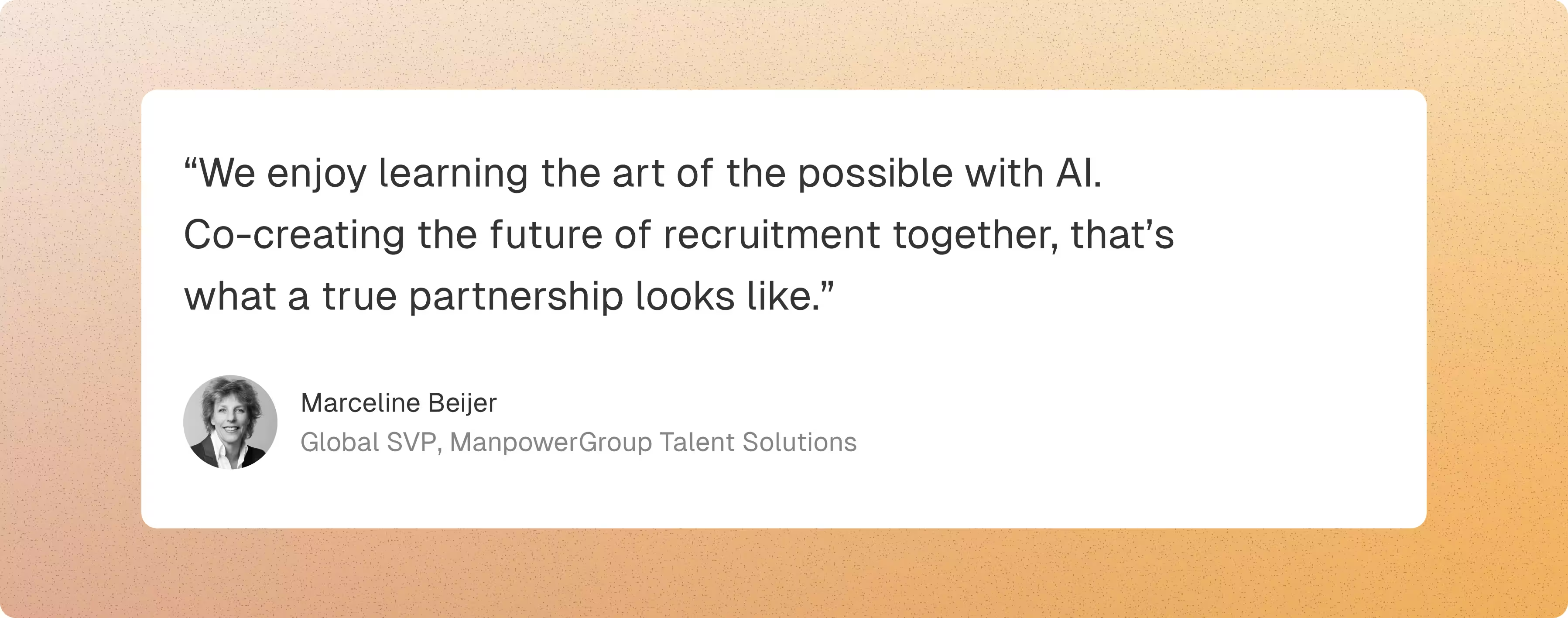
ManpowerGroup partnered with Carv to explore how agentic AI could be woven directly into their operating model. From the outset, the work was co-creative. Business leaders, recruiters, and technologists designing the future state together. The goal was not to drop AI “on top” of existing workflows, but to rethink how recruitment should work in the enterprise of the future, and then build towards that.
6.2 The solution
The engagement began with mapping the incumbent recruitment process to determine where to embed AI for optimal improvement. This became the blueprint for transformation. The team landed on customizing and implementing the 6 custom agents discussed earlier:
- Intake agent – Captures and structures every client conversation, translating nuance and requirements into ready-to-use data.
- Sourcing agent – Continuously searches live and historical databases to uncover hidden candidates and rediscover past talent.
- Engage agent – Personally re-engages candidates through contextual, conversational outreach in their preferred language.
- Screening & hosting agent – Guides applicants through the process, answering questions, scheduling interviews, and ensuring consistent communication.
- Admin agent – Joins meetings, captures notes, insights, and takes actions directly within the ATS.
- Insights agent – Acts as the intelligence backbone – synchronizing data, context, and communication across systems to provide unified visibility.
Grounding the design in real workflows ensured every capability introduced served a clear purpose: improving recruiter effectiveness and elevating the candidate experience. Some implementation highlights include:
- A data-driven foundation: Existing ATS data was activated as the intelligence backbone rather than replaced.
- Embedded AI, not adjacent: Carv’s agents operated inside ManpowerGroup’s flow of work, eliminating context-switching and redundant admin.
- Co-created AI agents: The rollout began with targeted, high-impact use cases to demonstrate quick value and build trust.
- Iterative scaling: Once early wins were proven, capabilities were modularized and expanded across countries and business lines.
6.3 The impact
ManpowerGroup’s AI transformation journey is still evolving, but it demonstrates what’s possible when AI becomes an operating principle. Recruiters experienced a fundamental shift in how they worked. With administrative tasks automated, they could focus fully on conversations, deeper engagement, and the strategic work that drives placements. Candidates felt the impact too: AI ensured timely updates, clear next steps, and constructive feedback, even after rejection – strengthening satisfaction and employer brand perception across regions.
7. Looking ahead
The AI transformation journey in staffing is underway. Leaders in the space have already taken steps towards an AI-enabled future, and many early adopters are following in their wake. What comes next will reshape how organizations operate, how recruiters work, and ultimately, which names will become household leaders in the industry.
Organizations that start this journey early will learn faster. They will discover what works for their unique model, build confidence in human-AI collaboration, and create a foundation that compounds over time. The ones who wait will find themselves in troubled waters over time.
The industry is moving, the technology is maturing, and the opportunity is here. Looking ahead, the firms that take action now will be the ones truly shaping the future of staffing.