

.avif)


There’s a misconception brewing across the staffing industry as AI adoption grows – and it’s one I believe is getting in the way of many agencies achieving the results they want from AI.
It comes down to what “AI transformation” actually means in practice for staffing firms.
First, here’s what it isn’t: AI transformation in enterprise staffing is not about adding more tools to your recruiter workflows, no matter how sophisticated they might be.
Real AI transformation involves redesigning your agency’s operating model completely. It means letting AI agents own processes end-to-end.
In more advanced setups, staffing firms are starting to operate with AI handling large parts of the workflow continuously. AI agents can take care of high-volume, repetitive tasks inside existing systems, while recruiters and hiring managers step in where judgment, context, or relationship-building is required.
This shifts recruiters from being the connective tissue of the workflow to becoming decision makers and relationship owners, with AI maintaining momentum across every step of the hiring process.
It’s worth noting that most staffing firms are still somewhere in between – experimenting with AI in parts of the process, while the overall workflow remains largely manual.
What an agentic process looks like in staffing firms
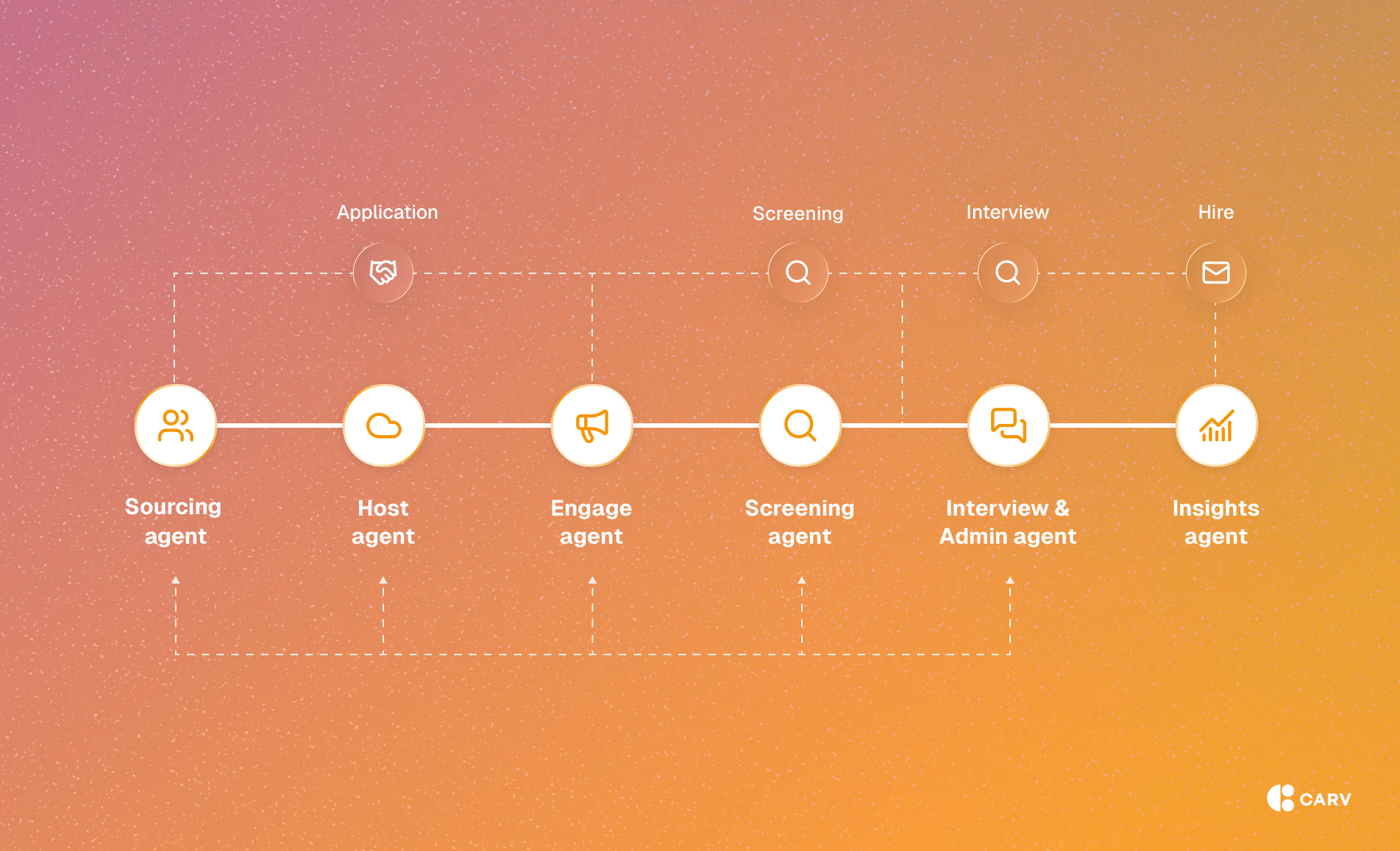
Across the market, we’re seeing agentic solutions take shape around a set of core AI agents we’ve identified to be at the center of most TA teams’ needs.
Delivery models, client expectations, and operational constraints all vary from one business to the next, so a one-size-fits-all approach doesn’t work. That’s why we’ve ensured the AI model is fully customizable because every business is different.
But any task in the recruitment workflow will fall into one of these core areas.
Each of these core agents owns a specific task. They’re not designed just to automate a job or speed up a workflow, but to manage their designated work end-to-end within the hiring workflow.
The real difference between businesses that just use AI and those that are AI transformed is that the latter will run all the relevant AI agents at once. They let these AI agents work symbiotically to keep the hiring process moving autonomously without relying on constant manual coordination.
With this out of the way, let’s look at the six core agents staffing firms require, what they do, and the bottlenecks they remove.
1. Sourcing agent
Every new requisition starts with sourcing, and by now, most recruiters are using AI in some way to help them source relevant talent for their roles.
But there’s a big difference between how an AI-ready agency and an AI-transformed staffing agency will approach sourcing.
Yes, using AI tools to source candidates on external platforms will speed up the process of finding talent. But then what happens with all these new candidates the tool uncovers?
For a lot of firms, these candidates end up siloed in the CRM with no recruiters available to screen them because they don’t have the capacity to cope with the increase in talent.
In an agentic setup, the AI continuously matches and rediscovers candidates from your existing talent pool or candidate database first, not external sources. It sorts through thousands of candidate records, building ranked shortlists automatically from the wealth of candidates you’ve already vetted and who are already waiting in your CRM for their next opportunity.
This process reduces the inefficient and costly sourcing strategy that a lot of agencies practice. Instead of starting from scratch on every requisition, with a recruiter managing the sourcing process, even if they’re supplementing with an AI tool, the sourcing agent manages everything autonomously.
This saves the firm massively on resources by reactivating and reusing their existing talent pools rather than building new ones every time there’s a new requisition.
2. Host agent
The host agent is like your front-of-house recruiter – a sophisticated human-like concierge available 24/7 to welcome candidates and answer any questions they might have about the application process.
When an applicant hits the ‘apply’ button, or reaches out to your agency directly – whether via your website, by email, or even by phone – the host agent is there to respond to them instantly. Their role is to greet candidates, support them through the application process, and set clear expectations from the first interaction.
And if you’ve dabbled in any generative AI technology recently, you’ll know just how sophisticated these chatbots are nowadays.
Using gen AI technology similar to ChatGPT, the host agent can handle any questions candidates fire at them, just like a human would. Even if a candidate goes entirely off piste and starts asking what the agent’s favourite pizza topping is, they’ll gradually and naturally bring them back to talking about their job application.
Using a host agent in this way completely eradicates the need for any human to handle the boring and time-consuming repetitive task of answering the same questions over and over when they have more important decision-making to do.
3. Engagement agent
If host agents are your front-of-house staff, your engagement agents are the ones serving the table, keeping candidates warm and happy until dinner (i.e., a job offer) is served.
Engagement agents have a crucial role to play. They handle all candidate outreach and follow-ups, ensuring communication is compliant and personalized to that candidate so they stay engaged throughout the whole hiring process.
Engagement agents keep candidate pipelines warm, maintain momentum between stages of the hiring process, and prevent candidates from disengaging before they reach the job offer stage due to slow or inconsistent communication from recruiters.
And the best part is, these agents can handle this highly sophisticated level of communication at almost any scale. They get to work, keeping thousands of candidates engaged without needing any input from human recruiters at all. They don’t even need any human triggers to start working – engagement agents get their triggers from other agents in the workflow.
4. Screening agent
Your screening agent is essential to running an efficient hiring process that locks in the best talent quickly. Using sophisticated conversational AI technology, the agent qualifies candidates consistently and in real time by asking structured knockout questions in a human-like, conversational way.
This step happens automatically when the candidate hits the apply button. The screening agent is always on, so there are no manual screening queues where candidates have to wait around until one of your recruiters is ready to qualify them - by which time the best candidates will already have been hired by someone else.
These agents also manage availability checks and capture readiness signals to determine which candidates are qualified to be processed through to the interview stage. That way, when hiring managers are ready to start on interviews, their calendars are already filled with qualified candidates before they’ve had to perform any manual tasks.
5. Interview & admin agent
Even the most transformed staffing firms still run human, recruiter-centric interviews – and that’s not likely to change any time soon. But interview agents have created such a beneficial recruiter-AI synergy that they’ve become completely integral to the interview process at any staffing firm that uses them.
These agents have transformed the entire interview experience for both candidates and recruiters.
The agent handles virtually all administrative tasks associated with interviewing candidates: scheduling, rescheduling, sending reminders, capturing notes throughout the conversation, and suggesting essential follow-up questions.
After the interview, the agent also handles updating the ATS, ensuring the candidate profile captures all new information that was gathered during the interview. These are all tasks that prevent recruiters from having the space to truly engage with candidates during interviews.
Instead of worrying about admin and logging information so they can score candidates later, the interview agent frees recruiters up to think critically about what’s going on during the interview and whether the candidate is likely to perform well in the role.
6. Insights agent
The final AI agent in the recruitment workflow is arguably the most crucial, particularly for those running the firm. The insights agent unifies activity across all agents to deliver real-time insights that provide a clear view of what’s happening across your recruitment process, and where the opportunities are to streamline it further.
All you have to do is tell the insights agent which recruitment metrics you want to track, and the AI will use sophisticated algorithms and data management techniques to give you full visibility of your recruiters’ pipelines, detect any bottlenecks, and support forecasting and planning based on real-time data signals.
This kind of reliable information gives you, as a business leader, the insights to make decisions that lead to meaningful business transformation and make changes that could give your agency a serious competitive advantage in the market.
How it all comes together: AI orchestration
The real power of an AI-transformed staffing process doesn’t come from each of these individual agents, but from the overarching orchestration of combining them into a powerful, autonomous recruitment workflow.
Instead of launching fragmented AI projects at your firm, where you’re onboarding multiple AI tools to optimize single steps in the process, staffing firms experiencing real transformation will take a much more holistic approach.
All of these AI agents can speak to each other, operating with shared context and coordinated handoffs that work across the entire workflow autonomously.
This is why the “orchestrator” is really the key component to a truly AI-transformed staffing firm. Think of the orchestrator as the “team lead” of these six individual agents. The orchestrator has these main responsibilities:
- Determines which agent acts next
- Passes context forward between agents so nothing is lost or miscommunicated
- Ensures work continues without waiting around for a human to perform a trigger.
So instead of managing fragmented AI-powered workflows that involve a whole load of manual coordination, the orchestrator ensures your agency functions under a single, always-on operating layer.
These AI systems can automatically progress candidates, escalating applicants to your recruiters only when human judgment is required, so your recruiters can focus on outcomes and results instead of getting bogged down in lengthy processes.
Orchestration across agents is what ensures consistency, efficiency, and, when the time comes, it’s what will allow your staffing firm to scale.

What changes for recruiters (and what doesn’t)
As any leader will know, the biggest challenge of business transformation is usually resistance from your employees. Even if you’re bringing in this new technology to make their jobs infinitely easier, it can be a challenge to get everyone initially on board.
Focusing on the positives of what will change about their jobs is an important part of earning buy-in. They need tangible use cases and case studies that demonstrate clearly what will change in their day-to-day roles and the new responsibilities that come with managing an AI-driven recruitment process.
In an AI-transformed staffing firm, recruiters are no longer acting simply as workflow coordinators – they’re elevated to the position of advisors and decision-makers.
Administrative chasing, follow-ups, scheduling, and data cleanup move into the background, handled continuously by agents, so they can focus on the important conversations and making hiring decisions.
What doesn’t change is where human value is highest: exercising judgment, building trust with candidates and clients, handling exceptions, and making final placement decisions.
Transforming your operations without disruption
AI transformation doesn’t need to involve a “big bang” rollout at your staffing firm. In fact, that’s exactly the sort of approach that comes with disruption and risk – both of which are entirely avoidable with the right strategy.
The most successful firms introduce AI in a controlled way, treating it like a redesign of their operating model. This might sound major and disruptive, but it’s not if you introduce it in stages, align it to real operational bottlenecks, and scale it only as your confidence in the new model grows.
This is why we always recommend that your starting point with AI should be to look at your processes first, not technology.
Map out your firm’s end-to-end delivery flow as it exists today, identify where momentum consistently breaks, and ask a simple question at each step: Does this really still need to rely on humans to get done?
Most firms begin by introducing agents at the highest-friction points (e.g., admin coordination, screening, and candidate re-engagement) where impact is quick, and risk is low. These agents operate inside existing systems, allowing teams to see value without changing how recruiters or hiring managers work day to day.
As your data quality improves and trust in your new system builds, this is when you can start adding in additional agent layers – either sequentially or in parallel – until the full six-agent loop is active.
The pace and focus of how you handle this rollout is entirely up to you. Some organizations stagger the rollout by function or by region, while others move faster if the transformation feels more urgent.
Either way, what matters most is not speed, but control. AI transformation works when each step reduces friction, proves measurable impact, and prepares the organization for the next phase – without disrupting delivery or impacting your recruiters’ confidence in the process.
Of course, not every workflow can or should be automated, and successful implementations depend heavily on data quality, process clarity, and adoption within teams.
Choose a partner to guide your transformation
AI transformation isn’t a one-off project – it’s a long-term journey that requires commitment and a provider you can trust.
With the right agentic partner there to support your AI transformation the whole way, you can be confident that the rollout will go smoothly and that you’ll upgrade your operating model in a way that gets results.
When choosing a software to partner with, look for one that:
- Integrates directly into your existing ATS and CRM systems
- Preserves context across every step of the workflow
- Proves KPI impact early and continuously
- Reduces complexity instead of adding to it.
Platforms like Carv are designed to support this shift by connecting workflows, preserving context, and reducing manual coordination. Book a demo with a member of our team to find out how our agentic solution can support your AI transformation every step of the way.