

1. So many candidates, so little time
Retail volume hiring has always lived in a category of its own. High candidate volumes, a decentralized operating model, and the reality that candidates are often customers of your organization make it one of the most complex TA environments to operate in.
Over the past two decades, this complexity has fueled a strong push toward “digital transformation,” and early on, the impact was tangible.
Applicant tracking systems replaced spreadsheets, career pages have been optimized for mobile, and scheduling has become automated. As a result, retail TA teams became more structured and more mature. But that KPI-improvement-momentum has largely stalled.
For years now, progress has simply been incremental: slightly faster workflows, marginally better conversion rates and modest efficiency gains; The industry has been in ‘fine-tuning mode’.
While useful, these marginal improvements have failed to meaningfully move the core KPIs or address the structural issues at the heart of retail hiring.
That paradigm, however, is changing.
With the emergence of AI, for the first time since the early days of digitalization, retail talent acquisition has access to technology that doesn’t just speed up existing processes or streamlines parts of them; it fundamentally reshapes them. In other words, AI has the power to push retail TA out of fine-tuning mode and back into true transformation mode: AI transformation.
Unlike traditional systems, AI can operate at the scale required for retail hiring without adding operational complexity. It can engage thousands of candidates simultaneously, adapt to local context while remaining centrally governed, and make decisions in real time rather than after the fact. This marks a shift from process-driven hiring to intelligence-driven recruitment, where the system actively reduces friction and puts the candidate back at the center of the hiring process.
At the core of this transformation sits Agentic AI.
Where traditional automation follows predefined rules, agentic systems can perceive context, make decisions, and act autonomously within clearly defined boundaries. This makes them uniquely suited to the realities of retail volume hiring, where scale, variability, and speed collide. By embedding intelligent agents at critical inflection points in the hiring journey – screening, scheduling, qualification or selection, follow-up, and re-engagement – retail organizations can deliver truly personalized candidate experiences at scale.
And this shift is not theoretical, experimental, or years away. Leading retailers are already adopting agentic AI as the foundation of their talent acquisition strategy. As they do, they redefine the competitive landscape.
Brands that continue to rely on legacy tech and process-heavy models will increasingly find themselves competing against organizations operating with an entirely different hiring paradigm, one that is faster, cost-efficient, and fundamentally more aligned with modern candidate expectations.
That is not a fair fight, and the outcome is predictable. So now the question is: what does the path forward look like in practice?
In this whitepaper, we explore how intelligence-driven transformation in retail recruitment works. We break down the role of agentic AI, outline where and how to deploy it for maximum impact, and share real-world examples of organizations that have already embarked on this journey, along with the early results they are seeing.
The goal is simple: to equip retail leaders with the insight and clarity needed to make the right decisions today, so they can not only survive the years ahead but thrive in them.
2. A unique set of challenges…
Retail volume hiring is not difficult because retail organizations lack tools, processes, or intent. It is difficult because retail hiring is structurally different from almost every other TA environment.
Unlike corporate recruiting, retail hiring is inherently multi-location. It operates as hundreds of separate funnels running in parallel, across different locations, under different local conditions. Every store has its own hiring environment: a unique labor market with its own candidate supply, wage pressure, commuting realities, cultural expectations, and competition. Even stores within the same city often operate under dramatically different circumstances.
This decentralization is not a flaw; it is fundamental to how retail works. But it creates a persistent challenge for talent acquisition: how do you run a hiring model that is consistent, scalable, and on-brand, when the execution occurs locally?
This is why retail TA often feels like it is constantly balancing opposites:
- Central governance vs. local autonomy
- Speed vs. consistency
- Volume vs. personalization
- Efficiency vs. candidate experience
And because hiring happens so close to operations (at the store level), any friction within the process doesn’t just slow down recruiting; it impacts store performance directly. The result is a TA model that operates under high pressure, high variability, and constant urgency.
Within that reality, three challenges consistently determine whether retail hiring succeeds or fails:
- The role of store managers
- The variable nature of the work
- Candidate demand volatility
2.1 Store managers ≠ recruiters
Store managers play a crucial role in retail hiring. They know what good performance looks like on the floor, they understand team dynamics, and they often make the final decision. Yet despite their central role in the hiring process, store managers were never set up to function as recruiters, even if the model requires them to.
A store manager’s primary responsibility is running the store: driving sales, ensuring a positive customer experience, managing inventory, executing campaigns, and maintaining operational standards.
In that environment, recruitment is rarely the priority – it is a necessity competing with dozens of other urgent tasks. And when everything is urgent, hiring gets relegated to “when there’s time.”
The consequences are predictable:
- Applications go unanswered for too long
- Candidates drop out before they ever speak to someone
- Interview slots are hard to coordinate
- Follow-ups are inconsistent
- Decision-making becomes rushed
In volume hiring, speed is a survival condition. The longer a candidate waits, the more likely they are to accept another offer, lose interest, or simply disengage. And because store managers are stretched thin, they become the bottleneck in the system, especially during high-volume periods.
2.2 The variability factor
When hiring execution depends on hundreds or thousands of store managers, consistency becomes nearly impossible. Some managers are great at recruitment. Others are not. Some move quickly. Others delay. Some deliver excellent candidate experiences. Others unintentionally ghost candidates or create friction through slow and inconsistent communication.
This variability doesn’t only affect hiring KPIs, it also affects brand perception. In retail, candidates are customers. A poor hiring experience easily evolves into a poor customer experience. And unlike corporate environments, that impact is immediate and measurable: rejected or ignored candidates don’t just disengage from the hiring process, they disengage from the brand.
In short, retail volume hiring depends heavily on a group of stakeholders with the least capacity, the most operational pressure, and highly variable recruiting skills. That is a structural constraint that no amount of fine-tuning can eliminate.
2.3 Candidate demand volatility
The third force that consistently breaks retail volume hiring is volatility – not just on the store side, but on the candidate side as well.
Retail hiring operates at the intersection of two volatile systems. Store demand fluctuates by season, promotion, location, weather, and footfall. Candidate availability fluctuates just as unpredictably, shaped by shift work, second jobs, commuting constraints, school schedules, and local labor dynamics. Both sides move constantly, and rarely do so in sync.
This volatility is unique to retail.
A flagship store in a city center may be flooded with applicants, while a nearby suburban one struggles to attract any. Holiday peaks create sudden hiring surges across regions, while quieter periods require a completely different staffing posture. Candidates may apply in high volumes one week, disappear the next, then re-enter the market unexpectedly. And they do so on their own time – late at night, between shifts, or over the weekend.
Traditional hiring models were never designed for this. And this is where manual, human-led processes begin to fail.
Humans are wired to create structure. That instinct works well in stable environments. In retail volume hiring, it becomes a constraint. Every attempt to box, standardize, and sequence the process adds friction precisely where flexibility is required.
What makes this especially problematic is that volatility is not an exception to be managed; it is the operating condition. Retail hiring does not move in cycles that can be smoothed out with better planning alone. It requires a model that can absorb fluctuation without constant human intervention. And that exposes a 4th and more complex issue; to solve for this, a more unique solution is required.
3. …Requires a unique solution
To determine the right solution for this unique set of problems, first order of business is to define what the ideal retail volume hiring process needs:
Retail requires a process that provides more flexibility towards the candidate and adaptability to the location manager’s day-to-day, preferably powered by a hiring model that operates continuously, responds instantly, and flexes across locations, seasons, and demand spikes without requiring constant oversight.
If that sounds impossible, you’re right. Up until recently, it was.
The introduction of agentic AI in hiring has changed the playing field and redefined the boundaries around the ‘ways to do it better’.
If set up right, AI can handle all the high volume-low impact tasks like initial candidate engagement, qualification, scheduling, follow-up, and reactivation. Store managers only have to step in where their judgment matters.
And this autonomous hiring reality is not a far-future concept. Many forward-thinking retailers are already taking steps in this direction, because the cost of doing nothing is rising, and every day you wait is a day the competition moves ahead.
So, where to start?
The first thing to realize is that the path forward is not adding another point solution or optimizing an already-overloaded workflow. It is introducing a new hiring infrastructure – one designed for how retail actually operates today. At the basis of it all sits Agentic AI. An advanced form of customizable AI focused on autonomous decision-making and/or action.
In the next chapter, we’ll unpack Agentic AI and dissect why it forms the foundation for transformation in retail talent acquisition.
4. Agentic AI: The basis for transformation
Agentic AI refers to AI systems that can operate with a defined objective, interpret context, and take action autonomously within clearly governed boundaries. Rather than simply producing outputs (such as a recommendation, a score, or a drafted message), agentic AI can execute end-to-end workflows: engaging candidates, asking clarifying questions, making decisions based on policy and constraints, and triggering the next best action.
In practice, this means an agent can manage real interactions in real time, adapt its behavior to different candidate scenarios, and maintain momentum throughout the hiring journey, while escalating to human stakeholders only when judgment, approval, or a final selection is required.
This capability is especially relevant in retail talent acquisition, where hiring performance is often constrained not by lack of process but by lack of capacity and responsiveness.
Agentic AI introduces a new operating layer: one that can run continuously across locations, absorb high-volume interactions, and create consistent candidate experiences without requiring store managers to be available at every step.
4.1 The real benefits of AI (when applied correctly)
In retail volume hiring, the problem is rarely the process itself. The issue is that it breaks at predictable moments. There are key inflection points in the candidate journey where speed, clarity, and follow-through matter disproportionately and where the system most often slows down. A candidate applies, but waits too long for a response. Screening happens, but scheduling stalls. An interview takes place, but feedback and next steps disappear into operational chaos. In high-volume hiring, these moments are where momentum is lost, candidate intent evaporates, and the funnel leaks at scale.
It is precisely at these inflection points where an AI agent can deliver disproportionate impact, by taking ownership of the repetitive, high-frequency actions that typically slow the process down: initial engagement, qualification questions, scheduling coordination, reminders, follow-up, and reactivation. Agents can help “plug the holes” in the funnel and keep candidates moving forward.
Unlike humans, agents do not get overwhelmed by volume, do not lose track of candidates, and do not operate within store opening hours. They are available 24/7, always responsive, and able to maintain a consistent tone of voice in every interaction, at any time of day, across any location. For candidates, this translates into a hiring experience that feels immediate, clear, and supportive: a friendly, always-on guide that reduces uncertainty and keeps momentum.
At the same time, the operational benefits are significant. Store managers are no longer responsible for the continuous coordination work that pulls attention away from the floor. Instead of spending valuable time on administrative follow-ups and scheduling logistics, they can focus on the parts of hiring where human judgment matters; evaluating fit, making decisions, and leading the store. The result is a model that improves candidate experience and hiring outcomes, while reducing workload where retail can least afford it.
5. Getting started
So now that we know agentic AI is the way forward, the question becomes: how do you set up this new reality correctly?
The first step is not technical; it’s a mindset shift. Retail leaders need to move away from thinking in point solutions and isolated optimizations, and instead see this AI era for what it is: an opportunity to redesign hiring in a fundamentally different way. Those who approach AI as “just another tool” will improve only marginally. Those who treat it as an opportunity to implement a new operating model will pull ahead, and the gap between the two will widen quickly.
This shift is also understandably uncomfortable. Transformation implies change, and change can be perceived as risky, especially in a hiring environment that is already under constant pressure. The good news is that this is no longer uncharted territory. Forward-thinking retailers have already begun paving the way, proving what works, what doesn’t, and where the highest-impact opportunities sit. The task now is not to reinvent retail hiring from scratch, but to learn from the patterns that are already emerging and decide how to apply them in your own context.
Once this mindset shift is in place, the work of transformation becomes practical. The focus moves from whether to adopt agentic AI to how to design it, where intelligence should sit, how agents should interact with humans and with the hiring journey, and how this new model can scale across every location without adding complexity.
5.1 A four step framework for AI transformation
To make this shift practical, treat AI transformation not as a technology rollout, but as a structured redesign of the hiring operating model. The most effective implementations follow a clear sequence:
1. Map your current journey
Document the end-to-end hiring flow as it exists today – from first touch through hire, rejection, and re-engagement. In multi-location retail, the “real process” is often different from the intended one. The goal is to capture reality: who does what, when, where delays occur, and how candidates experience the journey across locations.
2. Identify breakpoints
Next, pinpoint the moments where momentum consistently breaks: delayed responses, inconsistent screening, scheduling bottlenecks, missed follow-ups, and drop-off between stages. These breakpoints are the inflection points that drive most of the KPI damage, because they are where candidates disengage and where store-level workload spikes.
3. Define the agentic setup
With breakpoints clearly defined, design where AI agents should sit in the journey and what responsibilities they should own. This includes defining the boundaries of autonomy, escalation logic to humans, integration into existing systems, and how governance is maintained centrally while execution happens locally.
4. Create a rollout plan
Finally, translate the setup into a rollout approach that balances speed and control. That means sequencing deployment by agent type, location or role, measuring early impact on core KPIs, aligning stakeholders (TA, operations, store leadership), and scaling systematically based on what works. The goal is not just adoption, but sustained operational change.
6. What happens when you redesign retail hiring around intelligence?
The impact of redesigning retail hiring around intelligence will be visible across many areas but two outcomes consistently stand out as the most immediate and the most strategically valuable: time-to-hire and candidate experience.
6.1 Time-to-hire shrinks drastically
In retail volume hiring, speed is a competitive necessity.
Most hiring delays do not come from complex decision-making – they come from waiting. Waiting for a first response. Waiting for screening. Waiting for scheduling. Waiting for feedback. Waiting for the next step to be triggered by someone who is busy running a store.
When intelligence is embedded into the journey, these delays vanish.
AI agents create speed by removing the operational friction that slows hiring down in distributed environments. They engage candidates instantly after application, qualify them consistently, coordinate scheduling in real time, and maintain momentum through reminders, follow-up, and status updates. The hiring journey continues moving even when store-level capacity does not.
The result is a shorter path from application to hire, driven by three mechanisms:
- Immediate response time, which increases conversion early in the funnel
- Sharp decrease in drop-off, because candidates stay engaged and informed
- Minimum dependency on manager availability, which removes bottlenecks during busy periods
Time-to-hire shrinks because the system stops requiring store managers to be involved in every step. Managers engage when their input matters most: evaluating fit and making the final decision, and can spend the rest of their time optimizing store operations.
6.2 An optimal candidate experience
Candidates applying at one of your stores will not evaluate that one store in isolation; they experience the brand. And in a labor market shaped by consumer-grade expectations, a good candidate experience is no longer defined by whether the process is functional. It is defined by whether it is fast, supportive, personal, and on brand.
When retail hiring is redesigned around the principles we discussed earlier, the candidate experience becomes optimal.
Instead of being passed between systems, inboxes, and different stakeholders, the candidate is connected to a single, always-on entity that follows them throughout every stage of the hiring journey. From the moment they apply, they have continuous access to guidance: immediate answers, clear next steps, real-time scheduling support, proactive reminders, and timely updates. The experience becomes structured and responsive. Not because humans are suddenly available 24/7, but because the hiring model itself is through AI.
This has a direct effect on candidate confidence and conversion. Candidates are less likely to disengage when they feel supported, informed, and in control. Friction decreases, uncertainty disappears, and momentum is maintained throughout the process.
Just as importantly, this optimal experience extends beyond a single application flow.
In traditional models, candidates often reach a dead end: an application is rejected, the store stops responding, or the role closes, and the candidate disappears, even if they could have been a strong fit elsewhere. In an AI-powered model, candidates are actively redeployed rather than rejected by default. They can be routed to other nearby stores with demand, matched to different roles based on availability or fit, or placed into talent pools for reactivation when demand shifts.
In short: intelligent hiring creates a candidate experience that is not only scalable, but genuinely best-in-class at every location, for every candidate, at every stage.
7. Case study: Carrefour rethinks high-volume retail hiring and cuts TTH by 63%
When you operate retail at a global scale, hiring is an operational challenge.
Carrefour is one of the world’s largest retail organizations, with thousands of stores across multiple countries and formats. Every year, the company processes tens of thousands of applications to keep stores staffed, shifts covered, and customer experience consistent. The volume alone creates pressure, but the real complexity lies in where and how hiring happens: locally, across hundreds of stores, under constant operational demand.
The challenge: scale, speed, and store reality
Carrefour had already invested heavily in digital infrastructure. Core systems were in place, processes were standardized, and recruitment teams were experienced. The question was no longer how to digitize hiring, but how to make it work at the pace and scale of modern retail.
At the heart of Carrefour’s hiring model sat a familiar tension. Store managers play a critical role in recruitment decisions, yet hiring is only one of many responsibilities they carry. Running the store always comes first. As a result, recruitment tasks competed with operational priorities on the shop floor. Delays were not caused by lack of intent, but by lack of capacity.
And in a high-volume environment, delays have consequences. Candidates expect fast, clear responses. When communication slows down, interest drops. Qualified applicants move on. Vacancies stay open longer, putting additional pressure on store teams and customer experience.
Carrefour recognized that this wasn’t a problem that could be solved by asking managers to “do more,” or by adding another tool into an already complex stack. What was needed was a way to keep hiring moving even when managers were focused elsewhere.
The approach: embedding intelligence into the flow of hiring
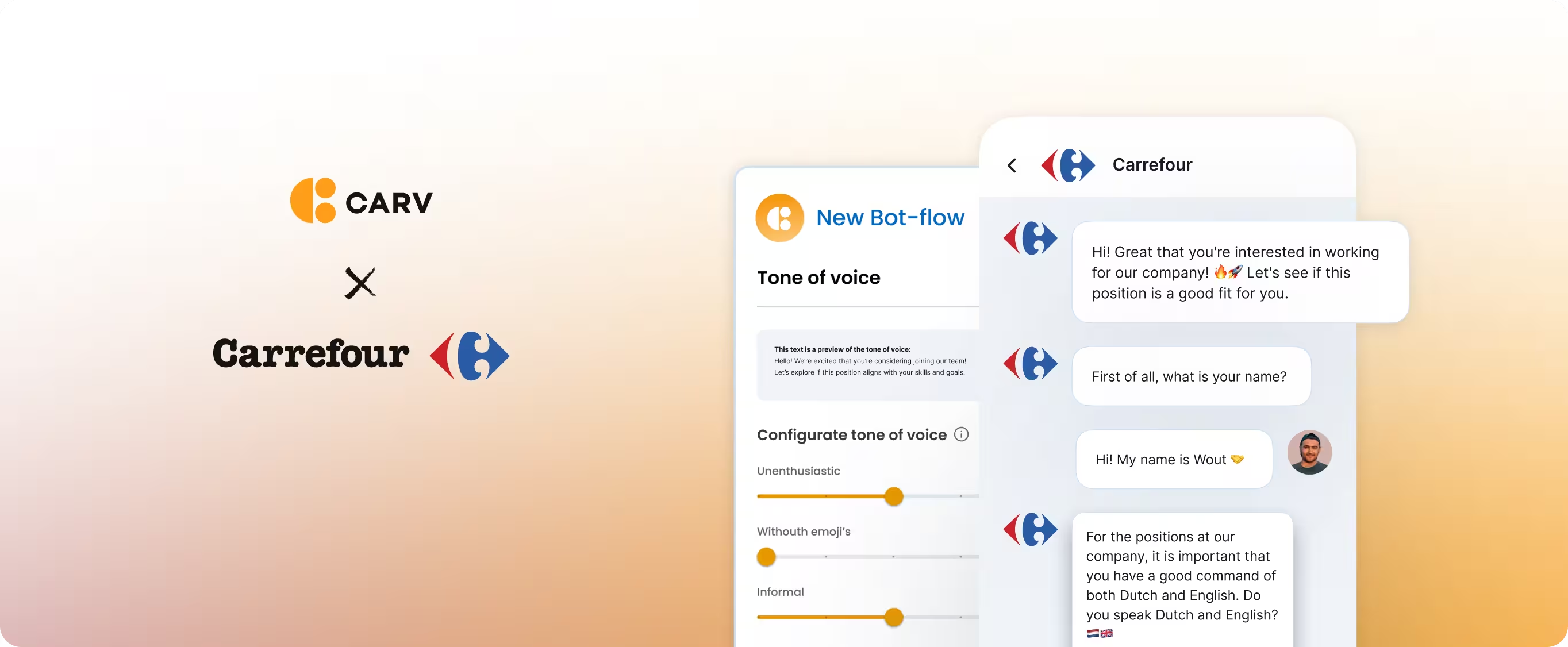
Carrefour partnered with Carv to explore how conversational, agentic AI could be embedded directly into its existing hiring operation, without disrupting store workflows or core systems.
Rather than positioning AI as a front-end experiment or a standalone chatbot, the focus was on operational reliability: ensuring that every candidate received a response, that qualification happened consistently, and that managers only engaged when it mattered.
Carv’s conversational agents were integrated with Carrefour’s existing SAP environment, allowing AI to operate as part of the hiring process rather than alongside it. From the moment a candidate applied, the system took over initial engagement – asking questions, clarifying availability, screening for basic criteria, and guiding candidates through next steps.
Crucially, this interaction happened on the candidate’s terms. The system operated continuously, across evenings, weekends, and peak periods, adapting to different languages and local requirements without slowing down.
When candidates were ready for the next step, interviews were scheduled automatically, with reminders sent to reduce drop-off and no-shows. Store managers were brought in at the right moment without being responsible for keeping the process alive.
The impact: a fast, predicable, and consistent hiring engine
The impact of this shift was felt across the organization. For store managers, recruitment stopped being a constant background task. Administrative coordination was absorbed by the system, allowing managers to focus on running the store and engaging with candidates when it truly mattered.
For candidates, the experience became faster, clearer, and more respectful of their time. Applications no longer disappeared into silence. Questions were answered immediately. Next steps were visible. The hiring journey began to resemble the responsiveness candidates already expected from the Carrefour brand as customers.
At an organizational level, hiring became more predictable and easier to scale. Processes were applied consistently across locations, without forcing stores into rigid workflows or additional training overhead. As demand fluctuated – by season, region, or store format – the system absorbed volume without creating bottlenecks.
Looking ahead
Carrefour’s journey with AI-driven hiring is ongoing. What began as a way to relieve pressure on store managers has evolved into a broader shift in how hiring is supported across the retail operation.
By embedding intelligence directly into the hiring flow, Carrefour has taken a meaningful step toward a model where recruitment adapts to retail realities.
As the organization continues to evolve its intelligence strategy, hiring is no longer treated as a manual dependency or an operational risk, but as a system that can scale, respond, and support the business in real time.
About Carv
We believe retail hiring should be human work, powered by intelligent systems.
In retail, every hour on the floor matters. Our technology takes on the repetitive, high-volume tasks that slow hiring down and pull store managers away from operations – so people can focus on leading teams and serving customers.
Carv’s platform connects the three forces that define retail hiring at scale: candidates, store teams, and the organization.
For candidates – who are often also your customers – our conversational agents deliver a fast, transparent, and always-on experience. They meet candidates on their time, guide them through the process, and ensure every interaction reflects the brand behind it.
For store managers and hiring teams, Carv removes administrative burden from the hiring process. Our agents handle engagement, screening, scheduling, and follow-up automatically, allowing managers to stay focused on the store while meeting only qualified, ready-to-hire candidates.
And for retail organizations, Carv acts as the intelligence layer across locations. We unify data, workflows, and decision-making across systems – enabling consistent hiring standards, better talent routing, and real-time visibility without sacrificing local autonomy.
Retail moves fast. Hiring should too. Carv makes that possible.