

%20(1).avif)


Recruiters aren't short on tools. They have applicant tracking systems (ATS), candidate relationship management (CRM) apps, scheduling platforms, sourcing software, and more.
The problem is that these tools don’t communicate well with each other, so hiring teams spend more time managing the stack than moving top candidates through the hiring process.
AI recruiting assistants change the narrative. Rather than adding another layer to an already fragmented workflow, the best ones replace the entire thing. In this article, we explain what AI recruiting assistants are, how they work, and the many benefits for hiring teams.
What is an AI recruiting assistant?
An AI recruiting assistant is an AI-powered tool that automates tasks across the entire recruitment process, from sourcing and screening to scheduling and follow-up.
AI recruiting assistants are different from the tools recruiters already use. For example, the ATS tracks candidates, while the CRM manages relationships. Then there are a variety of point tools that solve one problem each, such as job boards or onboarding software.
An AI recruiting assistant sits above these apps, using artificial intelligence to streamline handoffs, reduce bottlenecks, and help recruiting teams make better hiring decisions in less time.
Why traditional recruitment tools fall short
Most recruitment software is designed to make individual steps faster, not connect them. These tools worked in the past, when hiring was simpler. Today, they create compounding problems.
- Too many tools: Hiring teams juggle multiple platforms – none of which share data. This forces recruiters to do manual data entry to bridge the gaps between systems.
- Manual data entry: This task isn’t just tedious. It wastes time that recruiters could spend evaluating qualified candidates and building relationships with top talent.
- Context loss: When candidates move from sourcing to screening to scheduling, recruiters lose valuable context. The next person in the chain can’t access details from previous stages.
- Slow candidate movement: Every manual handoff adds lag. In competitive markets, that lag often costs hiring teams the best candidates, and time-to-fill metrics go up.
The evolution: Tools to assistants to agentic systems
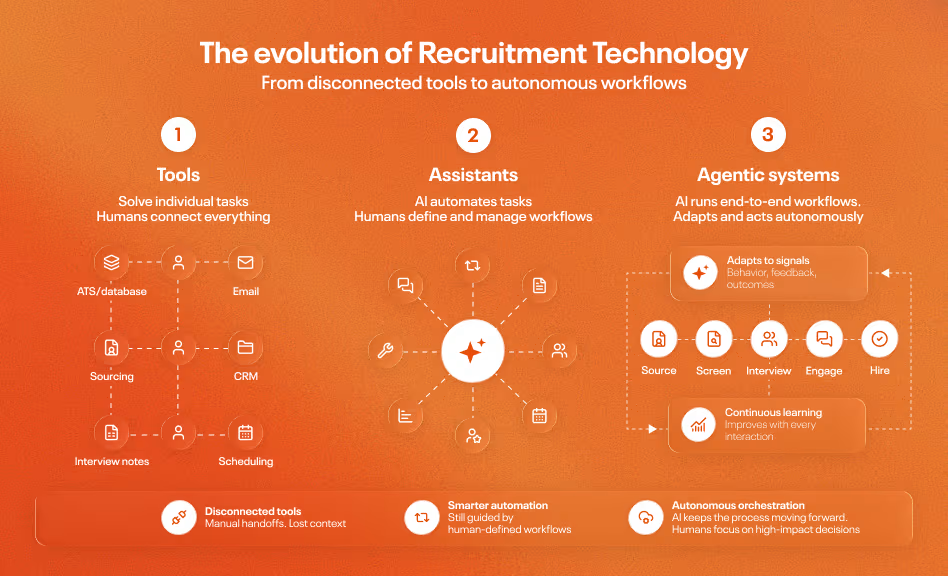
To understand where AI recruiting assistants fit in the hiring process, you must first understand how recruiting technology has evolved. Here is a quick overview:
Tools
Recruitment tools solve solitary tasks. An ATS stores applicant data. A scheduling tool books interviews. A sourcing tool finds candidates via industry databases, social media sites like LinkedIn, and the company’s talent pool. Meanwhile, a human recruiter coordinates everything in between.
Assistants
AI recruiting assistants automate duties that previously required manual effort. They screen resumes, schedule interviews, send follow-ups, and surface best-fit candidates without waiting for a recruiter to trigger the next step. As such, they reduce repetitive tasks and increase productivity. However, assistants still operate within a workflow that humans must define and manage.
Agentic systems
Agentic systems run end-to-end workflows, responding to signals, adapting to candidate behavior, and maintaining momentum across the entire recruiting process without human intervention. When a candidate applies, the system engages immediately. When a candidate goes quiet, the system follows up. This is the next stage of AI recruitment, and it represents a real leap in technology.
Types of AI recruiting assistants
The category covers a wide range of functionality. Here's how the main types break down:
- Sourcing assistants: These assistants search job boards, social media sites like LinkedIn, and internal talent pools to surface top talent for open roles.
- Screening assistants: These assistants evaluate resumes and applications against defined criteria. That way, hiring managers spend more time with candidates who fit.
- Interview assistants: These assistants support AI interview workflows with structured guides, real-time note capture, and post-conversation summaries.
- Admin assistants: These assistants write job descriptions, update records, and maintain compliance documentation to keep hiring systems in sync.
- Scheduling assistants: These assistants automate interview scheduling tasks. Doing so eliminates the back-and-forth emails that often extend the recruitment process.
- Engagement assistants: These assistants manage real-time communication with job seekers via chatbots and automated follow-ups, which reduce drop-off at every stage.
- Analytics assistants: These assistants track pipeline health, candidate engagement, and time-to-hire, so recruiting teams have the visibility they need to catch problems early.
How do AI recruiting assistants work? An end-to-end system
The best AI recruiting software is a layered system in which data flows in, gets processed, triggers actions, and produces usable outputs – all without human involvement.
It starts with the input layer. The system ingests data from resumes, recorded calls, ATS records, job descriptions, and historical hiring data. This is the foundation for everything else.
Next comes the processing layer. Natural language processing (NLP) reads and interprets unstructured inputs like resumes and interview transcripts. Scoring models evaluate candidates against role requirements, while automation logic determines what should happen next and when.
Then there's the action layer. Based on processing, the system takes action without waiting for a human, screening applicants, scheduling interviews, sending initial outreach and follow-up messages to candidates, and directing hiring managers to the best talent.
Finally, we have the output layer. The system surfaces insights, generates reports, and delivers decision-ready information. Instead of digging through data, recruiters receive clear information about where every candidate stands and what they should pay attention to.
The benefits of AI recruiting assistants
There are many benefits to using AI recruiting assistants. Some of the more powerful ones are:
- Faster hiring cycles: By automating the steps between application and offer, you can compress time-to-hire and reduce candidate drop-off.
- Reduced admin: Scheduling, data entry, follow-ups, status updates. AI handles these tasks at scale, which allows hiring teams to focus on higher-value work.
- Improved candidate experience: AI recruiting assistants also reply faster and more consistently than most hiring managers, which candidates appreciate. This is especially important in high-volume hiring scenarios where candidates are also customers.
- Consistent evaluation: Structured interviews and standardized scoring – staples in AI-powered hiring workflows – reduce unconscious bias and improve hiring decisions.
- Scalable hiring: Whether your team needs to hire 10 people or 10,000, AI recruiting tools can maintain the same level of consistency and speed throughout the recruitment cycle.
- Stronger employer brand: Finally, a well-run hiring process will reflect well on your organization, while a positive candidate experience builds long-term brand equity.
The limitations and risks of using AI recruiting assistants
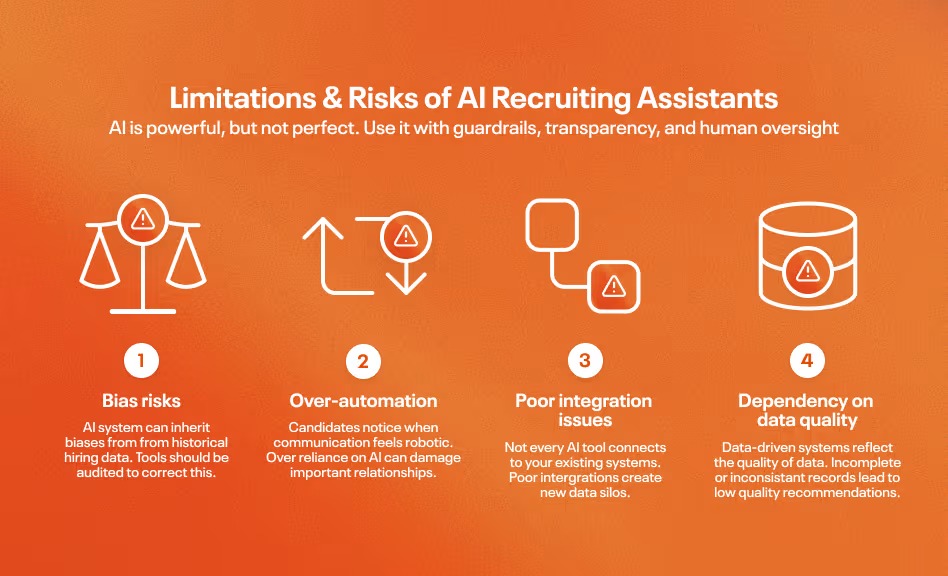
Of course, AI recruiting assistants have limitations, and using them carries risk. Here are four risks you should be aware of before you use AI technology to hire new employees:
- Bias risks. When AI systems are trained on historical hiring data, they can inherit the embedded biases. Recruitment automation tools should be audited to correct this.
- Over-automation. Candidates notice when communication feels robotic. An over-reliance on AI throughout the recruitment process can damage important relationships.
- Poor integration issues. Not every AI recruiting tool will connect to your existing system. Poor integrations create new data silos, which you must guard against.
- Dependency on Data Quality. Data-driven systems reflect the quality of data they run on. Incomplete or inconsistent records lead to low-quality recommendations.
AI recruiting assistants vs. AI recruiting platforms
An AI recruiting assistant handles task execution. It screens resumes, sends messages, books interviews, etc. It reacts to events and completes discrete actions within recruitment workflows.
An AI recruiting platform handles workflow orchestration. It connects candidate profiles, video interviews, assessments, and outreach into a unified operating layer. Then, it manages the decision-making logic that determines how each element interacts with the others. Rather than executing one task at a time, platforms coordinate and optimize the full sequence.
For complex, high-volume hiring, the difference between a capable assistant and a true platform is obvious, helping brands hire the best candidates in less time.
How Carv's agentic AI improves talent acquisition
Most AI recruiting tools bolt automation onto an existing process. Carv functions as an agentic layer across the entire hiring workflow, from first contact to final placement.
Rather than replacing one step with a smarter tool, Carv deploys specialized agents to handle specific recruiting tasks, like screening, scheduling, engagement, admin, or talent pool management. It then coordinates these agents to achieve high-volume hiring at scale.
For teams that manage many candidates across multiple roles or locations, our end-to-end coverage holds up in high-pressure situations, when demand spikes.
Carv also tackles admin elimination in a concrete way. Teams that use our platform can take on more volume without adding headcount. The system simply absorbs the repetitive work that typically limits recruiting capacity. If your organization wants to move fast, improve talent pool quality, and maintain candidate experience, Carv provides the hiring infrastructure you need.
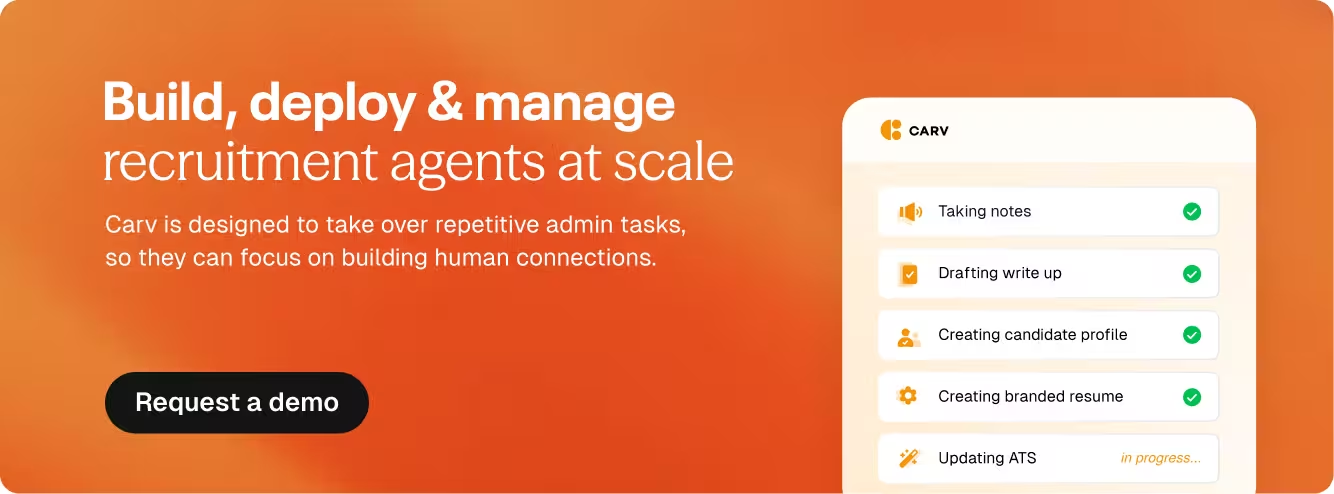
Request a demo of Carv today to see if our platform is right for your company.
.avif)
