


%20(1).avif)


Most TA organizations adopt AI expecting it to transform the way they work. And they’re not wrong to expect that. After all, the headlines say that AI is going to redefine the way we work, right?
Well yes, but there’s nuance to that. Technology on its own doesn't change how an organization functions; the operating model does.
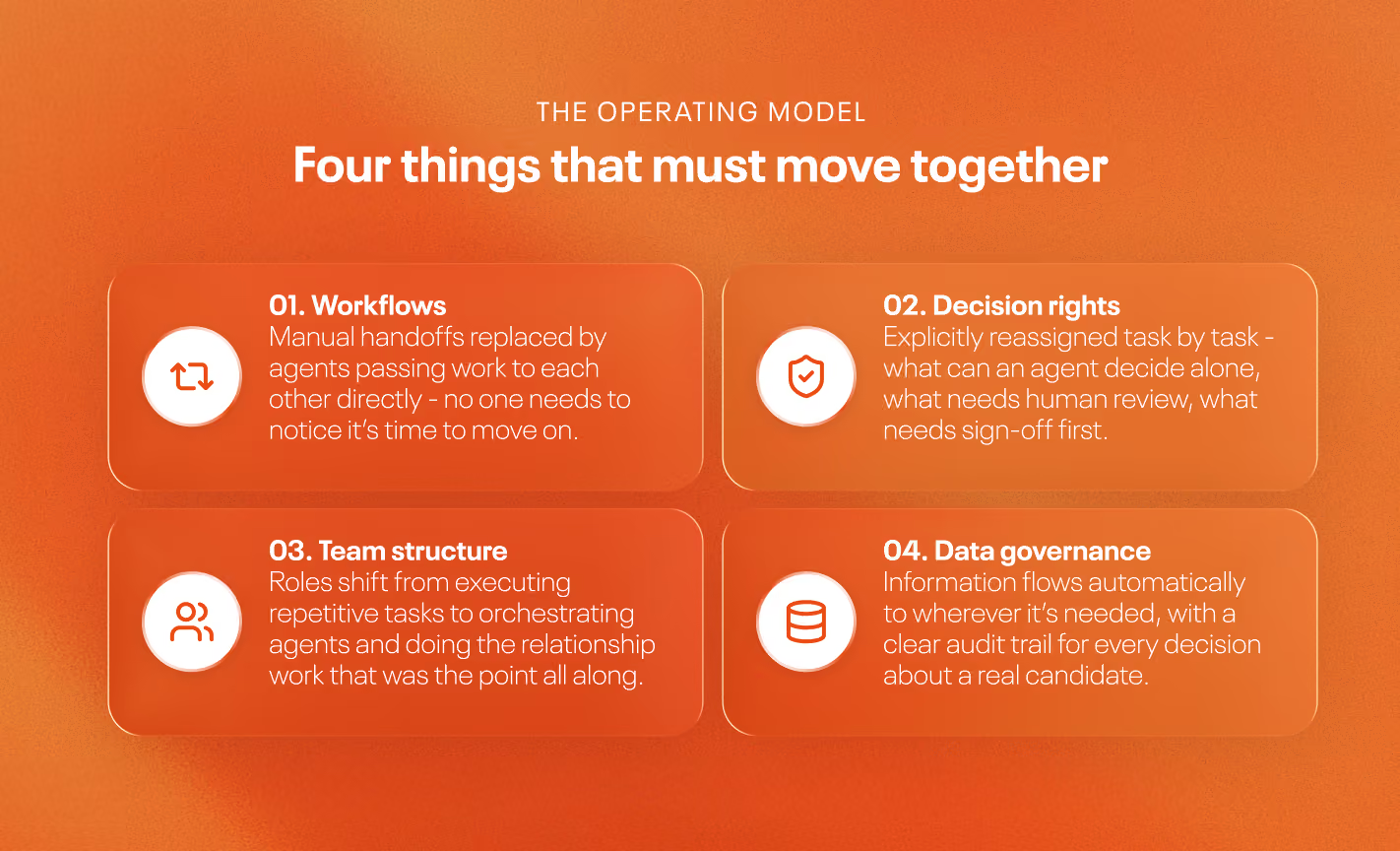
And by “operating model” I mean (1) how work actually flows, (2) who or what makes each decision, (3) how teams are structured and measured, and (4) how data moves between systems.
A successful rollout of AI is one where all four of those change, but getting these pieces to move together does not start at technology.
The prerequisite question
Throughout the AI implementation lifecycle, there's one question that determines whether any of these things actually change, or whether the operating model stays exactly as it was. And that question is should this task exist, and should it be done by a human?
Take screening, for example. It is a necessary step in recruitment, but does it need to be done by a human?
If that task is handed over to AI, what happens to how work flows, to how data moves between systems, to how decisions get made? That's the actual question: what shifting one task does to the operating model underneath it, not just to the task itself.
Everything a successful AI transformation and rollout needs, downstream, follows from answering this question, repeatedly, before any technology gets deployed.
.avif)
What follows, once you answer it
Once you have that answer, the real work starts: knowing that not all tasks should exist and not all tasks require human input, you can rethink your process and workflows in a way that redistributes the work between people and AI agents.
That redistribution is the foundation real transformation is actually built on. And once it starts, the four components mentioned above move in the same direction:
Workflow changes first. In the old model, work moves through a series of handoffs: a recruiter completes a step, then manually initiates the next one. Once you've decided a step doesn't need a human, there's no reason for it to wait on one. An intake agent triggers a sourcing agent, which triggers engagement, which triggers screening, without a person having to notice it's time for the next step and start it. The workflow stops being a chain of manual triggers and becomes a continuously running system.
Decision ownership changes next. Most organizations avoid this part, because it means committing to an actual answer instead of leaving it vague. Which decisions does an agent make outright? Which decisions require a human before things move forward? Getting this right means most of an organization's people end up positioned above the recruitment process, steering and handling exceptions, rather than inside every step of it.
Structure follows decision rights. Once you know what agents own outright, the org chart built around humans owning everything stops making sense. People move from doing repetitive tasks themselves to managing agents, handling exceptions, and spending more time on the relationship work that was the real point of the job.
Governance and data structures have to change too, because a redesigned model needs a different relationship with data than the old one did. Instead of information sitting in whichever system a person happened to update last, it needs to flow automatically to wherever it's needed, with a clear audit trail for anything that influenced a decision about a real candidate.
This is also where compliance obligations actually get satisfied or missed; an operating model with unclear data flow is much harder to audit than one designed with traceability built in from the start.
That same data has another job once agents are doing part of the work: it has to measure performance for both humans and AI. Most recruitment KPIs were built to track people, calls made, time to respond, placements closed, and none of them were designed with an agent in mind.
Once agents own part of the process, those KPIs need to expand into a shared framework that tracks an agent's outcomes alongside a recruiter's performance. Without that, there's no way to actually tell whether the redesign is working, only a sense that some things got faster.
None of these four are independent decisions. They're what happens, in sequence, once an organization embarks on the transformation journey.
Why transformation needs both design and discovery
Organizations sometimes hope that if they adopt enough individual AI tools, an operating model redesign will emerge on its own, as a byproduct of accumulated automation.
It doesn't. Each tool optimizes its own slice, and slices don't self-assemble into a coherent operating model. They accumulate into the fragmented stack that becomes its own problem a year or two later, because nobody with the authority to redesign anything was ever asked the actual question.
Our ManpowerGroup TalentSolutions collaboration is an excellent illustration of design over discovery because the team addressed this directly before any part of the new system was deployed.
Business leaders, recruiters, and technologists sat together to map the existing process and, task by task, decided which parts belonged to agents and which stayed with people.
The resulting model, with coordinated agents embedded into their existing platform, didn't happen by accumulating enough point solutions. The team designed the system end-to-end before any of it went live.
The mandate that decides who wins
The design part is, in a way, the easier half. The harder half is that a redesigned operating model doesn't get implemented unless someone with real authority forces it through.
That's because a new operating model, more often than not, surfaces some uncomfortable realities. A role someone has held for years might become redundant, and a process or tool that leaders heavily invested in might turn out to have been the wrong call.
Redesign on paper is easy. Redesign that actually changes workflow, decision rights, structure, and data requires someone willing to make those tough calls.
Many organizations won't. They'll buy an agent or two, bolt them onto the existing workflow, leave decision rights where they've always sat, and call it transformation. It won't be. It'll be the same way of working, just slightly faster and slightly more expensive to run, and the gap that creates is bigger than it looks.
An organization running the old model with AI bolted on top gets marginal gains. An organization that redesigns the model gets something categorically different: recruiters spending their time on judgment and relationships instead of admin, more roles filled per recruiter without adding headcount, and a cost structure that doesn't scale linearly with volume anymore.
That's a different ceiling on how much the business can grow, and in a market where every competitor has access to roughly the same AI within a year or two, that gap is what actually separates winners from everyone else.
So if you're rolling out AI for your recruitment function right now, and want to make sure you get this right, we're happy to guide you through it.
.avif)