

%20(1).avif)


Most enterprise TA teams are already in the process of adopting AI, but very few have the luxury of replacing everything at once. Recruitment at this scale runs across multiple regions, role types, and systems, which means there's no version of adoption where a team simply flips a switch and runs it all through an AI-driven process on day one.
For this reason, how the implementation is approached and structured is crucial for future success.
In this article, we'll look at how to properly phase a deployment for enterprise reality: How to sequence it, how to validate it, and how to bring the organization along with it.
Why enterprise deployments need to be staged
An enterprise recruitment operation isn't one process. It's several, running across different systems and levels of maturity, and that's true whether or not AI is involved. A full replacement, done in one motion, treats it as a single process anyway, which is why it doesn't hold up at this scale.
Staging is the alternative: instead of one commitment covering the whole operation, the rollout gets broken into stages, each scoped to a part of the operation that can actually absorb it, and each producing proof the next stage can build on.
But staging only works if two things are in place before it starts.
The first is a clear picture of the whole journey, not just the next stage. Where the operation stands today, where it needs to get to, and how to move between the two, mapped in both big lines and detail. Without that, each stage risks solving for itself instead of for the destination.
The second is a plan for what has to change alongside the technology: ways of working, tech infrastructure, and how teams are structured and work day to day. Staging manages the risk of the rollout. It doesn't manage the risk of the organization failing to change with it, that has to be built in on purpose.
So let's take these one by one and look at how to properly phase an enterprise deployment.
Start with the full picture, then sequence by leverage
That first requirement, a clear picture of the whole journey before any stage begins, is where the actual implementation work starts.
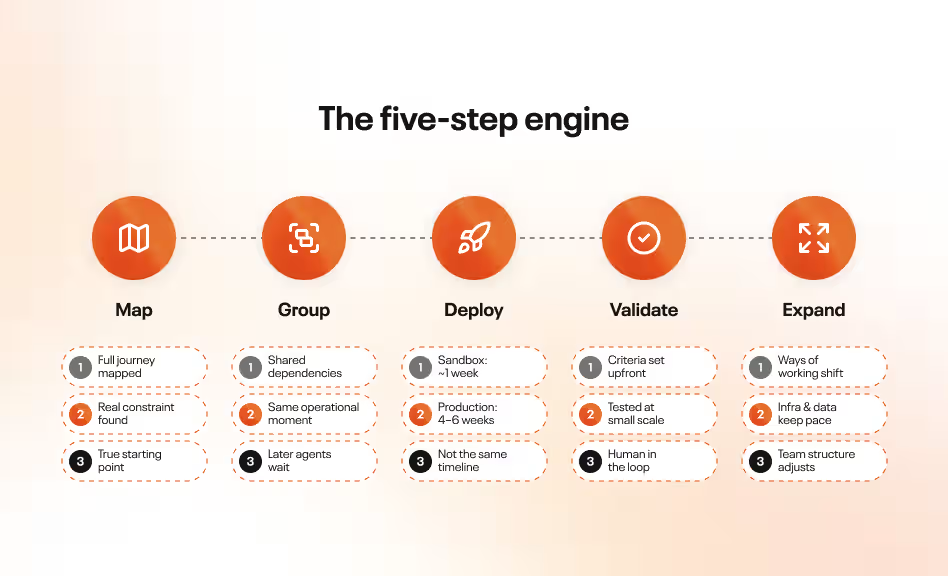
In practice, it involves mapping the recruitment process end to end, across every system a candidate or recruiter touches and every handoff between one step and the next. This has to happen before any agent gets chosen, because the map is what tells you where the process consistently loses momentum. Not where it's slow in general, but where a handoff, a wait, or an inconsistency between teams or locations repeatedly costs time or candidates.
Once those points are visible, the next decision is what the first phase of deployment should actually cover. The instinct is to follow the candidate journey in order, but the stronger approach is to start wherever the operation's real constraint sits, and that isn't always the same place:
- In high-volume, entry-level hiring, the constraint is usually upstream: speed of response and screening capacity, since that's where the most drop-off happens.
- In staffing, where a single candidate can match several open roles at once, the constraint is often on the matching side rather than the front door, since the volume problem isn't incoming applications but the difficulty of placing people fast enough.
- For senior or specialized roles, the constraint is frequently an existing but underused talent pool rather than new applicant volume at all.
The pattern across all three: the first phase belongs wherever volume, drop-off, or matching complexity is actually concentrated for that operation, not wherever the candidate journey happens to start on paper. Two organizations in the same industry can have different answers, and mapping the process is what makes the difference visible instead of assumed.
Once that starting point is set, the rest of the phases aren't arbitrary either.
Agents tend to group by dependency and by function, not by convenience. Some naturally sit in the same phase because one can't do its job without the other already running: a scheduling agent has nothing to act on until a screening agent has produced a shortlist, so the two get deployed together rather than staggered.
Others group because they serve the same operational moment even if they touch different systems: in retail or logistics, response and screening agents usually launch as one phase because they're both solving the same upstream constraint.
Agents further down the journey, like talent pool re-activation, rediscovery, or onboarding, tend to land in a later phase almost by default, since they depend on a working pipeline of candidates and clean data to act on, which earlier phases are what generates.
That sequencing logic is what turns a list of agents into an actual roadmap, one where each phase is buildable on what the last one delivered.
None of this sequencing means anything, though, until it's actually tested. The next question is what proves a phase is ready to expand.
Validate your hypothesis before you scale
A phase being live isn't the same as a phase being proven. Staging only produces the evidence it's supposed to if that evidence is actually collected on purpose, not assumed because nothing obviously broke.
That starts with agreeing on what success looks like before the phase runs, not after. Without criteria set in advance, a result can be read as a win or a problem depending on who's looking at it, and expansion ends up resting on impression instead of proof.
Defining the threshold upfront - response time, screening accuracy, time saved per hire, whatever the phase is actually meant to move - is what makes the result usable as evidence rather than just an outcome.
It also means testing at a scale the organization can actually observe closely, so that issues get fixed before the new setup runs at full volume. A failure mode that shows up once, in a controlled test, is a finding. The same failure mode showing up thousands of times in production is a problem.
That only works, though, if there's a real mechanism for catching issues and acting on them, not just running the test and hoping nothing goes wrong. This means having a way to flag when something doesn't go as expected, route it to the right person, and make sure it gets resolved before the next batch runs into the same thing.
It also means having a human in the loop on any decision that carries legal, compliance, or candidate-impact weight, since that's not a place where "the test went fine overall" is good enough.
Put together, these three things are what turn a completed pilot into an actual answer to whether a phase is ready to scale:
- Success criteria agreed before the phase runs, not after
- Testing at a scale the organization can observe closely, before it runs at full volume
- A live mechanism to catch, route, and resolve issues, with a human in the loop on anything carrying legal, compliance, or candidate-impact weight
That answer is also what decides the pace of everything from here. A phase gets expanded because the evidence says so, not because six months have passed since the roadmap was signed off.
But evidence that a phase works is only half the picture, the organization receiving it has to be ready to work with it too. So here’s where the change management part comes into play.
Keep the operating model moving at the same pace as the deployment
A validated phase that lands on an unchanged operating model doesn't scale, it stalls. Proof that the technology works isn't the same as the organization being set up to work with it, and the second usually gets left for whenever the first forces the issue. At that point the change is reactive instead of planned, and the gap between what the system can do and what the team is actually set up to do with it is already costing time.
That readiness plays out on three levels:
- (1) ways of working, who owns decisions once a task no longer needs a person,
- (2) infrastructure and data, whether the systems underneath can support an agent doing the work,
- (3) team structure, how the team itself is organized to work alongside it.
Keeping pace means all three move in the same increments as the deployment, not as a separate project that catches up afterward. Each phase that goes live should come with its own answer to a specific question: now that this task doesn't require a person to run it, who owns the decisions around it, and what does that person's day look like differently as a result?
That answer needs to exist before the phase goes live, not once someone notices the old job description no longer matches the actual work.
The same logic applies to infrastructure and data. A phase that hands a task to an agent also hands that agent a dependency, on clean, current data to act on, and on systems that can support write-back in real time rather than a person catching up on notes at the end of the day.
If that groundwork isn't in place by the time the phase launches, the agent inherits the same data gaps a person was quietly working around, and the phase underperforms for reasons that have nothing to do with whether the technology works.
Team structure follows the same pattern. As agents take on more of the process, the shape of the team managing it changes too: fewer people doing the process by hand, more managing exceptions and the agents handling the routine cases. That shift has to happen in step with each phase, not after it, or the team ends up managing a process that no longer matches the role it was built around.
Now, we said in the beginning that both the process and the operating model have to be mapped before any practical implementation work starts.
The process can be mapped in full detail upfront because it already exists to observe. The operating model can't, because how work gets done under agents doesn't exist yet to observe, it only becomes clear once a phase is running and generating evidence. So the operating model gets planned at the big-lines level upfront, and the detail, specific handoffs, ownership, team adjustments, gets filled in phase by phase, as each one goes live.
Alright, one more thing before we wrap up: what to actually expect on timing, since that's where a lot of otherwise well-planned rollouts run into a different kind of trouble.
Don't mistake sandbox speed for a production timeline
Configuring a phase in a sandbox environment is fast. Once the scope and the flow are agreed, building the integration in a test environment typically takes about a week. That's true even for a phase with real complexity behind it, because a sandbox is working against a controlled version of the data and doesn't have to hold up under production load.
Moving that same phase into full production, or running it alongside a broader ATS migration, is a different timeline entirely. That work typically runs four to six weeks, and the difference isn't the complexity of what's being built, it's everything that comes with a live environment: real data migration, integration with systems already in daily use, and the operational dependencies that only show up once something is actually running at scale.
The practical implication is that a fast sandbox result doesn't mean production is a formality that follows automatically. Confusing the two leads to timelines that look achievable on a slide and then slip the moment a phase moves toward go-live.
Planning for both timelines separately, rather than treating the sandbox result as a preview of production speed, is what keeps the rest of the roadmap credible once a phase actually launches.
The full picture is the risk management
It's easy to be drawn toward whichever solution promises the fastest, simplest-looking deployment. On paper, that looks like the lower-risk choice: fewer steps, a shorter timeline, less to plan for upfront.
But a full AI deployment touches everything from infrastructure and team structure to the candidate journey. When the full picture isn't clear from the start, the consequences don't show up early, when they're still cheap to fix. They show up later, once a phase is live and the gaps in planning have already become gaps in the operation.
That's why the two requirements this article opened with matter as much as they do. The full picture, mapped in detail before anything goes live, and the plan for how the operating model changes alongside it, separate a deployment that holds up under enterprise complexity from one that only looked simple before it started.
A phased deployment accounts for what the faster-looking option leaves out.
If you’re in this process and mapping out what agentic recruitment could look like for your own organization, we're happy to help you work through it.