
%20(1).avif)


For the past decade, enterprise talent acquisition teams have largely followed the same strategy when building their recruiting technology stack: choose the best solution for each individual problem and connect everything together through the ATS.
A sourcing platform from one vendor. A CRM from another. Interview scheduling, assessment tools, and analytics from several more. Every application had a specific responsibility, and as long as data flowed between systems, the overall process remained intact.
As artificial intelligence becomes a foundational part of recruiting, enterprise leaders face a choice between two ways to adopt it: keep the point solution approach and layer AI tools on top of their existing stack, or replace the separate tools with a single end-to-end AI platform.
Until recently, AI point solutions were the only option on the table. End-to-end AI platforms are a newer category, so the natural entry point was adding an AI tool wherever a gap existed, one at a time.
That's no longer the only path forward, and at enterprise scale, it's no longer the better one.
Why AI introduces new architectural challenges
Before we dive into system design choices, let's first understand why working with AI recruiting tools is so different from working with traditional recruiting software.
For most of the software era, the question of how tools work together had a simple answer: exchange structured data through integrations, with a person in between for coordination.
Data from a candidate interview was captured manually by a recruiter and added as notes to predefined ATS fields that a scheduling tool or a CRM could later read. The systems never had to understand the interview itself. They only had to read what a person had already interpreted and typed in.
AI can work directly with the interview itself. It can listen to the conversation and pick up that a candidate mentioned being open to relocating, or that they can only start after a certain date, details that never made it into a structured field, because no field existed for them.
Instead of waiting for a recruiter to interpret and type that in, the AI captures it directly, as part of understanding the conversation itself, and makes it available for whatever comes next. So the next tool in the process, interviewing, assessment, scheduling, and so on, already has this context available, whether or not a recruiter is there to coordinate.
So AI changes how tools work together on two levels.
- The first is context, or what gets exchanged: AI generates reasoning, not just data, and that reasoning has to go somewhere.
- The second is coordination, or how context gets exchanged: getting that reasoning to the system that needs it next is a separate question from generating it in the first place.
Now, whether AI actually addresses both challenges depends on how it's deployed, and this is the architectural choice TA leaders need to think through when choosing between AI point solutions and end-to-end agentic platforms.
.jpg)
Why point solutions leave both problems unresolved
An AI point solution is a standalone tool that does one job well and stops.
An AI interview assistant, for example, can understand the full context of a candidate conversation and can generate summaries or insights, but that data stays locked inside the tool that produced it.
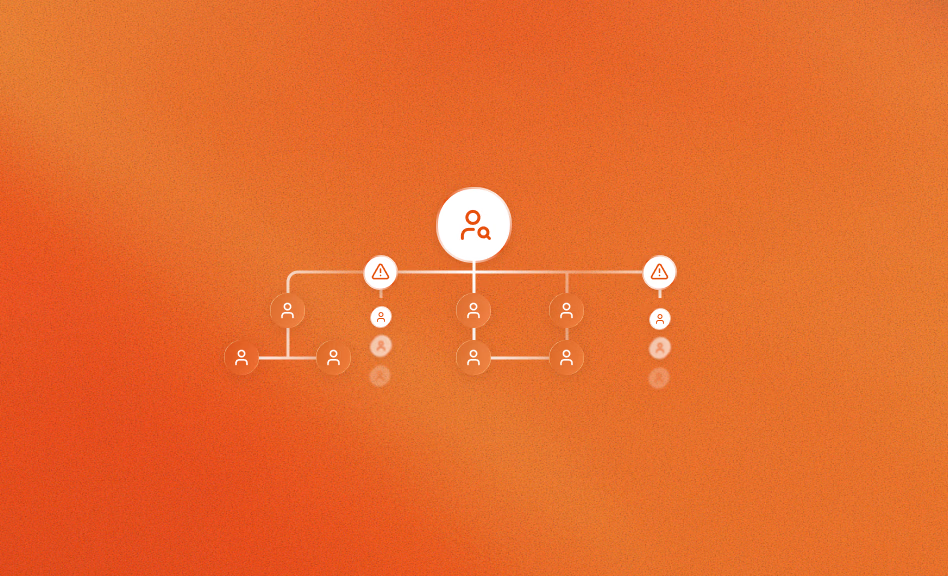
That leaves the context problem unresolved. The interview tool understands the candidate, but nothing beyond it does. And because that reasoning never leaves, the coordination problem isn't resolved either. A person still has to read the summary, transfer it to the ATS, and process it in whichever way needed for the next tool.
The same gap shows up in scoring and assessments. An AI assessment tool can produce a strong score along with the reasoning behind it, where a candidate showed strength, where they hesitated, but by default it only outputs the score.
If that reasoning never gets passed along, and the candidate later doesn't pass the interview, nobody downstream ever finds out why a good score didn't translate into a good fit. The only way around that is a recruiter manually transferring the full context from the assessment tool to the ATS, which is exactly the coordination problem the AI tool was supposed to remove.
Now, at low volume, these issues might not register. An AI point solution might seem like a good option in isolation, because it does exactly what it claims: it produces a sharper summary, a better score, faster scheduling, one candidate at a time.
At scale, though, that same work multiplies across every recruiter and every candidate at once, and there aren't enough hours in a recruiter's day to manually carry context between tools for every handoff.
So it's not that the AI tool is bad in itself. The real issue is that stitching AI point solutions onto a traditional stack solves neither the context nor the coordination problem, it just moves both further downstream.
A best-of-breed AI stack doesn't solve this either
Now, you might think both problems can be solved by buying AI tools that are more sophisticated and can communicate with each other. After all, AI point solutions, despite specializing in one job only, can capture context and pass it along to the next tool in the stack.
In theory, that's correct. An assessment tool could hand over its entire reasoning as structured data, not just a score. An interview tool could pass all the context about a candidate not just to the ATS but also to the scoring tool. If that happened, the context problem would be solved, and the coordination problem would go with it.
In practice, they rarely do. Each vendor, at best, builds its integration around whatever the next system in the chain is set up to receive, which is usually a status update or a field, not a reasoning trail nobody asked for.
Most point solutions don't even offer that much, because they were never built with an API designed to expose their reasoning in the first place, only the output a person is expected to read. That means the context problem stays exactly where it was, and with it, the coordination problem too.
That's a design choice, and it's one every point solution vendor makes independently, with no shared incentive to standardize on passing more than the minimum.
So even a stack of excellent individual tools AI still routes its reasoning through a person, not because this way of working is impossible to avoid, but because nobody building point solutions cares about or is responsible for solving the coordination issue within the final stack.
This is why swapping in more capable AI point solutions, one category at a time, doesn't get an enterprise organization any closer to solving either problem. Each tool getting smarter doesn't fix a gap that was never about intelligence in the first place.
Why an end-to-end platform removes the bottleneck
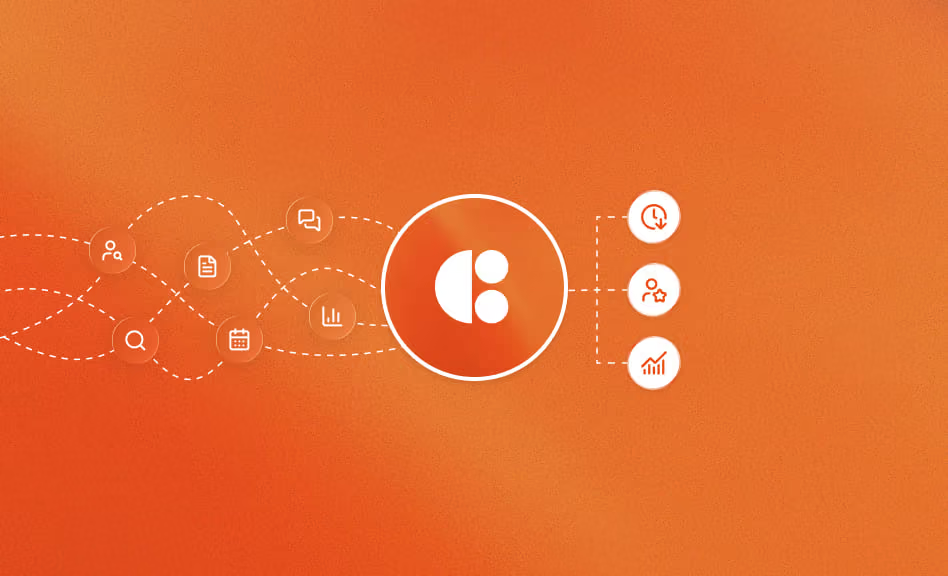
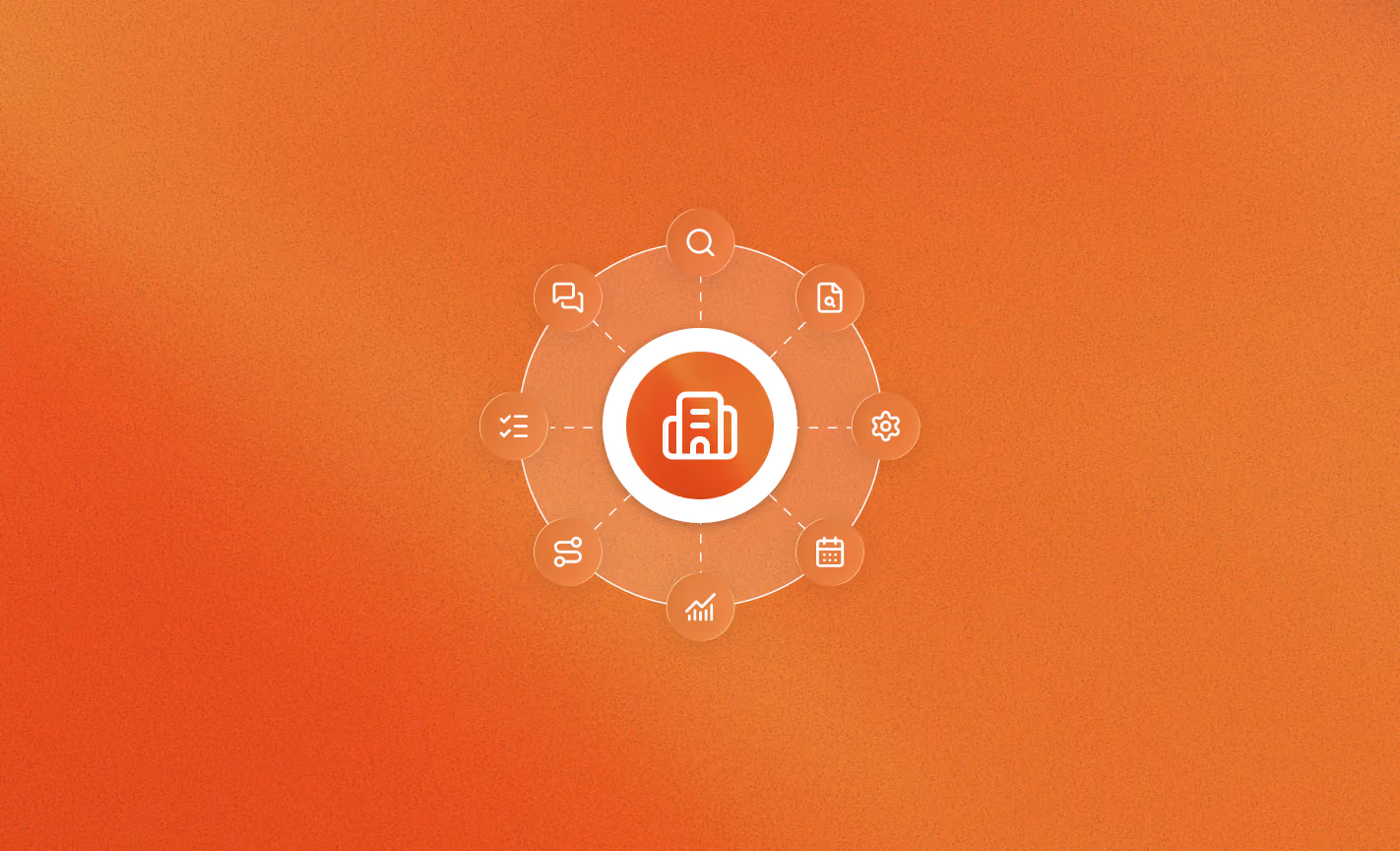
An end-to-end platform starts from a different premise. Instead of buying a tool for each task and hoping the integrations hold up, every capability, sourcing, screening, interviewing, scheduling, is built as an agent inside the same system, sharing the same memory, business rules, and candidate history from the start.
This resolves the context problem directly. An assessment agent's reasoning doesn't stay locked inside the tool that produced it, because the interview agent that picks up next already has access to it. A scheduling agent doesn't need someone to notice a cancellation and explain it, because it already has the context to understand what changed.
And because that context is already shared, the coordination problem is resolved along with it. Nobody has to notice, interpret, or carry anything between systems, because the handoff isn't a separate step that a person performs. It's built into how the system works.
None of that depends on how many recruiters are running the process or how many candidates are moving through it at once, which is exactly the constraint a point solution stack can't escape.
This also means the system gets better as it's used, not just faster. Every interaction an agent has with a candidate adds to a shared record the next agent draws on, so a recruiter isn't just getting a task done, they're building context the rest of the system can use immediately.
That's not something a stack of point solutions can be upgraded into, no matter how many of them get replaced with better versions. An end-to-end platform is the only approach that resolves both at once, which is why it's the only one that holds up at enterprise scale.
What this means for enterprise TA
AI point solutions still have a place. They're a fast way to prove a use case works and get a team comfortable with AI before committing to a bigger shift, and bolting one onto an existing ATS is often the right first move for exactly that reason.
But proving a use case and running one at enterprise volume are different problems. Bolting AI point solutions onto a traditional stack leaves both the context and the coordination problem in place, and neither one gets lighter as the organization grows. They get heavier, one recruiter and one candidate at a time.
A more sophisticated best-of-breed stack doesn't change that, because the limitation was never about how smart any single tool is. It's about whether the system as a whole was built to carry context and coordinate on its own.
That's the actual choice enterprise TA leaders are making, not which point solution to add next, but whether to keep growing a stack that depends on people to hold both problems together, or move to a platform where that dependency doesn't exist. At enterprise scale, only one of those choices holds up.