
.avif)


If you’re leading talent acquisition in logistics, you’ll almost certainly have taken a significant chance on digital transformation in the last decade.
Maybe you invested in an ATS with automation features, introduced scheduling tools, or even AI-driven screening software to handle high volumes of applicants at the top of the funnel.
So why, after all this investment, does the recruitment process still feel a bit broken?
Not broken in an obvious way: Hires are happening, shifts are (mostly) covered, and operations keep moving. But many logistics organizations are finding there’s a constant low-grade pressure where candidates still disappear between steps of the hiring process, and hiring managers are perpetually behind despite doing everything right.
We need to talk about why the AI recruitment model most logistics organizations are currently using isn’t working – and how a continuous agentic AI workflow is key to fixing it.
Why traditional AI doesn’t work for logistics recruitment
When you invest in the idea that artificial intelligence will totally transform your recruitment process, it’s frustrating when you’re still seeing candidates falling through the cracks, and the rippling impact this has on shift management.
This is still happening because recruiting in logistics is a totally different job compared to recruiting in other sectors. Unlike other types of organizations, logistics recruitment is built around shift coordination. The job of a logistics recruiter isn’t just hiring new staff, but managing complex workflows of current and future employee movement across a high-volume, multi-site, multi-shift system.
And because logistics recruitment relies on this process-driven coordination, this leaves the whole process vulnerable to breakdowns.
Most hiring technology is step-focused. It makes screening faster, scheduling easier, and communication generally better. But in logistics, candidates don't fall out during these steps, but between them.
For example, they fall out during the 24-hour window where nobody followed up on their onboarding question, so they accepted another job offer, or during the shift change that reshuffled their interview slot without telling them.
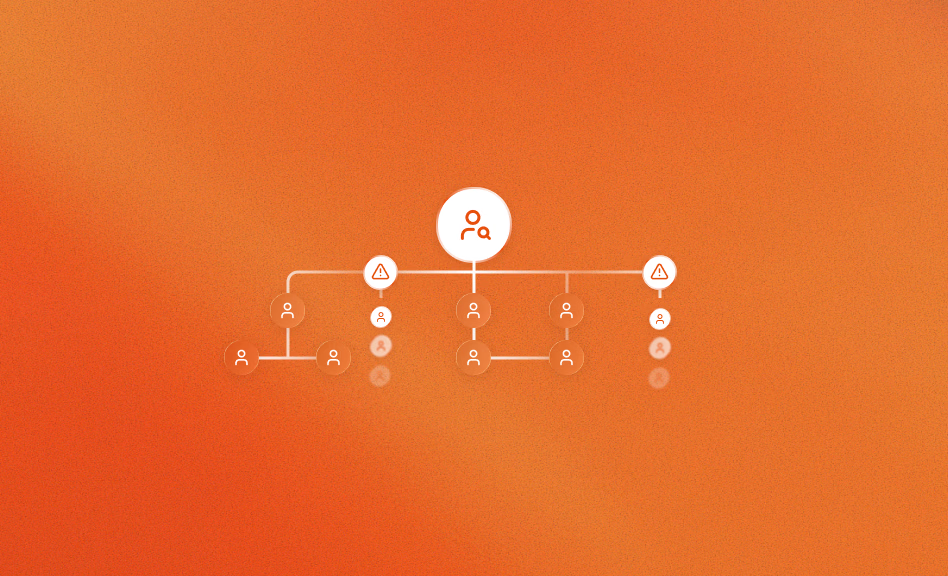
And what do these critical pressure points all have in common? They rely on a human recruiter to pick up where the AI tool left off. This is what we call the “continuity problem,” and it's a problem that’s structurally different from anything previous hiring technology has been built to address.
Of course, faster screening and scheduling is great, but not if it just exacerbates pressure points along the recruitment funnel. What logistics recruitment really needs is continuity in the process, so no candidates drop out during these critical points. In other words, we need an agentic AI model that can run the whole workflow end-to-end with almost no human intervention.
Here’s what that looks like in practice.
What an agentic AI operating model looks like
Agentic AI introduces a new operating model where recruiters go from being responsible for triggering workflows and executing tasks (like assessing screened candidates, updating the ATS, and scheduling interviews) to simple workflow ownership.
The old AI-driven recruitment model
Even when an organization has embedded AI solutions into the hiring process, the model still relies on human recruiters to fill the gaps.
For example, they’re still expected to monitor inboxes, reschedule interviews when shifts change, and update the ATS after decisions are made.
In logistics hiring (where recruiters are tasked with managing multi-site, multi-shift systems), this isn’t sustainable, no matter how many AI tools are brought in to speed up steps in the funnel. Relying on human input between stages means constantly hemorrhaging candidates along the way.
The new agentic AI system
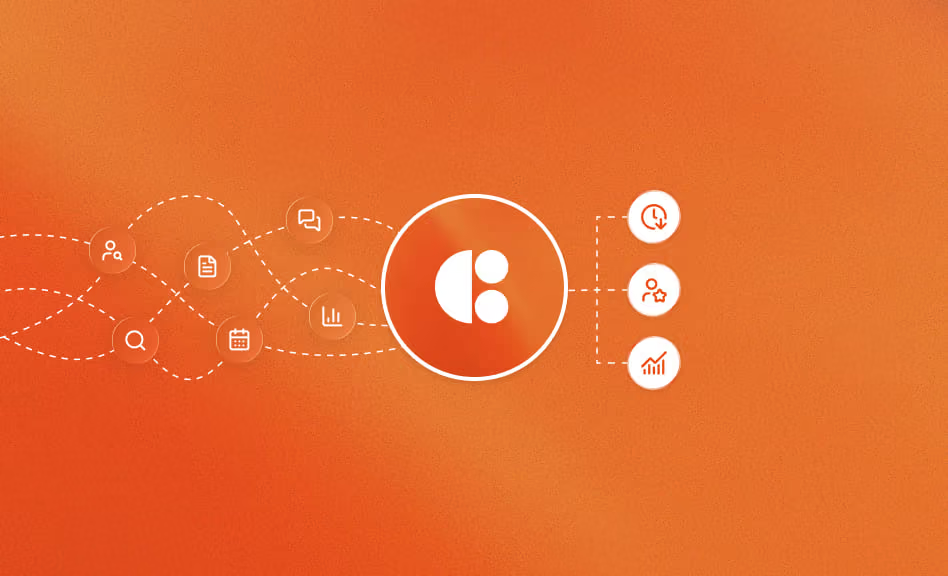
The new agentic AI logistics recruitment model is a continuous ecosystem where no human input is required between stages. Progress from one stage of the recruitment process to the next doesn’t stall until a human recruiter gets involved – tiggers are managed autonomously by AI through the orchestration layer.
This means candidates are constantly engaged with, and screening runs continuously without human input. It means scheduling adapts to shift complexity automatically.
Right now, your recruiters are the connective tissue between every step, and when they’re unavailable to step in, that’s when breakdowns happen.
With this new mode, recruiters step in only in extenuating circumstances where human judgment is required (e.g., exceptions that fall outside of your set guardrails and final hiring decisions).
When we look specifically at the common pressure points in a logistics hiring process, it becomes clear just how crucial this shift to a continuous agentic AI model really is.

7 critical pressure points in logistics hiring that require agentic AI
For AI to really work in logistics recruiting, you need an AI-powered agentic system that creates continuity across the entire end-to-end workflow, closing up these critical gaps where candidates are known to drop off.
1. Engagement ownership (Host Agent)
If there’s one clear trend in logistics hiring right now, it’s that response speed determines who wins the candidate – every time. With so much competition and candidates wanting immediate responses from employers, your recruiters are expected to have an “always-on” strategy that simply isn’t possible.
Embedding a Host Agent into your hiring workflow ensures candidates are ‘met’ instantly. From the moment they hit ‘apply’ or engage with you on one of your communication platforms, the agent will be there to answer any FAQs and advise the candidate on next steps. It can even manage proactive candidate outreach where necessary.
This engagement can happen across shifts, languages, and time zones – without the candidate waiting around for a hiring manager to have the time to respond (by which time another employer may have snapped them up).
2. Screening continuity (Screen Agent)
To keep the operational wheels of your logistics machine turning, you need candidate screening to happen continuously. If you wait to react only when a gap emerges in a shift schedule or when a hiring manager has a rare free day that they can manually review applicants, you’ll be hemorrhaging great workers left, right, and center.
With a structured screening layer in place (aka the Screen Agent), this absorbs all applications that stream in and triggers a sophisticated, autonomous screening agent that asks all candidates the same qualifying questions for the relevant role. These agents also provide a fairer and safer screening process than those handled by a human recruiter because they’re completely free of unconscious biases.
3. Coverage protection (Route Agent)
In logistics, demand fluctuates across different sites so quickly that it becomes an impossible task to keep tabs on who needs to be hired where. And what’s really inefficient is that often, great candidates are rejected simply because by the time they complete screening for a particular role, demand for that site has dropped.
Embedding a Route Agent into your hiring process ensures qualified candidates are never lost to competitors due to bad timing. Instead of rejecting them based on demand, the candidate is automatically redirected to new roles or sites where demand still exists.
4. Shift-resilient interview coordination (Schedule Agent)
Scheduling interviews in logistics is in itself a major logistical challenge. When your entire candidate market and hiring managers are already on a busy shift schedule, this makes finding interview slots that suit both parties a real challenge.
Add to this the extra complication of rescheduling and no-shows, and the whole experience of trying to get candidates and hiring managers into an interview becomes an exhausting task that takes a lot more time and energy than it should.
Scheduling Agents keep momentum in the hiring process by automatically scheduling and rescheduling interviews without any human intervention by syncing up calendars and allowing the algorithm to find free slots. That way, shifts can continue, and supply chains stay intact without human resources ever having to intervene.
5. Day-one follow-through (Onboard Agent)
The easiest way to lose a candidate is to assume that once they accept the job offer, it’s a done deal. We know all too well that keeping momentum with new employees is essential to ensuring they show up on day one and stay retained in the job.
An autonomous Onboarding Agent can follow up with successful candidates, keeping them warm and engaged up until day one and beyond. Not only does this reduce early attrition, but it also protects your organization from any unexpected coverage gaps due to no-shows.
6. Administrative load compression (Admin Agent)
Regardless of whether you have a dedicated human resources team or hiring is handled solely by shift managers, the admin load involved in logistics talent acquisition can cause serious friction across various stages of the recruitment process.
Adding an Admin Agent to your recruitment workflow eradicates admin load for your hiring team completely. The Admin Agent automates all the administrative repetitive tasks that can cause disruptions throughout your end-to-end hiring process. But this isn’t just traditional automation – with a continuous agentic workflow, the orchestration layer ensures the AI is triggered autonomously any time it’s needed with virtually no human oversight required.
The impact this sort of process automation can have on your recruitment process and metrics really can’t be overstated.
7. Pipeline visibility (Insights Agent)
Having complete transparency over the complex workflows that keep shifts running isn’t just crucial for you – the agents must maximize their AI capabilities too. These AI agents don’t act in isolation, but together as one continuous flow.
The Insights Agent’s job is to provide data-driven insights that help you continuously streamline and optimize your process, surface potential bottlenecks early, protect coverage forecasting, and connect hiring performance directly to goal-driven operations so you see the impact of those efficiency gains in real-time via an analytics dashboard.
When you consider these pressure points, it’s no wonder that the strategy of adding more AI tools to your process isn’t working – you need to let autonomous agents provide continuity that plugs the gaps in between stages to carry momentum.

What changes for your recruiters (and what doesn’t)
So what does this actually change for your recruiters' day-to-day? When an agentic workflow is embedded, they’re no longer the connective tissue between every step. The system carries momentum on its own, meaning hiring teams aren’t wasting time chasing lost candidates and backfilling shifts.
What doesn't change is the important role they play in decision-making and relationship-building. They’re still essential for establishing hiring needs with managers (particularly when the goalposts keep changing).
They’re the ones who can identify when a candidate looks right on paper but actually won’t be right for a site (and vice versa). Agentic AI handles continuity – it doesn't replace the human capacity that actually can't be systematized.
The impact of switching to a continuous agentic AI hiring model is that you’ll instantly start to see fewer no-shows, faster time-to-hire, and fewer shift gaps to backfill.
And slowly, over time, you’ll start to hear reports of better candidate experience as well as happier recruiters and hiring managers who finally have the time and space to get on with the more important parts of their job.
What this means at a leadership level
Once the workflow changes, the positive impact this has on wider business processes and goals becomes clear.
Suddenly, you have scalability you’ve never seen before; your recruiter capacity frees up massively without needing to add headcount. Candidate quality also improves because hiring keeps happening on their clock – during peak periods, nights, and weekends.
Your recruiting process is no longer vulnerable to breakdowns and can operate as an autonomous hiring engine with recruiters acting only as owners and overseers of their continuous workflows.
Your organization will begin winning when the system carries autonomous momentum and lets your recruiters focus on the decisions that actually move the business forward.
Reading about continuity is one thing; seeing how it runs across your workflow is another. Carv's agentic model is built specifically for logistics. It’s designed around these breakpoints, where hiring stalls and shift complexity make coordination so difficult to sustain. If you want to see how Carv maps to your current recruitment setup, book a demo with a member of the team today.