

.avif)


Hiring in the logistics industry is a 24/7 proposition.
Candidates apply at all hours of the day, shift changes expose critical employment gaps, and peak periods create sudden demand spikes. Most hiring workflows can't handle this reality.
But why?
Because they depend on humans to move the process forward. This leads to slow response times and candidate dropoff, which then leads to procurement delays, supply chain issues, and a poor customer experience because your company doesn't have the workforce it needs.
AI-agents are changing the game by injecting decision-making intelligence into end-to-end hiring workflows. That way, momentum isn't derailed by a lack of human availability.
In this article, we break down the agentic setup that makes "always-on" logistics hiring possible, and how both logistics providers and retailers can use it to optimize operations.
What “always-on” actually means in logistics hiring
"Always-on" does not mean constant automation. It means your hiring process never stalls.
Candidates receive immediate engagement, no matter the time. Screening takes place right away, not when busy inboxes allow for it. Scheduling runs smoothly rather than collapsing under shift complexity. And drop-offs get detected and rerouted automatically.
Just as important, human intervention happens by design, not by accident. In other words, AI solutions take care of monotonous tasks, allowing humans to focus on what really matters.
Put simply, "always on" is a system behavior, not a feature list. Every component, from your ATS integration and candidate-facing chatbots, likely connected via APIs, to your ERP system, forms the core foundation of your recruitment process.
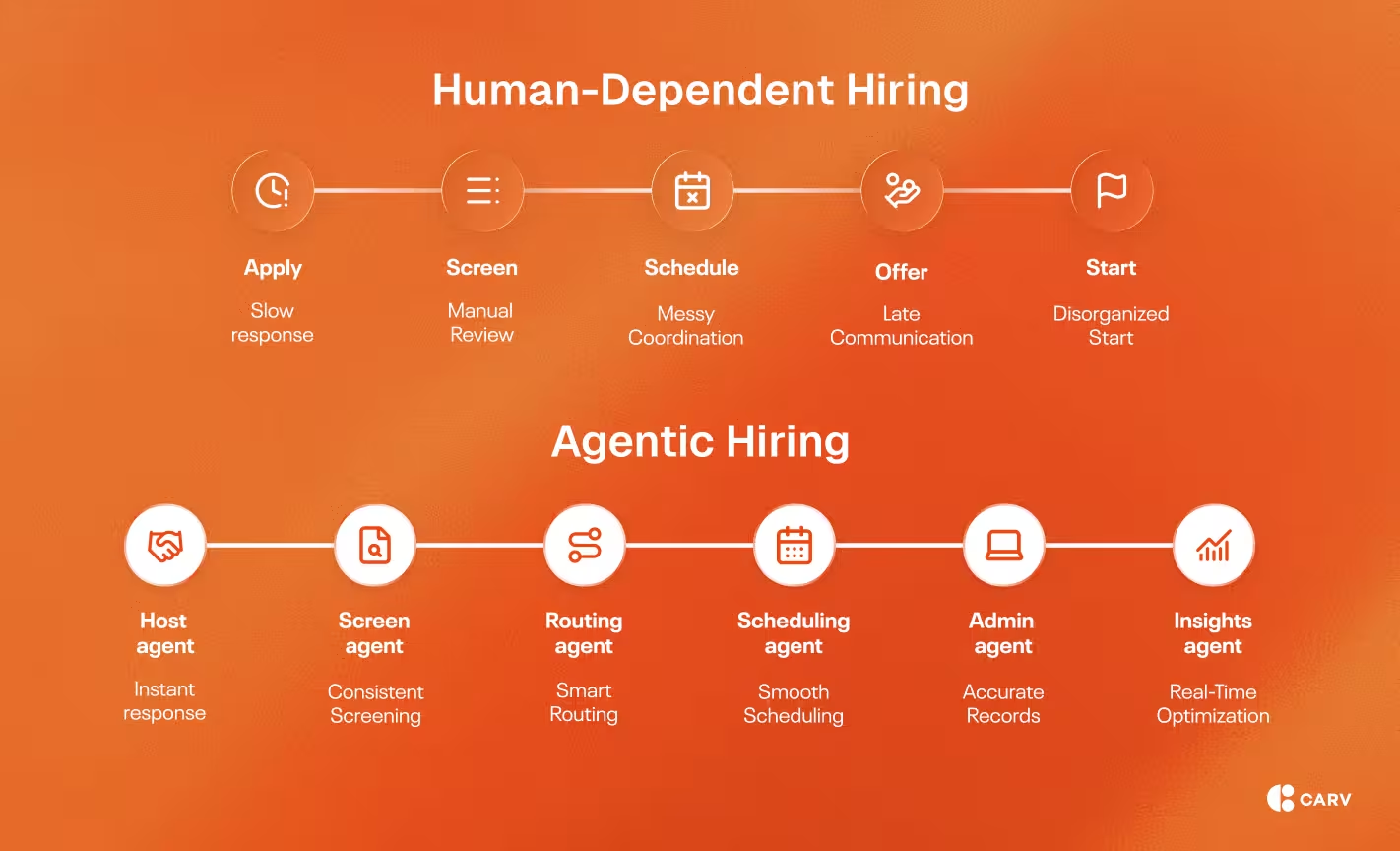
The front door: Host agent
In logistics, candidates apply outside of typical business hours.
Many of them compare multiple operators at once, too, which makes first contact essential. If you engage top candidates before your competitors, you have a better chance of hiring them.
This is why the host agent is so important. AI tools that fill this role handle post-application engagement immediately. Even better, they can engage in multilingual conversations via SMS, WhatsApp, voice, or web; clarify roles for candidates and set expectations; and even answer candidate questions in real time across shifts and time zones.
Carv's host agent operates across these exact channels, making it a natural fit for this front-door function. Expect to cut response times from hours to seconds and give your organization a strong operational advantage in the marketplace.
The qualification core: Screening agent
Candidates are applying for your open roles. Now, you need to screen them in an efficient way.
The screening agent solves this problem by applying structured, consistent evaluation across role requirements, shift availability, location fit, and compliance criteria.
One of the best things about this AI-driven agent is it puts every candidate through the same process, regardless of when they applied or which depot they applied to. This consistency removes store-by-store and site-by-site variability, and ensures volume doesn't dilute standards.
In addition, feedback loops built into the screening process enable the system to improve over time. It flags patterns in candidate quality to inform the next sourcing decision. When this happens, you can build an entire ecosystem of quality candidates to pull from in the future.
The flow optimizer: Routing agent
Demand in logistics shifts constantly. A candidate who does not fit the open role at Site A might be exactly what Site B needs. The routing agent manages this in real time.
Using its AI capabilities, the routing agent redirects qualified candidates to nearby sites, matches applicants to alternative shifts or roles, and prevents unnecessary rejection due to localized demand changes. By doing so, the routing agent limits waste, enables better operational efficiency, and improves candidate experiences across the organization.
In real-world, high-volume environments, this kind of intelligent routing transforms a fragmented candidate pipeline into a reliable business asset.
The coordination engine: Scheduling agent
Coordinating interviews across complex shift windows, multiple sites, and candidate availability is difficult. This fact makes manual scheduling a common bottleneck in logistics hiring.
The scheduling agent streamlines this process. It handles interview booking across shift windows, sends automated confirmations and reminders, manages rescheduling flows, and runs no-show recovery sequences. That way, employees never have to chase down candidates.
Plus, reinforcement learning helps the agent improve its scheduling logic over time, discovering which approaches reduce cancellations and which communication sequences bring candidates back after a missed step. The result is a more reliable system that improves scalability.
The continuity layer: Onboarding agent
Getting candidates to accept offers is one thing. Getting them to show up for their first shift is another. The onboarding agent bridges this gap.
Once you add one to your recruitment workflows, it will send pre-start reminders, confirm documentation completion, set first-day expectations, and conduct early check-ins to catch candidate issues before they result in no-shows.
Generative AI powers much of this communication, making it possible to personalize messages without adding manual effort. For logistics operations that manage hundreds of new starters across multiple locations, this layer is essential.
After all, early attrition compounds cost and operational strain in ways that aren't always obvious. You might not see the impact in metrics, but you will definitely see it on the floor. The onboarding agent minimizes early attrition without human intervention.
The invisible backbone: Admin agent
Strong hiring systems require accurate data, which is the admin agent's job.
The admin agent updates ATS records automatically and synchronizes candidate status changes across systems – all while maintaining data integrity throughout the process.
This is the cutting-edge infrastructure work that nobody sees, but everyone depends on. You can't use real-time data sources if they aren't organized in logical ways that allow for easy recall.
The admin agent makes sure the entire pipeline stays clean and accurate, giving every other agent in the system a data-driven foundation to operate from.
The control tower: Insights agent
The insights agent aggregates data across other agents in the stack: Host, Screen, Route, Schedule, and Onboard. It then surfaces bottlenecks in real time, identifies drop-off patterns by shift or location, and enables intervention at key moments.
To accomplish the last task, the agent uses machine learning and predictive analytics to spot problems before they become crises, rather than diagnosing them afterward.
Without this layer, the other agents in the system operate in isolation, their context fragments across the system, and momentum leaks away because no governing force holds it all together. The insights agent is what turns a collection of AI solutions into one powerful engine.
Rolling this out without disruption
An "always-on" agentic setup doesn't require a "big-bang" rollout. In fact, a phased approach can deliver faster time-to-value and stronger human oversight throughout the transition.
Start with one role or depot. Then, deploy the host, screening, and scheduling agents. Next, set clear KPIs and measure your new system against them. Finally, once you achieve noticeable value, expand to routing, onboarding, and insights agents.
One of the best things about agentic hiring is that it scales modularly, meaning each phase builds on the last without requiring you to overhaul everything at once. For logistics teams that haven't used autonomous systems before, this approach keeps the rollout controlled.
Evolving from process to engine
For logistics hiring purposes, demand forecasting and operational planning only go so far. Stakeholders in this industry need a new system that maintains 24/7 momentum.
Fortunately, an "always-on" agentic setup isn't experimental. It’s the exact infrastructure logistics companies need to manage shift volatility, peak demand, and thin margins.
If you want to see what this workflow looks like in practice, request a demo of Carv today and explore how you can build an intelligent hiring system for your operation.
.avif)
.avif)
