


.avif)


Retail hiring hasn’t really changed much in the last decade.
Yes, we digitized applications, introduced ATSs, and automated parts of the workflow, but the underlying system – the way hiring actually moves from application to offer – has remained largely unchanged.
What’s more, outcomes are now depending less on process and more on who happens to have time. That’s the real constraint. Not tools. Not effort. Availability.
What AI changes isn’t just speed, but the dependency itself. Instead of relying on managers to keep things moving, hiring can run continuously – responding instantly, progressing automatically, and removing the moments where candidates would otherwise stall.
This is where retail hiring actually breaks and what changes when those bottlenecks are removed.
Retail hiring always fails in the same places
High-volume hiring tends to stall at the same predictable points – the moments where speed, coordination, and follow-through matter most.
A candidate applies after their shift and hears nothing back. Screening varies depending on who’s running it that day. Scheduling turns into a slow, back-and-forth exchange. And by the time everything lines up, the strongest candidates have already accepted offers elsewhere.
This isn’t a failure of effort (if anything, retail teams are working harder than ever), but a failure of structure.
Across multi-location environments, these delays don’t stay isolated. They compound.
The 5 bottlenecks that break retail hiring
Across hundreds of conversations with retail hiring leaders, the same constraints show up again and again – different brands, different geographies, and different store formats. But the breakdown points are remarkably consistent.
Each ultimately traces back to a single limitation: the capacity of store managers.
Here’s where hiring slows down, and what changes when that constraint is removed.
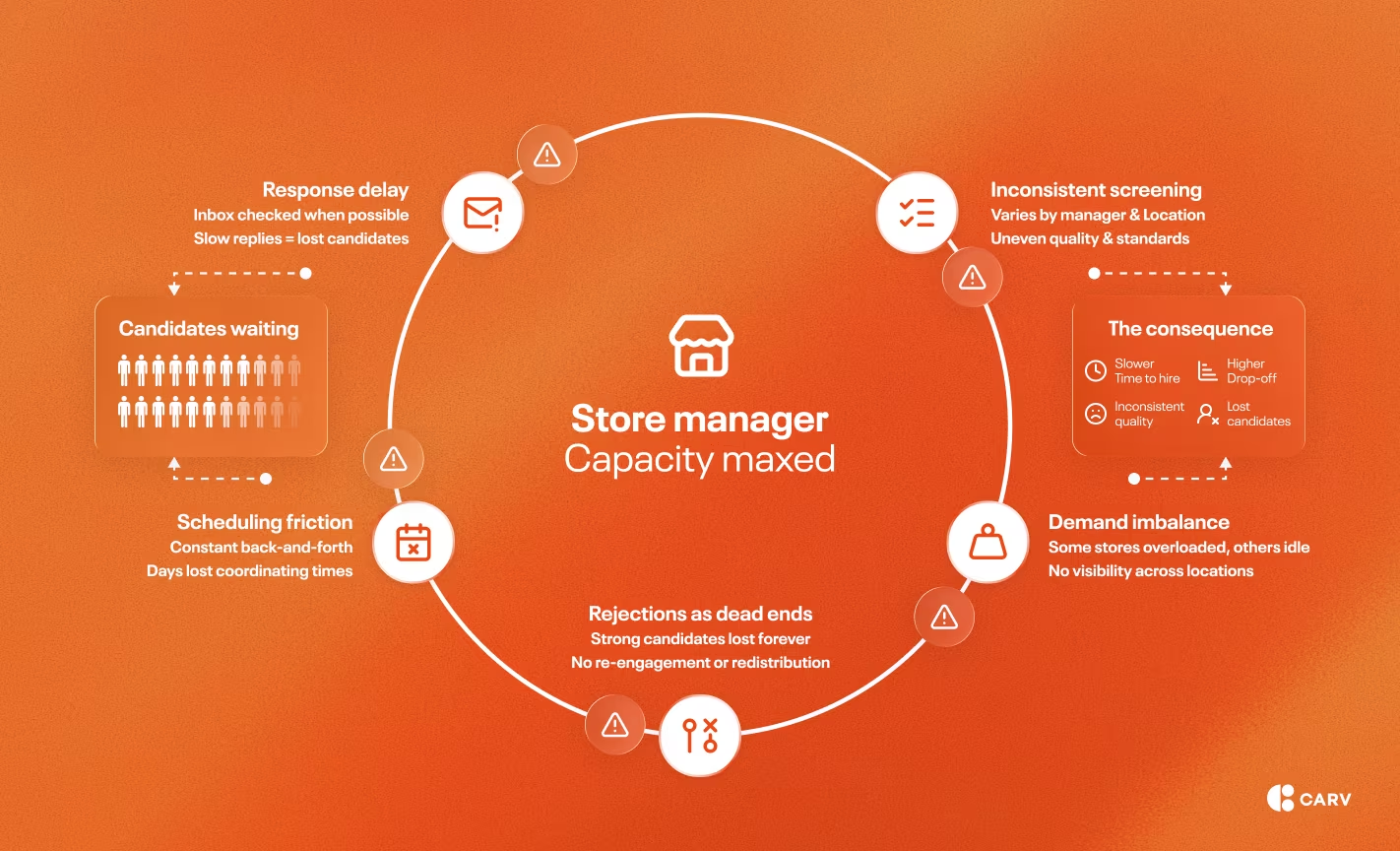
1. Response delay: The race is over before you start
A candidate applies on Friday evening and doesn’t hear back until Monday. And by that point, they’ve already accepted another offer.
In retail hiring, speed is decisive. The first employer to respond, engage, and create momentum is usually the one that wins.
The problem is that response times are still tied to human availability. Managers check their hiring inbox when they can, which means responses are delayed merely by circumstance.
At the same time, candidates behave differently. They apply in the evenings, on weekends, and in between shifts, expecting the same immediacy they experience elsewhere. The system simply isn’t aligned with that reality.
When response is no longer dependent on availability, everything changes. Instead of waiting for someone to pick up the process, candidates are engaged immediately regardless of when they apply.
The impact isn’t just faster response times, but sustained momentum. Candidates move forward rather than wait, which increases conversion at the top of the funnel and accelerates everything that follows.
2. Inconsistent screening: Ten stores, ten different standards
Walk into ten different stores, and you’ll often find ten different approaches to screening.
Some managers run thorough conversations. Others move quickly because time is limited. Some skip steps entirely. The result is a process that varies widely across locations, even when the role is identical.
Standards tend to drift because consistency is difficult to maintain under pressure. The reality is that store managers aren’t hired to be recruiters. They’re hired to run stores, and hiring becomes just one more task they fit in when they can.
When screening becomes system-driven instead of manager-dependent, that variability disappears. Every candidate is evaluated against the same criteria, asked the same core questions, and moved forward based on consistent standards.
In this way, decisions become more predictable, quality improves across locations, and managers no longer need to spend hours on repetitive screening conversations.
3. Scheduling friction: The slowest step in the funnel
Scheduling should be simple. In practice, it rarely is.
A candidate suggests a time. It doesn’t work. Another option is proposed. That doesn’t work either. Messages go back and forth, hours pass between replies, and what should take minutes stretches into days. By the time a slot is confirmed, interest has (more often than not) cooled.
Retail adds another layer of complexity. Managers work rotating shifts, need to balance store coverage, and can’t always step away during peak hours. Coordination becomes hard by default.
When scheduling is handled in real time, the entire dynamic shifts. Instead of coordinating manually, candidates select from available time slots immediately after screening, with confirmations and reminders handled automatically.
The back-and-forth disappears. Time-to-interview compresses from days to hours. Show rates improve because the process feels immediate and organized.
For managers, this means fewer interruptions and less context switching. For candidates, it means a process that keeps pace with their expectations.
4. Multi-location demand volatility: Imbalance across the network
In retail, demand is never evenly distributed. One store may be overwhelmed with applications, while another struggles to attract enough candidates for the same role just a short distance away.
Candidates apply to the locations they know – often those closest to them or most visible – which creates natural imbalances across the network.
The result is inefficient hiring. Qualified candidates are rejected in one location while identical roles remain open elsewhere.
Most stores operate in isolation, with limited visibility beyond their own pipeline. Even when managers are aware of other opportunities, there’s no systematic way to redirect candidates.
When hiring is viewed at a network level rather than a store level, that changes. Candidate flow can be redistributed in real time, matching supply with demand across locations.
Instead of losing qualified applicants, organizations can retain and redirect them – improving overall fill rates while reducing reliance on new sourcing.
5. Rejections as dead ends: Losing candidates you already earned
In traditional hiring, rejection is considered to be the end of the relationship.
A candidate who performs well but doesn’t get the role receives a rejection message, and that’s it – even if they would be a strong fit elsewhere.
In an environment where multiple locations are hiring continuously, this is truly a missed opportunity. Each role operates as its own pipeline. Once filled, the process resets, and strong candidates are lost even though similar opportunities exist elsewhere in the network.
When candidates remain visible beyond a single requisition, that changes. Instead of starting from scratch each time, organizations can re-engage silver medalists who are already known, qualified, and interested.
This reduces the need for constant new sourcing, shortens time-to-fill, and creates a more continuous relationship with candidates.
From the candidate perspective, the experience shifts as well. Instead of a dead end, the process feels ongoing. And that distinction matters, particularly in retail, where candidates are often customers too.
How to resolve your high-volume hiring bottlenecks
These bottlenecks don’t require more effort to solve. They require an entirely different structure.
Here's how to get started:
- Map your current process end-to-end. Document how hiring actually works across locations – not the idealized version, but the reality. Where does execution depend on manager availability? Where do candidates wait? Where do handoffs break down?
- Identify your recurring bottlenecks. Focus on the constraints that slow your funnel significantly, create inconsistent candidate experiences, waste substantial manager time, or prevent you from scaling during peak hiring.
- Redesign around AI and human strengths. AI should own instant response, consistent screening, scheduling coordination, cross-location routing, and candidate engagement. Humans should own final hiring decisions, complex conversations, and setting the standards AI operates within.
- Work with a partner built for retail volume hiring. You need customized AI systems aligned to your workflows, integrations, and operating model – not generic off-the-shelf solutions that create more work.
The goal with leveraging AI isn’t to just add more tools to your tech stack, but to remove real, structural constraints. You can keep hiring moving, even when managers are busy, and give managers and candidates alike a better process.
How this works in practice for Carrefour
Carrefour is already operating this model at scale. By deploying agentic AI to handle candidate engagement, screening, scheduling, and routing across locations, they’ve seen the following results:
- Reduced dependency on store manager availability
- Improved hiring speed and predictability
- More consistent candidate experiences across markets
The always-on hiring takeaway
Always-on hiring doesn't mean more effort from store managers. It just means different infrastructure, and with the right tools in place, it can actually mean better results for less effort.
When AI systems own the moments where retail hiring consistently stalls:
- Store managers stay focused on running the business.
- Candidates receive fast, consistent follow-through.
- The hiring funnel keeps moving – even during peak demand, nights, and weekends.
Carv is built specifically for the challenges of multi-location retail hiring. Our agentic platform handles the bottlenecks that consistently stall retail hiring funnels:
- The Host Agent eliminates response delay by engaging every candidate instantly, answering questions, setting expectations, and moving them forward the moment they apply.
- The Screening Agent removes inconsistency by applying the same qualification standards across every location, ensuring fair, reliable evaluation at scale.
- The Interview Agent brings structure to decision-making, guiding evaluations and capturing insights so hiring remains consistent without adding burden to store managers.
- The Scheduling Agent eliminates coordination friction by allowing candidates to book instantly into live availability, removing the back-and-forth that slows everything down.
- The Admin Agent removes the invisible workload, keeping systems updated and data clean without requiring manual input from store teams.
- The Routing Agent prevents wasted applications by redirecting qualified candidates to nearby roles or locations where demand still exists.
- And the Insights Agent makes the entire system visible in real time, surfacing bottlenecks, drop-offs, and performance gaps as they happen.
Together, these agents transform hiring from a series of manual, disconnected steps into a continuous system that moves candidates forward automatically, maintains consistency across locations, and allows store managers to focus on what actually requires their attention: making the final hiring decision.
Retail leaders using Carv’s AI volume hiring software see faster fill rates, lower sourcing costs, improved candidate experience, and – most importantly – store managers who can finally focus on running the business instead of drowning in hiring admin.
Ready to fix your retail hiring bottlenecks? Book a demo to see how Carv's AI can remove the structural constraints slowing down your hiring.
.avif)
.avif)
