


%20(1).avif)


So, you’ve got a stack of resumes on your desk and a bunch of interviews lined up. You know the drill - finding the right candidate is like finding a needle in a haystack. But fear not, because I’ve been in your shoes, navigating both every facet of recruiting world, and I've got some wisdom to share.
If you search for the best interview questions to ask candidates, you’ll get hundreds of lists. And most of them look the same.
All the same categories. The same prompts. And the same advice about “digging deeper” or “finding the right fit.”
But here’s the thing most hiring teams quietly run into: The problem isn’t that you don’t have enough interview questions. It’s that everyone is asking different ones.
Different interviewers, who all have different styles, and different follow-up methods. And by the time you get to a debrief, you’re comparing gut feelings instead of actual evidence.
This is the exact place where hiring stops being effective. Because the quality of your hiring decisions is directly tied to the quality (and consistency) of the questions you ask.
So instead of giving you another long list of “good interview questions to ask candidates,” this guide does something more useful: It aims to show you how to ask the right questions, in the right way, so answers are actually comparable and your hiring decisions become easier to make.
Why interview questions matter more than most teams think
Interview questions shape the evidence you get back from your candidates during the recruitment process. Ask vague questions, you get vague answers. Ask inconsistent questions, you get inconsistent signals.
This shows up in very tangible ways:
- candidates get evaluated differently depending on the interviewer
- long, messy debriefs where no one quite agrees
- hiring managers relying on memory instead of structured input
- strong candidates slipping through because their strengths weren’t surfaced
Better interview questions directly improve interviews, as well as decision quality, speed of hiring, fairness across candidates, and candidate experience (because interviews feel more intentional, less random).
So yes, the questions matter. But how you use them matters most.
What makes a good interview question?
Not all interview questions are created equal.
The best interview questions to ask candidates tend to share a few characteristics – and once you see them, it becomes obvious why some interviews feel insightful, and others feel like guesswork.
Good questions are always:
- Role-relevant – They connect directly to what the candidate will actually do, not abstract hypotheticals.
- Open enough to reveal evidence – They allow candidates to explain how they think, not just give a yes/no answer.
- Tied to specific competencies – You’re not just “getting to know them,” you’re evaluating something concrete.
- Repeatable across candidates – So you can compare answers, not just impressions.
- Easy to evaluate – You can actually score or discuss the response afterward, instead of relying on vague feelings.
If a question doesn’t do at least a few of these things, it probably isn’t helping you make better hiring decisions.
How to use interview questions consistently across candidates
This is where most teams fall short. Even with great questions, inconsistency creeps in quickly.
One interviewer goes off-script. Another focuses too much on culture. Another dives deep into technical details. And suddenly you’re not evaluating the same candidate – you’re evaluating different aspects of them.
A few simple practices can make a big difference:
- Decide upfront what gets asked in a phone screen vs hiring manager interview vs final round.
- Keep a shared baseline across interviewers. Not everything needs to be identical, but the core signals should be.
- Capture answers in a structured way. Notes should be usable, not just personal reminders.
- Compare evidence. “I liked them” is not useful. “Strong ownership in X example” is.
.avif)
The best interview questions to ask candidates
Below are structured, high-signal interview questions for candidates, grouped in a way that aligns with how hiring decisions are actually made.
1. Motivation and career goals
- Why are you interested in this role?
- What are you hoping to get from your next role?
- What kind of work gives you the most energy?
- How does this role fit your longer-term goals?
These questions help you understand intent – not just whether someone can do the job, but whether they actually want to.
2. Role-relevant skills and experience
- Tell me about your experience with [specific skill or tool]
- What is the most relevant project you’ve worked on recently?
- Which parts of your previous roles apply most directly here?
- What kind of environment helps you perform at your best?
This is where you connect past experience to future performance.
3. Problem-solving and decision-making
- Tell me about a difficult problem you had to solve
- How do you make decisions when information is incomplete?
- Describe a situation where your first approach didn’t work
- How do you balance speed and quality in your work?
These questions reveal how candidates think, not just what they’ve done.
4. Teamwork and communication
- Tell me about a time you worked closely with others to achieve a goal
- How do you handle disagreements within a team?
- How do you adapt your communication style?
- Tell me about a time communication broke down and what you did
Because most roles don’t happen in isolation.
5. Ownership and accountability
- Tell me about a time something didn’t go as planned
- When have you taken ownership beyond your role?
- How do you respond to critical feedback?
- How do you make sure your work meets expectations?
This is often what separates average hires from strong ones.
6. Adaptability and resilience
- Tell me about a challenging period at work
- How do you respond when plans change unexpectedly?
- What have you learned from a failure?
- How do you maintain performance under pressure?
Especially important in fast-moving environments.
Interview questions recruiters should avoid
Some questions feel useful, but actually produce weak signals. Common ones to be careful with:
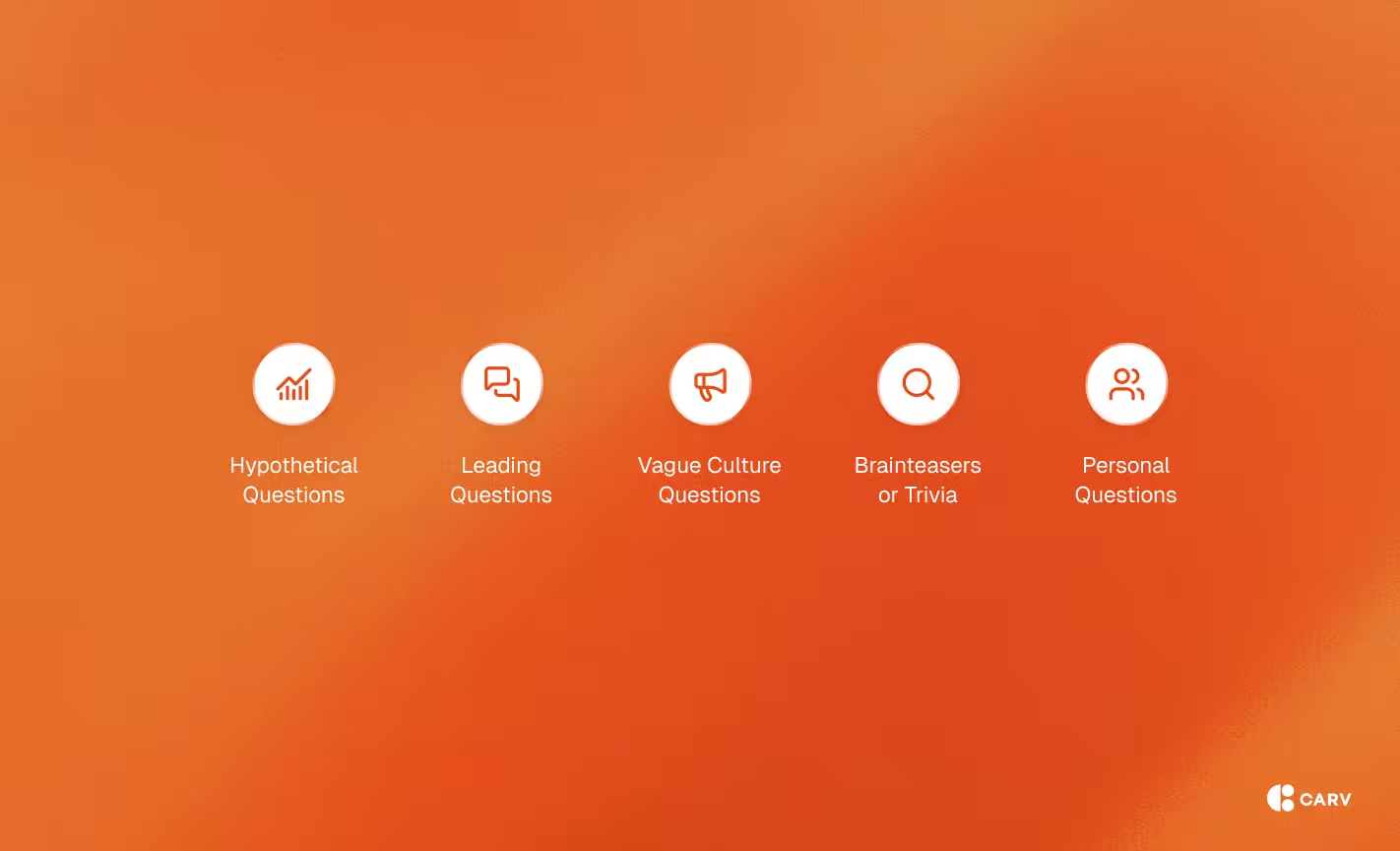
- Hypothetical questions – “Imagine you had to…” → often leads to idealized answers, not real behavior.
- Leading questions – “Would you say you’re good at teamwork?” → easy to answer, hard to evaluate.
- Vague culture fit questions – “Do you think you’d fit in here?” → unclear, subjective, and biased.
- Brainteasers or trivia – Rarely relevant, often frustrating for candidates.
- Overly personal questions – Risky from both a legal and an experience standpoint.
If a question doesn’t give you something you can actually compare across candidates, it’s probably not worth asking.
How to build a structured interview question set
The strongest hiring teams don’t improvise their interviews. They design them.
A simple, useable structure could look like this:
- Phone screen – Focus on motivation, availability, and baseline fit.
- Hiring manager interview – Deep dive into role-relevant skills and experience.
- Competency interviews – Focused on specific skills (problem-solving, communication, etc.).
- Final stage – Alignment, edge cases, and decision validation.
At each stage, make sure to keep a consistent set of core questions, continually align on what “good” looks like, and ensure answers are captured in a usable format.
This is what creates consistent interview questions across candidates, and ultimately, better hiring outcomes.
How Carv helps teams use interview questions better
Carv helps close the post-interview disruption gap by operationalizing the interview layer of hiring, not just by helping teams write better questions, but by helping them use those questions consistently and turn the answers into something structured, shareable, and usable inside the wider hiring process.
Instead of treating interviews as isolated conversations that disappear the moment the call ends, Carv connects the full workflow around them. Intake discussions can be turned into structured interview plans, recruiters and hiring managers can align on what should actually be assessed, and interviews themselves become a source of evidence rather than a source of admin.
During the interview, Carv’s admin agent supports the process in the background by automatically capturing notes, creating summaries, and reducing the need for interviewers to split their attention between listening and documenting.
That matters more than most teams realize, because the moment an interviewer stops scrambling to write everything down, they can actually stay present in the conversation, probe where it matters, and evaluate the candidate properly. After the interview, that information does not sit in someone’s notebook or get lost in Slack.
It can be structured, synced back into the ATS, and used as part of a more evidence-based debrief.
This is also where Carv becomes meaningfully different from standalone interview note-taking tools. It does not stop at transcription or summaries. Because Carv sits across the hiring workflow, interview data stays connected to the broader process: role context, earlier screening outcomes, candidate records, next steps, and downstream decision-making.
In other words, the interview is no longer a disconnected event. It becomes part of a coordinated system.
For teams hiring at scale, that changes a lot. Structured interview questions become easier to standardize, interviewer drift becomes easier to control, and answers become easier to compare across candidates because the process around them is finally doing some of the work it should have been doing all along.
So instead of asking better questions only when the recruiter happens to be exceptionally prepared, teams can run better interviews consistently, with less admin, clearer evidence, and a much stronger foundation for the hiring decision that comes next.
FAQ
1. What are the best interview questions to ask candidates?
The best questions are role-relevant, open-ended, and consistent across candidates so answers can be compared.
2. How many interview questions should you ask?
Typically, 6-10 high-quality questions per interview is enough to get meaningful insight without overwhelming the conversation.
3. Should interview questions be the same for every candidate?
Core questions should be consistent to allow comparison, with room for follow-up based on responses.
4. What interview questions should recruiters avoid?
Avoid vague, leading, or purely hypothetical questions that don’t produce measurable evidence.
5. How do you evaluate answers consistently?
By asking the same core questions, capturing structured responses, and aligning on evaluation criteria beforehand.
.avif)
.avif)
.avif)