
.avif)


Applying for jobs has never been easier.
For a lot of roles – particularly in industries like hospitality, warehousing and logistics – it’s just a matter of hitting the ‘apply now’ button on a job posting and the candidate’s job board profile will land in the recruiter’s inbox.
But while this is great news for candidates, it creates a lot of extra work for recruitment teams. When you have hundreds of job seekers applying to every role, it becomes virtually impossible to pull out qualified candidates manually.
This is why an automated candidate screening process has become completely integral to any volume hiring process. And now, artificial intelligence is taking candidate screening to a whole new level.
Using AI, recruitment teams can now ‘talk’ to candidates during the screening process, asking them initial screening questions and analyzing their performance – all without actually speaking to them.
AI candidate screening is taking volume hiring by storm, but it comes in a whole load of different shapes and sizes and addresses different recruitment needs too. Understanding where your organisation sits in terms of what technology or features your hiring process might need to achieve the hiring outcomes you’re looking for, is what this guide is about.
So first, what exactly is AI candidate screening?
What is AI candidate screening?
AI candidate screening is the use of artificial intelligence to evaluate and filter job applicants at the start of the recruitment process before a human recruiter gets involved.
While automated resume screening is something that’s been around for years, AI technology is now really ramping up how we screen candidates. Now, recruitment teams can entirely automate full-process screening, including screening phone calls, text conversations and even video pre-screening interviews.
AI screening platforms use natural language processing (NLP) to ‘understand’ these text and voice conversations with candidates and translate them into structured data that the technology can use to make judgements on suitability for roles.
By automating all the work that needs to happen from when a candidate hits ‘apply’ to when they get invited to interview, AI screening creates a much faster and more positive experience for everyone involved. It also gives recruiters space to focus on the parts of their job where human judgement actually matters: building relationships, assessing culture fit, and hiring the right people.
How AI candidate screening works
Just to get a little technical for a minute, it’s helpful to understand the different stages of how AI screening technology actually works. How does the technology screen candidates and make decisions about who to progress to interview? Here’s how.
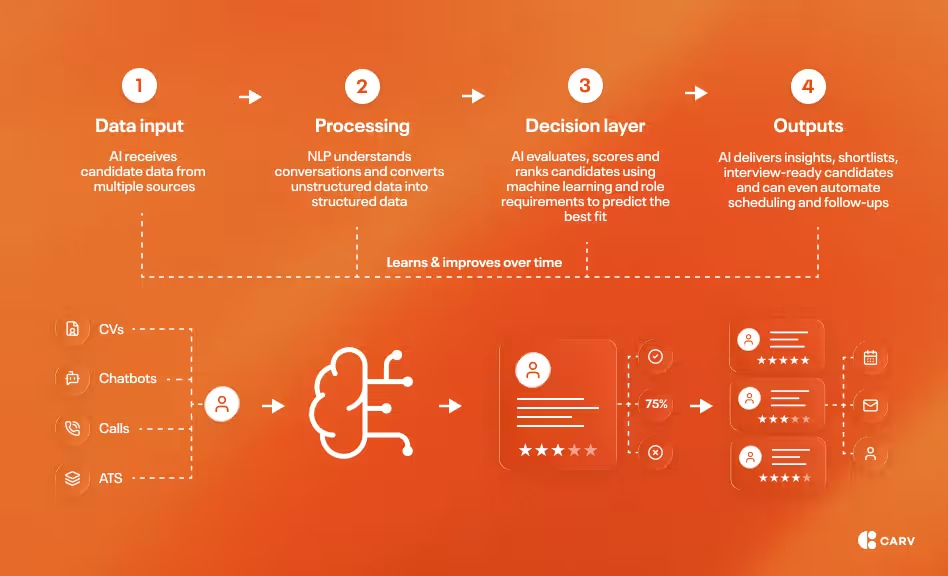
Step 1: Data input
First, the AI receives candidate data either in the form of a CV or data gathered through AI-powered screening calls, chatbot conversations or any data that’s entered into the applicant tracking system (ATS) (by human recruiters or via automation).
Step 2: Processing
Using natural language processing, the AI is able to ‘understand’ candidate communication, translating the unstructured data from natural conversations into structured data that can be used for candidate evaluation and eventually hiring decisions too.
Step 3: Decision layer
The AI then uses the processed candidate data to either rank candidates in order of fit or pass/fail them against the role requirements to decide who will progress to the next stage.
Using machine learning, the AI also learns successful patterns in your organization’s historical hiring data then uses an algorithm to make data-driven predictions about which candidates are most likely to succeed in the role.
Some AI systems can also filter candidates by different skills, qualities and experience and produce a scorecard which assesses their suitability against the job description.
Step 4: Outputs
Finally, the technology is able to provide clear insights about the candidate based on what it’s processed. For example, it can auto-generate candidate profiles on each candidate, and create shortlists of interview-ready applicants to send on to recruiters.
Some AI-powered hiring platforms like Carv will even automatically handle interview scheduling based on shortlists without having to involve a recruiter.
5 types of AI candidate screening
AI screening doesn’t just involve one single technology. Over the years, it’s grown from basic CV parsing all the way through to autonomous AI agents that can conduct end-to-end screening conversations, compile shortlists, and hand off interview-ready candidates without a recruiter lifting a finger.
The type of technology that will suit your organization depends on how you want to recruit and the level of hiring manager input you want to retain. Here’s an overview of the different types of AI candidate screening currently on the market and how they work.
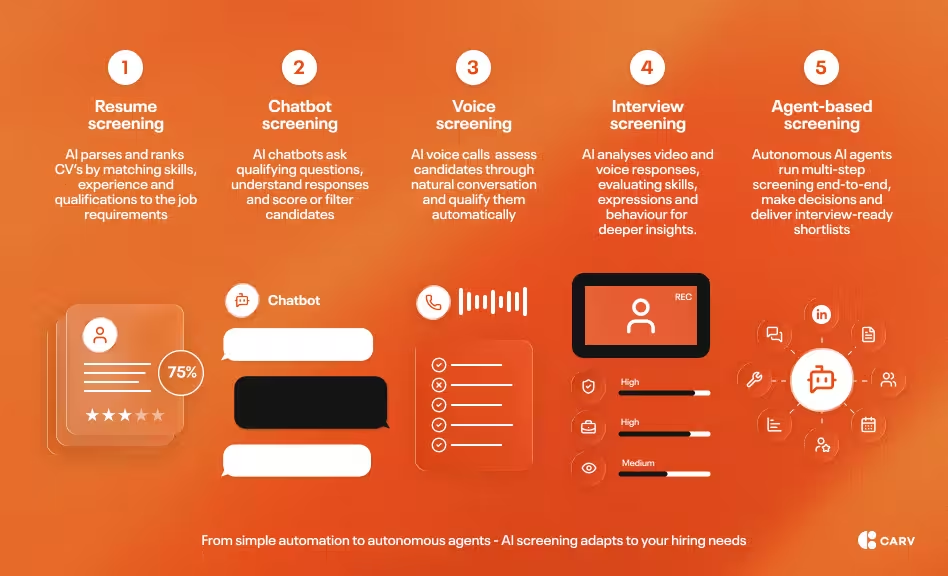
1. Resume screening
With simple AI-powered resume screening, the AI parses and ranks CVs based on keyword-matching, but also matches up skills, experience, and qualifications. It does this using an algorithm that scores resumes against the job description, filtering out candidates who don't meet the minimum job requirements to create a shortlist for recruiters to work with.
2. Chatbot screening
With chatbot screening, a text-based conversational AI bot asks candidates top-level pre-set qualifying questions like "Are you eligible to work in the UK?" or "What's your notice period?" The bot then filters in/out or scores candidates based on their answers, progressing the most qualified candidates to the next stage.
These chatbots can be hosted on your company’s careers site, Facebook page or even on WhatsApp. Conversational AI technology is so sophisticated that it can easily handle situations where the conversation goes off-piste, guiding the candidate back on course to eventually reach the end of the screening process.
And if a candidate asks a question that falls outside the parameters of what the bot is permitted to answer (for example “is there room for negotiation regarding the salary?”), the AI will notify a human recruiter to step in for manual review.
3. Voice screening
Voice screening also uses conversational AI technology to operate. When a candidate submits an application, this automatically triggers an AI-powered voice call, where a bot asks qualifying questions to assess their suitability for the role.
Candidates respond to questions verbally and the AI uses natural language processing to analyse their answers, qualifying them in or out based on pre-defined criteria related to the job description.
Like with chatbot screening, if the candidate asks any questions the bot can’t answer, they can notify a human recruiter to step in.
4. Interview screening
This is a more sophisticated type of AI screening as it involves analysing both voice and video. Interview screening normally entails candidates answering skills-based or competency-based questions over video (either live or asynchronous). The AI then processes the verbal content, but also assesses facial expressions, eye contact, and body language too to give a more comprehensive assessment of how a candidate might behave in real-world scenarios at work.
5. Agent-based screening
The real pinnacle of AI screening, agent-based screening involves using an entirely autonomous AI agent that can actively conduct a multi-step screening process end-to-end without needing any human oversight.
So rather than responding to human inputs, the agent takes its own initiative: it might pull a resume, look up a candidate's LinkedIn, ask dynamic follow-up questions, schedule calls, and compile a shortlist report – all without human prompting at each step.
Benefits of AI screening vs traditional screening
At this stage, I’m sure you’ve gathered that there’s a whole load of benefits to bringing AI screening technology in your hiring process. But for clarity, here’s a quick overview of how AI screening can have a huge positive impact on recruitment and your organization more broadly.
- Faster time-to-hire – delegating the screening process to artificial intelligence speeds up the hiring process in a way that would be unimaginable only a few years ago. It can take recruiters days - if not weeks - to respond to successful applicants, by which time many of the best candidates will have accepted another job offer elsewhere. AI completely eradicates that time-to-first-response by replying to applicants instantly. This not only reduces time-to-hire but also ensures your business doesn’t miss out on quality candidates due to bad communication.
- Consistency that leads to a fairer hiring process – While human judgment is always going to be an important part of hiring, involving humans too heavily in the early stages can actually result in less fair assessment. While a human recruiter might struggle to stick objectively to the same judgement criteria for every candidate, AI removes this risk and ensures the process isn’t affected by unconscious bias. An off-shot of this is that you’ll see quality of hire improve as candidates are assessed purely on how they match the role requirements rather than whether a recruiter likes them or not.
- Huge scalability – Using AI to manage candidate screening allows you to assess an almost unlimited number of applicants in less time than it would take to screen just one job applicant using a traditional screening process. This means AI can support volume hiring at a scale never seen before – and with more quality candidates filling your roles in a fraction of the usual time-to-hire, the potential for growth is huge for your business.
- Better candidate experience – Poor communication is one of the most common issues candidates complain about during a traditional hiring process. With so many applicants for each role, it’s become almost normal for them not to get a response from a recruiter for weeks or months - if even at all. AI screening means every candidate gets an instant response, which creates a much better candidate experience whether they’re successful or not.
- Better recruiter experience – The day-to-day job of a recruiter has become admin-heavy, with few able to focus on the relationship-building core tasks that made them want to become recruiters in the first place. Delegating the high-volume admin task of early-stage screening to AI protects recruiters from burnout and frees up their time to focus on the more human parts of their jobs.
- Hiring intelligence – AI screening generates structured, queryable data at every stage of the funnel – drop-off rates, qualification patterns, source quality – that traditional screening can't produce. Using key metrics and predictive analytics, your AI screening process will give you insights that allow you optimize your hiring process over time, which is something you’d never get from a recruiter making manual screening calls.
Challenges & risks of AI candidate screening
As with any kind of transformative technology, AI-powered screening does come with some potential challenges and risks that are important to acknowledge.
While AI screening is designed to mitigate bias in the screening process, if the technology isn’t built, trained and used in a responsible way, it can have the opposite results.
For example, if the AI is trained purely on historic data and there have been biases already present in your talent acquisition strategy, the technology will just repeat these patterns. It will actively seek out candidates who meet the profile of previously successful candidates, so if these fit a narrow demographic, your workforce will become even less diverse.
If most successful candidates went to the same university, the AI will score other candidates who went to this university higher because the data suggests they’re likely to be a better match. Therefore, it’s so crucial that you regularly audit your screening process to make sure the evaluation criteria and scoring stays fair.
Similarly, over-filtering can become a problem if not kept in check. This is when the AI casts its net too narrow and rejects qualified candidates because they don’t tick enough boxes even when they could be an excellent fit.
Getting the outcomes you want from an AI screening process relies on you feeding the AI with good quality data on your candidates. If you have an ATS that’s full of incorrect, incomplete or outdated data, you’re going to get unreliable results from the system. So before you implement an AI screening process, it’s important to do a full data audit.
This might result in you having a lot less candidate data than you started with, but it will be reliable information that accurately reflects your workforce.
And finally, lack of transparency can become a challenge if organisations aren’t clear about their scoring criteria - both with candidates but also with the organization itself. If your hiring team doesn’t have full visibility on how candidates are being screened and qualified, how will they know it’s fair?
AI candidate screening tools
Since AI candidate screening comes in a few different forms, there are a whole load of different AI screening tools on the market that cater to these different types and needs. Choosing the right screening tool for your organization really depends on what you want your AI recruitment process to look like.
If you just want a tool with powerful AI-driven resume parsing, a simple tool like Hirize might do everything you need it to do. If you’re planning a more complex screening process that includes hosting AI interviews over video, HireVue or Willo would be good tools to take a look at. These platforms support adding video interview assessments as part of the screening process, which are a good means of assessing communication and problem-solving skills early on at scale.
Paradox is tool to consider if your recruitment data tells you you need a mobile-first screening process. This text-based AI screening tool allows candidates to go through the entire process on a phone screen even while on the go.
But if you’re looking for a tool that handles screening entirely autonomously as part of a larger recruitment platform offering, Carv is the tool to consider.
Carv uses AI agents to manage the full screening process end-to-end (including both text and voice-based AI). Outside of the screening process, Carv will also schedule interviews with shortlisted candidates and manage all interview-related admin – like sending follow-up emails and progressing candidates – with almost no recruiter input.
To understand how tools like Carv are able to offer entirely autonomous screening, let’s talk about the shift to agentic recruitment that’s happening in the industry right now.
AI screening in 2026: The shift to agentic screening
Most AI hiring tools on the market today are built to assist recruiters – they take a task, complete it, and hand it back to a human.
For example, a resume parser scores CVs and surfaces a shortlist. A chatbot qualifies candidates and flags them for review. A video platform records responses and waits for a hiring manager to watch and qualify them. For these types of tools, the recruiter is still the one holding the process together, manually moving candidates from one stage to the next.
But the downside of this is that if you’re still having to rely on a recruiter to review or trigger the next stage in the process when they have the time, this creates bottlenecks no matter how much it streamlines different stages of your process.
Agentic AI is a new type of screening technology that relieves recruiters of that responsibility entirely.
Rather than waiting for instructions at each step, an AI agent takes initiative – moving through the entire screening workflow autonomously, making decisions and triggering next actions without a human needing to sign off at every stage. It can pull a CV, cross-reference a LinkedIn profile, conduct a screening call, score the candidate, schedule an interview, and send a follow-up – all in a single uninterrupted workflow.
The result is that the entire early-stage screening stage runs by itself. This is exactly the problem Carv was built to solve. Rather than functioning as a single-purpose screening tool, Carv operates as a full screening agent – autonomously managing the end-to-end process from application received to interview scheduled, across both text and voice-based screening.
Agentic AI allows you to have a screening process that runs continuously in the background – surfacing the right candidates without any of the admin that usually comes with finding them.
Carv is the agentic AI platform built to support this type of screening. Book a demo today to see what an agentic AI screening process could look like in practice for your organization.