


.avif)


In high-volume hiring, slow pre-screening can cost you top talent. Applicants expect fast responses, and if they don't get them, they move on to whoever responds first.
The problem is that the screening process is so time-consuming.
Whether recruitment is your full-time role or just one more task on your plate, no one enjoys the admin headache of back-and-forth questions or interview scheduling.
That's why AI screening tools for volume hiring have become so essential. Built on smart machine learning and, increasingly, agentic AI, these platforms are already being used by agencies and in-house teams to automate candidate qualification, filter out non-matching candidates, and schedule interviews with shortlisted ones.
So let's take a look at the best AI screening tools for volume hiring, and what sets each one apart.
1. Carv
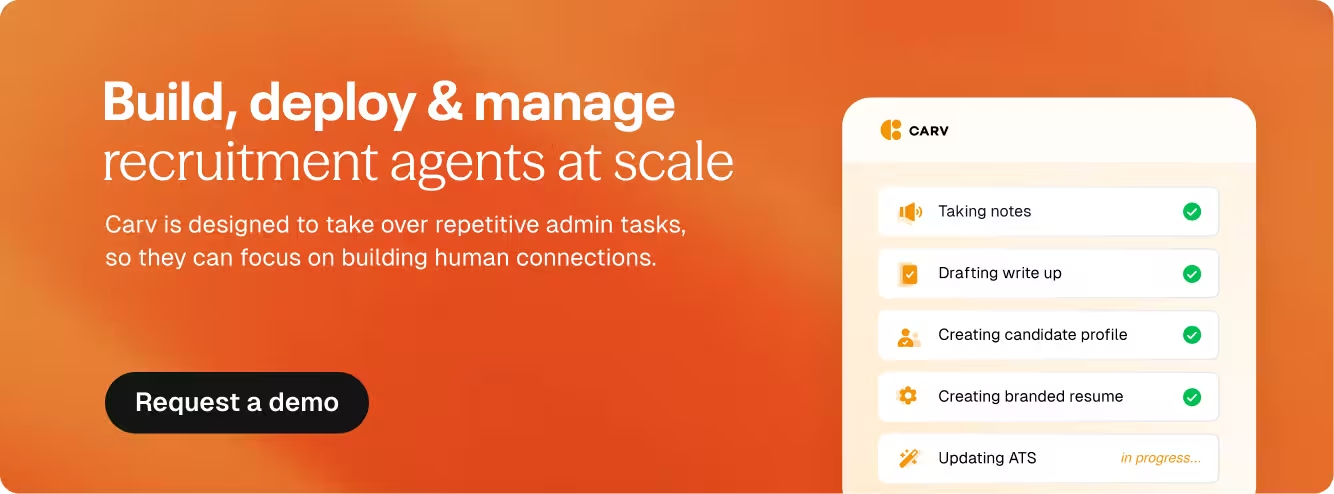
Carv is a purely agentic AI platform for volume hiring, not a bundle of point solutions. Instead of one chatbot bolted onto your ATS, Carv offers up a library of individual, specialized AI agents, each one built to own a single discrete step of the recruitment process, from a candidate's first interaction through to redeployment. Recruiting teams select, train, and embed only the agents they need, and can layer in custom agents for bespoke workflows.
The same core agent library powers Carv across every industry it serves – staffing agencies, logistics and warehouse operations, retail, and BPO/contact centers – with the mix of agents and business rules configured to each operation's hiring flow:
- Host agent: The always-on front door for candidates. Engages them the moment they enter the funnel, answers questions, clarifies intent, and guides them to the right next step, reducing drop-off before a recruiter gets involved.
- Screening agent: Confirms early whether a candidate can realistically do the job – gathering availability, eligibility, location, shift preferences, and dealbreakers – so only viable candidates enter the pipeline.
- Scoring agent: Evaluates candidate competencies against each role's specific requirements through live and asynchronous interactions, producing a dynamic confidence score surfaced directly in the recruiter's workflow.
- Scheduling agent: Books interviews and next steps by coordinating availability between candidates and hiring teams, removing the back-and-forth.
- Re-scheduling agent: Automatically coordinates interview changes when plans shift, handling availability updates and calendar coordination in real time.
- Re-activation agent: Re-engages candidates who've gone quiet or stalled in the funnel, bringing them back into an active conversation.
- Rediscovery agent: Automatically surfaces the most relevant candidates from existing talent pools as soon as a new vacancy opens, turning the database into an always-on source of ready-to-contact talent.
- Re-assignment agent: Engages candidates as assignments or contracts end, checks availability, and captures updated preferences, reducing talent leakage and speeding up redeployment.
- Talentpool maintenance agent: Periodically reconnects with candidates to confirm availability, update profiles, and validate interest, keeping the talent pool current and ready for fast activation.
- Custom agent: Carv designs and configures custom agents around an organization's unique requirements, processes, and business rules, including industry-specific hiring flows.
Whether it's a staffing agency filling shifts across client sites, a logistics operator hiring for warehouses, a retail chain hiring across hundreds of stores, or a BPO/contact center racing competitors to sign candidates first, the underlying agent library is the same. What changes is which agents get switched on and how they're configured, not the product itself.
This agentic platform sits on top of three additional layers: an AI Console where agents are configured, trained, and deployed; a Recruiter Hub where recruiters monitor agent activity, adjust criteria, and step in when human judgment is needed; and an Integration & Data Layer that connects Carv to your ATS and HR systems, keeping your existing systems as the source of record.
Carv serves both agency and in-house recruitment teams, from white-collar recruiting to blue-collar staffing, including brands like Carrefour, DHL Express, ManpowerGroup, ISS, and House of HR.
Top features of Carv for volume recruitment
- Automates early-stage screening: Carv's agents engage with applicants through their preferred communication channel to conduct pre-screening conversations via WhatsApp, SMS, or voice to find the right candidates for a given vacancy.
- Candidate-first experience: The AI agents operate 24/7 across languages, giving candidates timely, human-like engagement.
- Shorter time to hire: Carv customers cut time-to-hire roughly in half, thanks to a shortlist of pre-qualified candidates delivered automatically.
- Faster sourcing: By updating the ATS automatically, Carv ensures candidate sourcing doesn't start from scratch for every new vacancy. Existing talent pool candidates are matched to open roles, and the agents kick in, qualifying applicants and initiating the interview process for good matches.
- Built to scale without headcount: Customers report roughly 80% fewer admin tasks and a 70% reduction in cost per hire after deploying Carv's agents across their screening and scheduling workflows.
Carv integrates with most applicant tracking systems, from Bullhorn and Avature to Workable, Loxo, or Carerix.

2. Paradox
Paradox pairs its conversational AI assistant, Olivia, with the backing of Workday, which acquired the company in a deal announced August 2025 and closed that October. Olivia still guides candidates from application to interview over SMS, WhatsApp, and web chat, but the platform has pushed further into what Paradox calls "agentic recruiting" – flagging candidates who ghost interviews, automatically re-engaging people who go quiet mid-funnel, and handling more of the process without a recruiter stepping in.
Worth flagging for any prospect already running Workday HCM: Olivia is being folded in as the "Workday Paradox Candidate Experience Agent," which changes the buying conversation from "point solution" to "platform add-on."
Top features of Paradox:
- Conversational AI assistant (Olivia): automates screening, scheduling, and onboarding paperwork across SMS, WhatsApp, and web chat, in 29 languages.
- Agentic follow-up: flags interview no-shows and automatically re-engages candidates who've gone quiet in the pipeline.
- Workday integration: now ships as part of Workday HCM, on top of existing connections to SAP SuccessFactors, Oracle Taleo, iCIMS, and Greenhouse.
3. Fountain
Fountain is still built for high-volume, hourly, and frontline hiring, but its newest release, Cue, pushes further into autonomous territory – an AI layer pitched as handling sourcing, screening, and scheduling without manual intervention, on top of Fountain's existing mobile-first application flow.
Fountain leans hardest into onboarding and compliance (I-9 verification, HR paperwork) alongside screening, which makes it a common choice for retail, logistics, and hospitality teams that want hiring and onboarding running in one system.
Top features of Fountain:
- Cue: Fountain's newer AI layer for autonomous sourcing, screening, and interview scheduling.
- Mobile-first application: candidates apply and screen entirely from their phone, with built-in text/email reminders to cut drop-off.
- Onboarding and compliance: I-9 verification and HR compliance workflows built into the same platform as screening.
- Analytics: tracks time-to-hire, candidate demographics, and funnel bottlenecks.
4. Harver
Harver stays closest to its original positioning: structured, science-backed assessments rather than conversational AI. It scores candidates on cognitive ability, personality, and situational judgment across 42 languages, then pushes results into your ATS.
The 2026 version leans harder into the bias and predictive-quality story – Harver reports its AI-driven scoring improves candidate quality predictions and reduces 90-day attrition, positioning itself as a compliance-friendly alternative to more conversational, chat-first tools.
Top features of Harver:
- Predictive assessments: scores candidates on cognitive ability, personality, and situational judgment across 42 languages.
- Bias mitigation tooling: built to widen the diversity of shortlisted candidates rather than narrow it.
- VideoPitch: lets candidates record video responses in place of a first-round call.
- Workflow automation: triggers next steps automatically based on assessment results and candidate engagement.
5. PreScreen AI
PreScreen AI is still narrowly focused on one job: AI-driven voice screening for enterprise, multi-region hiring teams. It reads a CV and job description, generates tailored interview questions, then runs the actual screening conversation by voice in 50+ languages.
It's a lighter-weight option than the full platforms on this list – PreScreen AI doesn't try to own sourcing or onboarding, just the screening conversation, which it connects back into your ATS, CRM, or telephony stack via API or Zapier.
Top features of PreScreen AI:
- Voice-based AI interviews: real-time, human-like screening calls generated from the CV and job description.
- Skill and sentiment evaluation: scores both technical ability and soft-skill signals from the conversation.
- Multilingual: runs interviews in 50+ languages.
- Lightweight integration: connects via API or Zapier rather than requiring a full platform switch.
6. HireVue
HireVue has broadened from video interviewing into a fuller assessment suite: game-based cognitive testing, situational judgment tests, and personality inventories, alongside its original video and conversational AI screening.
The bigger 2026 shift is on the compliance side – HireVue now leads with real-time bias checks, audit logs, and diversity dashboards as core parts of the product, not an add-on, which matters if you're screening candidates in the US or EU under tightening AI-hiring regulation.
Top features of HireVue:
- AI video analysis: assesses verbal content and communication patterns from recorded interviews.
- Assessment suite: game-based cognitive tests, situational judgment tests, and personality inventories.
- Conversational AI screening: text-based qualification for high-volume roles, similar to a chatbot flow.
- Bias and governance tooling: real-time bias checks, audit logs, and diversity dashboards built into the platform.
7. Humanly
Humanly is a conversational AI platform aimed at hourly, frontline, and high-volume hiring – closer in spirit to Carv and Paradox than to Harver or HireVue. Its AI Recruiter engages, screens, and schedules candidates 24/7 by chat, SMS, voice, and video, and its AI Interviewer runs structured, consistent interviews at scale, ranking candidates afterward.
Humanly also leans on sourcing scale – it can pull from a database of 700M+ candidates for rediscovery and outreach – and builds bias auditing and EEOC/OFCCP compliance directly into its AI models, a notable differentiator for US enterprise buyers specifically.
Top features of Humanly:
- AI Recruiter: 24/7 candidate engagement, screening, and scheduling across chat, SMS, voice, and video.
- AI Interviewer: runs structured, autonomous interviews and ranks candidates for faster decisions.
- Sourcing at scale: searches a database of 700M+ candidates for outreach and rediscovery.
- Compliance-audited AI: models audited for bias and EEOC/OFCCP compliance.
8. Metaview
Metaview takes a different angle from the rest of this list – it's built around interview intelligence rather than pre-screening. It joins live interviews (Zoom, Google Meet, Teams, phone), transcribes them, scores the candidate against the role's rubric, and writes a structured report straight into the ATS the moment the call ends.
Its newer AI Sourcing add-on and "AI agents" push it toward the same autonomous-sourcing territory as Juicebox, but Metaview's core value is still further downstream than most tools here: less about getting candidates into the funnel, more about making sure what happens in the interview room actually gets captured and used.
Top features of Metaview:
- Interview notetaker: joins and transcribes live interviews, then writes a structured, rubric-scored report into the ATS.
- Reporting and analytics: tracks scorecard completion, interviewer-vs-candidate talk time, and interview volume by department.
- AI sourcing add-on: enables always-on candidate search across multiple platforms.
- Broad ATS write-back: syncs scorecards to Greenhouse, Ashby, Lever, Bullhorn, and 60+ other systems.
9. Juicebox
Juicebox (also known by its core product, PeopleGPT) is a sourcing tool first and a screening tool a distant second – worth including here because sourcing is often the actual bottleneck upstream of screening in high-volume hiring. It replaces Boolean search strings with plain-English queries across 800M+ candidate profiles from 30+ data sources.
Its AI recruiting agents can run sourcing searches continuously and manage outbound sequences, which makes Juicebox a natural pairing with a screening-and-scheduling tool like Carv rather than a true head-to-head competitor – it solves the "not enough candidates in the funnel" problem, not the "too many candidates to screen manually" problem.
Top features of Juicebox:
- PeopleGPT natural-language search: plain-English queries return ranked candidates across 800M+ profiles.
- AI recruiting agents: run continuous, autonomous sourcing searches that refine themselves over time.
- Integrated outreach: multi-step outbound sequences built into the same platform as sourcing.
- Broad integration: connects to 41 ATS platforms and 21 CRMs, or exports directly to CSV.
Over to you
The tools on this list aren't all solving the same problem. Some focus purely on screening (PreScreen AI, Harver), some on sourcing (Juicebox), some on capturing what happens after the interview (Metaview), and a few are trying to own more of the funnel end-to-end.
That's worth knowing going in: the right tool depends on where your actual bottleneck sits. If candidates are dropping off before you can even get them on the phone, sourcing and screening matter most. If good candidates are getting lost in inconsistent interview notes, an interview-intelligence layer might matter more than another screening bot.
If you're not sure where to start, an end-to-end agentic platform – one that covers the whole journey from first contact to talent pool reactivation, not just one step – tends to be the highest-leverage place to begin.
Book a demo to see Carv's agentic platform in action
.avif)
.avif)
.avif)