

.avif)


Manufacturing hiring has a speed problem. Whether you’re hiring machine operators, production workers, assembly line staff, technicians, or warehouse associates, the reality is the same: The best candidates rarely stay available for long.
Most are applying to multiple jobs at once. Some receive interview requests within hours. Others accept offers before recruiters have even reviewed their applications. In today’s labor market, hiring delays don’t just slow down recruitment. They directly impact production capacity, shift coverage, overtime costs, and workforce stability.
Yet many manufacturing hiring processes are still designed around workflows that were built for a different era. Applications sit in queues, the screening process happens manually, scheduling requires multiple touchpoints, and candidates continue to wait days for updates. By the time a recruiter reaches out, the candidate has often moved on.
The challenge facing manufacturing employers isn’t attracting talent. Many organizations already generate a healthy volume of applicants for frontline roles. The challenge is converting that interest into hires before candidates disappear from the funnel.
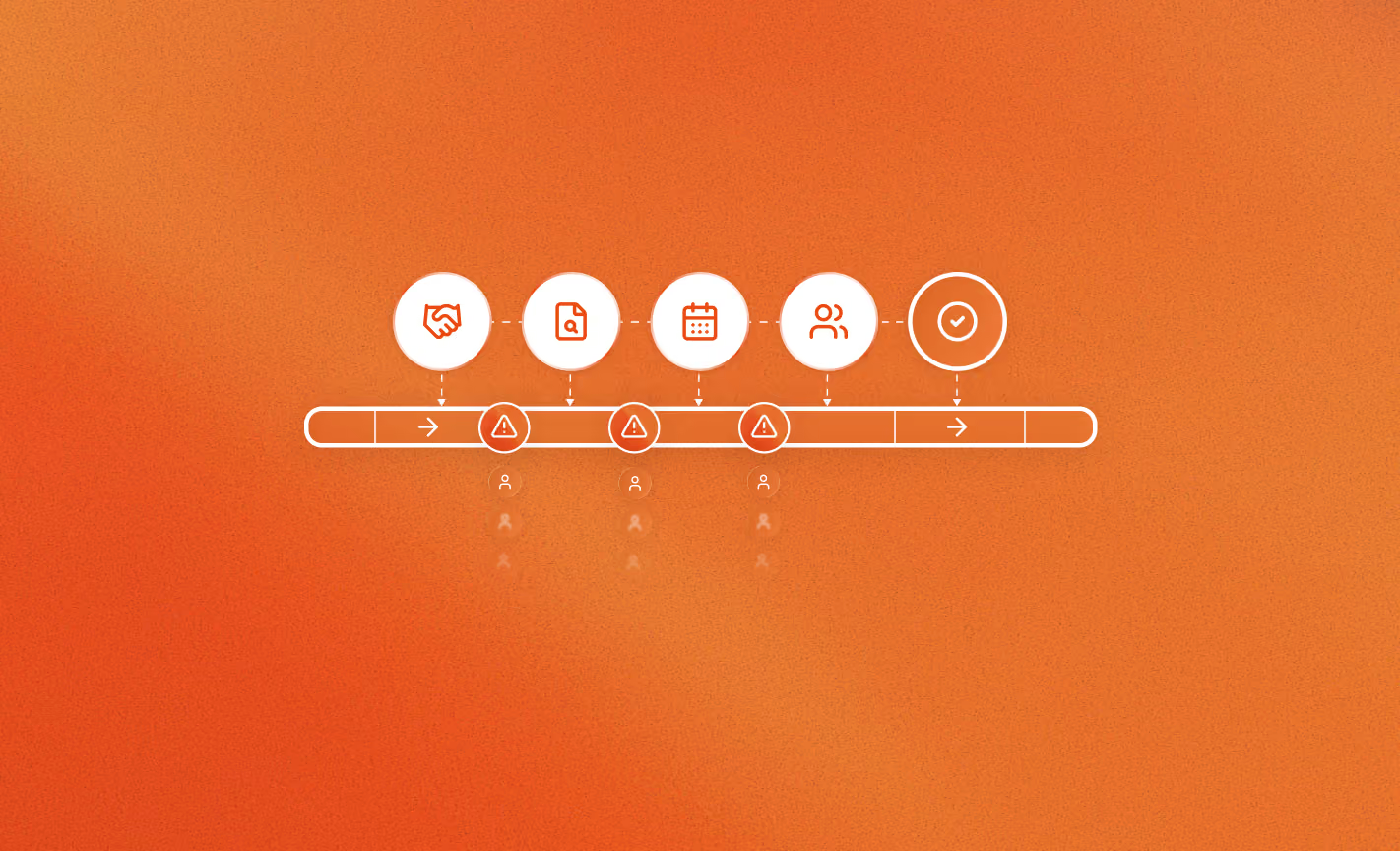
Let’s look at the four most common failure points in manufacturing recruitment today, and how AI agents are helping hiring teams solve them.
The problem is not sourcing
Manufacturing TA teams tend to invest heavily in the top of the funnel. Job boards, referral schemes, partnerships with local agencies, and social media posts for upcoming shifts.
Sourcing has become more sophisticated over the past decade, and application volumes for frontline roles are generally not the issue.
The drop-off happens afterwards. A candidate applies, and no immediate confirmation comes through. They hear nothing for a day, or two. Meanwhile a competitor has already screened them, sent a WhatsApp message, and booked an intake call.
By the time your recruiter opens their inbox on Thursday morning and works through the backlog, that candidate has already accepted elsewhere and simply moved on.
This is not a hypothetical pattern. It is the standard experience for candidates applying for frontline manufacturing roles across Europe, and it is the primary reason that otherwise well-run hiring processes consistently fail to convert applications into hires at the rate they should.
Why manufacturing is particularly exposed
Retail hiring has a similar problem with response speed, but retail candidates typically apply in the evening and have more flexibility around timing. Logistics has the same gap, but depot locations often have dedicated coordinators on site.
Manufacturing plants face a specific combination of factors that makes the drop-off problem worse than in comparable sectors.
1. Shift patterns create coverage gaps in the hiring process itself
The people best placed to move recruitment forward – HR business partners, line managers, on-site coordinators – are frequently unavailable during exactly the hours candidates are applying. A candidate who submits at 9pm after finishing a shift at another employer will not get a response until the following morning at the earliest, often later. Production doesn't pause for hiring admin.
2. Production pressure pushes recruitment down the priority list
When a line is running short-handed, the immediate pressure is to manage the floor. Recruitment becomes the task that gets picked up when everything else is handled, which in a manufacturing environment is rarely soon enough. Candidates who might have been converted are lost without anyone noticing.
3. Role requirements add friction to every step
Frontline manufacturing roles often carry specific requirements around shift availability, physical capability, certifications, and language. Screening manually for these takes time, and when a recruiter is working through applications one by one, the speed advantage of faster engagement is immediately eroded by the qualification bottleneck behind it.
4. Multi-site operations multiply the problem
Plants hiring across multiple facilities, shifts, or lines have the added complication that a candidate qualified for one site may be the right fit for another, but only if someone is paying attention when the mismatch happens. In a manual process, that cross-site routing almost never occurs. Qualified candidates are rejected on timing rather than fit, and lost to competitors instead.
.avif)
What the drop-off actually costs
The visible cost of candidate drop-off is an open role that takes longer to fill. The less visible cost is what that open role means for operations.
An unfilled position on a production line is not a neutral event. It means either running understaffed, which affects output and puts pressure on remaining operators, or managing the gap through overtime, which is expensive and unsustainable. In facilities where shift coverage is tight, one open role cascades quickly into a broader operational problem.
The harder calculation is the cost of re-advertising, re-screening, and re-processing a candidate pool for the same role after the first round of applicants drops off. In facilities with high turnover, this cycle repeats constantly, and the cumulative cost, in recruiter time, advertising spend, and management attention, is substantial even when it is never measured directly.
Where agentic AI changes the equation
The core problem is that the speed and consistency required to catch candidates in this short window cannot be reliably delivered by a human process operating at human pace. What manufacturing hiring needs is a system that removes the human dependency from the parts of the process where it creates the most delay.
That is what agentic AI does. Rather than individual tools that speed up isolated steps, an agentic setup runs the entire workflow end-to-end with minimal human input, maintaining momentum between stages rather than waiting for a recruiter to pick things back up.
Here is what that looks like across the specific pressure points.
Immediate engagement: The host agent
From the moment a candidate applies – whether at 6am before a morning shift, at 11pm from their phone, or on a Saturday – the host agent responds. Not an automated acknowledgement, but a contextual, conversational engagement that answers questions about the role, sets expectations about the process, and moves the candidate to the next step.
In a multilingual manufacturing workforce, this matters as much for language as it does for timing. The host agent engages candidates in whatever language they are most comfortable using, which removes one of the more persistent friction points in frontline hiring across European plants.
A candidate in a Polish-speaking production facility gets the same quality of immediate engagement as one responding in Dutch or French.
The practical impact is straightforward: Response time drops from hours to seconds. Candidates who would have drifted to a competitor while waiting for a human to pick up their application are instead already moving through your process.
Consistent qualification: The screening agent
Once a candidate is engaged, the screening agent takes over qualification. Every candidate is asked the same questions, evaluated against the same criteria, and assessed for the same role requirements – shift availability, location fit, certifications, physical requirements – regardless of which site they applied to, what day it is, or how busy the HR team happens to be.
In manufacturing, this consistency matters for a reason beyond efficiency. When screening is handled by different people under varying degrees of time pressure, standards drift. The criteria that matter to one line manager are not quite the same ones that matter to another. Agentic screening removes that variability, which over time improves the quality and predictability of who reaches the interview stage.
The screening agent also flags candidates who don't qualify for one role or site but might qualify for another, feeding directly into the routing logic rather than simply rejecting them and moving on.
Cross-site routing: The routing agent
This is the capability that manufacturing operations specifically tend not to have in a manual process. When a candidate completes screening but demand at their preferred site has shifted, the routing agent evaluates whether they are a fit for another site, another shift, or a comparable role elsewhere in the facility network.
In facilities with seasonal demand fluctuations, planned ramp-ups, or ongoing multi-site hiring, this means qualified candidates who would previously have been lost to timing are instead redirected intelligently. The effective candidate pool across all sites is considerably larger than any individual site sees, and agentic routing makes it accessible rather than wasted.
Shift-resilient scheduling: The scheduling agent
Scheduling is where manufacturing hiring loses a disproportionate number of candidates who have already cleared screening. The coordination challenge is real: Candidates are on shift schedules, hiring managers are on shift schedules, and finding mutual availability in a way that doesn't take three days of back-and-forth is genuinely difficult to do manually at volume.
The scheduling agent manages calendar availability, offers slots in real time, sends reminders, handles rescheduling when shifts change, and follows up with candidates who miss appointments without waiting for a recruiter to notice the no-show. The gap between screening completion and booked interview, which in a manual process can stretch to a week or more, closes to a matter of hours.
ATS hygiene and admin: The admin agent
Every step the agents take is logged automatically. Candidate records are updated, screening outcomes are captured, interview notes are structured and synced, and the ATS reflects what is actually happening in the pipeline rather than what someone managed to log at the end of a busy day.
For manufacturing TA teams managing high volumes across multiple sites, this has a compounding effect over time: Cleaner data, more reliable reporting, and a talent pool that can actually be drawn on for future hiring waves rather than one that has degraded through inconsistent record-keeping.
What this looks like in practice
ORANJEGROEP, a recruitment firm specializing in blue-collar hiring across Europe, faced a version of this problem at a significant scale: Candidates applying across ten countries and ten languages, a small core team that could not physically keep up with the volume, and a hiring process that was losing candidates at the gaps between stages rather than at the stages themselves.
After building an agentic hiring setup, their process engaged candidates immediately after application, around the clock, in their native language. Screening ran continuously. Scheduling was automated. Within six months, the team had processed over 15,000 candidates, made 500 additional hires, and tripled placement volume per recruiter – without adding headcount.
The constraint on their capacity was never sourcing. It was the gap between application and qualified, engaged candidate, and closing that gap was what changed the numbers.
The shift that matters
Manufacturing plants have spent years optimising production: Reducing waste, tightening cycle times, and eliminating bottlenecks. Most have applied very little of that thinking to recruitment, which in many facilities still operates with the same tolerance for delay and handoff failure that production workflows discarded a long time ago.
The candidates are applying. The sourcing is working. The question is whether the process on the other side of that application is fast enough, consistent enough, and available enough to convert them before a competitor does.
An agentic hiring setup answers that question structurally rather than relying on the availability of the people running it. For manufacturing operations hiring at volume, that structural answer is what makes the difference between a pipeline that converts and one that leaks.
Want to see how agentic AI works in practice for frontline hiring? Book a demo with our team.
.avif)
.avif)
