
.avif)


If your retail business operates on a model that relies on recruiting candidates in high numbers, you’ll be familiar with some of the great generalist HR and applicant tracking system (ATS) vendors on the market right now – iCIMS, Greenhouse, Ashby, Humanly, Workable, ApplicantStack, Workstream and Bullhorn, just to name a few.
But while these generalist systems can be transformative for many businesses, they’re not designed with retail hiring challenges in mind. It also won’t come as a surprise that AI has completely changed what we can do with HR tools and ATS's now. Thanks to technology like machine learning and conversational AI, retailers can deal with huge numbers of candidates in a way that was never possible before – providing a fast, streamlined process for candidates en masse while still making sure they get the same personalized candidate experience as if they’re dealing one-to-one with a human recruiter.
There are tools out there now that have been built specifically with retailers in mind, meaning they’re designed from the bottom up to tackle the exact challenges retailers face when recruiting high numbers of candidates into roles when demand is constantly fluctuating – across departments, across stores or even countries.
So instead of presenting you with a list of generalist HR tools for retailers, or even generalist AI-powered recruiting tools, I’ve pulled together a list of tools that have been built to address challenges that are specific to retail talent acquisition - a list that’s been curated around what actually makes retail hiring different from other high-volume hiring industries.
Why does retail hiring need its own tool stack?
If you’ve been using generalist HR software for managing candidates and finding that it hasn’t made the hiring process as easy and seamless as you’d hoped, that’s not entirely surprising. That’s because there are a few things about retail hiring that make it quite different from other high-volume hiring, and most generalist tools can’t support this.
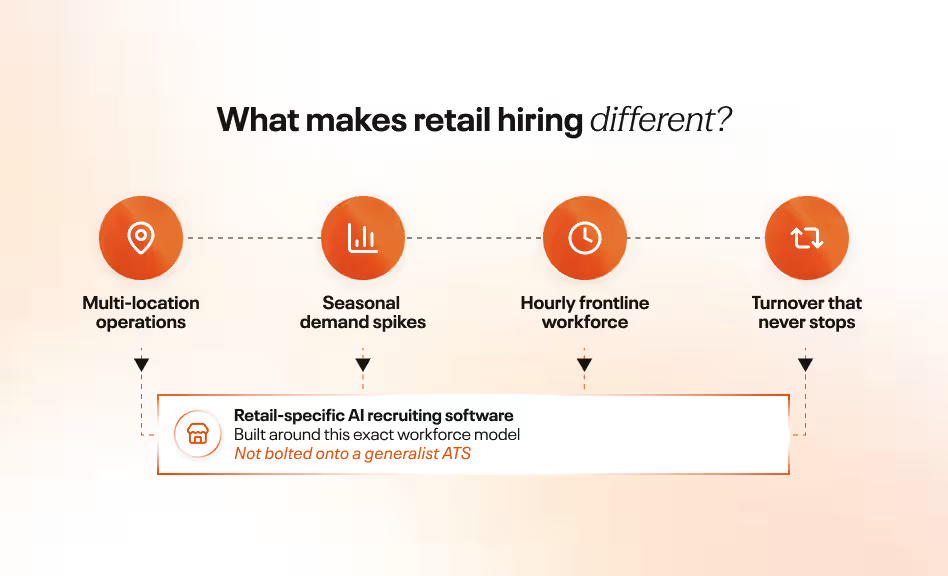
Retail businesses are built on a complex workforce model that involves multi-location, seasonal spikes, an hourly frontline workforce, and turnover that never really stops.
That’s why, for this guide, we’ve chosen AI recruiting software tools that are specifically built with this model in mind. Your standard ‘best hiring software’ might work magic for a lot of businesses, but it won’t touch sides for a complex enterprise retail recruitment operation. So here’s my top 10.
Top 10 AI recruiting tools for retail hiring
1. Carv
Best for: Agentic, always-on hiring
If, like Carrefour, you’re an enterprise retailer receiving thousands of candidate applications for roles across multiple stores globally, you need to lean on technology as much as you can to keep your shifts staffed. But an additional challenge for these kinds of retailers is that store managers are tasked with hiring, but they’re not recruiters. They don’t have the time to juggle hiring tasks and will often rush the hiring process because it’s a time-consuming part of the job, and quite simply, they have a store to run.
Carv’s agentic AI solution is perfect for these kinds of retailers, as the software is sophisticated enough that it functions as a 24/7, always-on retail recruitment system that requires virtually no human input. Job applicants are met by an AI host, who then handles conversational AI screening, scheduling, and admin across multiple store locations – all managed from one central dashboard.
When Carv is managing the hiring process, all store managers need to do is have the final say on the shortlist of fully qualified candidates who have passed all the screening and assessment, and welcome them to the store on their start day.
2. HigherMe
Best for: Managing large seasonal surges
HigherMe is a hiring tool that’s designed to absorb sudden multi-location vacancy spikes (Christmas, back-to-school) without impacting the day-to-day of business.
It’s a tool that’s been specifically created with retailers in mind, and the chaos that can ensue when there are surges in both demand and candidate applications, and everything needs to happen quickly without increasing the workload on store managers who aren’t recruiters and are already extremely busy with the job they’ve actually been hired to do.
HigherMe is built specifically for hourly, high-turnover employees, coming complete with features like mobile-first applications, AI pre-screening, and a ‘Hiring Hub’ dashboard that lets you view every location's pipeline and take bulk actions without logging into separate store accounts.
The potential downside of this is that, as it's built almost entirely around hourly, frontline hiring, if you've also got salaried or more executive roles to fill as well as hourly workers, you'll likely need a second hiring system to run for these vacancies alongside it, as these roles require a totally different approach.
3. GoHire
Best for: SMS-first candidate engagement
GoHire is built on the insight most retailers know is a given: your hourly candidate pool applies for jobs and communicates entirely on their smartphones.
According to GoHire’s data, candidates open recruitment texts 98% of the time, and 90% are read within three minutes, versus single-digit response rates for recruiting emails.
With this insight in mind, GoHire runs the whole early-stage candidate journey over two-way SMS, from the apply stage, through to pre-screen, to self-scheduled interview. For multi-location retailers, the stand-out feature of this tool will be how little manual chasing is required to fill up your candidate pipeline. They report that as many as 92% of qualified candidates self-schedule their interview within 24 hours of applying. Recruiters can also text candidates directly from job board listings via a Chrome extension without leaving the page.
The one thing to keep in mind is that because this tool is built around SMS, it leans on TCPA compliance being set up correctly. Therefore, it’s important that you capture candidate consent sufficiently from the beginning.
4. Paradox
Best for: Multi-location interview scheduling
Paradox is a talent intelligence platform whose main pitch is Olivia, the tool’s conversational AI assistant. There are a whole load of great benefits to letting Olivia manage stages of your recruitment process, but for retail hiring, the biggest one is her ability to schedule (and reschedule) a high number of interviews across many store manager calendars and locations all at once.
Olivia syncs directly with recruiters' and hiring managers' calendars, then sends qualified candidates open interview times via SMS, WhatsApp, chat, or email. The bot also handles the whole burden of rescheduling, managing changes to interview slots en masse through conversational scheduling, sending out reminders automatically when necessary without any human input needed.
For retailers with dozens or even hundreds of store managers all trying to book interviews around their shop floor duties, Paradox is able to lift that interview admin entirely off their shoulders.
It’s worth noting that Paradox is an enterprise-grade tool with enterprise-grade pricing and implementation, so it will be overkill if you're only managing a handful of store locations.
5. Turn
Best for: Fast background checks for hourly roles
The bureaucracy around background checks is a hiring bottleneck that large retailers will be very familiar with. If you have a slow system for background checks, this not only leaves shifts unfilled, but it can lead to drop-offs if candidates get another offer in the meantime.
As the brand name suggests, the background check tool Turn is designed for fast, high-turnover recruitment that supports rapid workforce planning and quick backfilling of hourly workers. Turn is able to deliver a full-bundle background check – including criminal, motor vehicle records, drug testing, and employment verification – with an average turnaround of just six hours.
The focus is very much on speed here, so if your retail business also needs more complex checks for senior or international hires, this probably isn’t the right tool for you.
The tool’s retail-specific screening is aimed at supporting high-volume workforce planning, such as ensuring there’s no internal workforce shrinkage when last-minute backfilling is a regular requirement, and it helps keep peak-season hiring moving.
Turn also offers seamless ATS integration to eliminate duplicate data entry and provides a mobile-friendly screening portal for on-the-spot screening at hiring events.
6. Harver
Best for: Frontline roles that require soft skills assessments
Like many retail hiring tools on the market, Harver uses conversational AI and candidate screening to assess job fit. But where it really stands out for retail hiring specifically is its use of situational judgement tests built specifically around real retail scenarios. This feature allows retailers to easily and reliably assess candidates for soft skills that are essential to a role but can’t be identified in a resume.
So if a candidate is applying for a grocery role, their assessment might involve being shown a video of a customer asking for help while they're restocking shelves, then being asked to choose the most effective response from a ranked list of options. They’re then automatically scored against what your own top performers would do to get a meaningful result that’s tailored exactly to your store's successful way of working.
According to Harver's own data, this kind of candidate matching improves the overall quality of hire, cutting time-to-hire by around 40% and reducing early attrition by up to 25%. It's also built to adapt to specific retail environments, so a grocery chain will have a very different virtual assessment from a luxury department store.
It’s worth noting that this assessment-heavy approach to skills-based hiring fits frontline and volume roles really well, but Harver won’t be the best match if you're screening for more niche or professional retail positions.
7. Sense
Best for: Rehiring seasonal boomerang employees
If your business relies heavily on rehiring past seasonal staff to keep things moving over peak periods like Christmas, you’ll be pleased to know that Sense is a hiring tool that’s built specifically around that challenge.
Sense’s secret weapon for retailers is its conversational CRM, which allows recruiters to tag and segment high-performing seasonal employees already in the CRM, and then uses conversational AI technology to send personalised re-engagement campaigns as the next peak season approaches. It does this automatically by running sophisticated recruitment automation workflows that do the forward thinking for you, so demand doesn’t sneak up on you.
Sense doesn’t just automatically recruit a step ahead of you at all times, but it also supports internal mobility through workflow automation and means you don’t have to do any outbound sourcing, which will reduce your cost-per-hire too.
Alongside these rehire workflows, Sense also runs conversational AI screening, interview and shift scheduling, and integrations into major HRIS platforms like SAP SuccessFactors, Oracle Taleo, and Workday.
With that much automation and configurability involved, Sense isn’t a simple tool you just plug and play in a day. It takes a fair bit of setup and is built for retailers with the scale (and internal resources) to make full use of it as an enterprise talent engagement platform. So you’ll need a bit of forward thinking with onboarding the software, but once it’s set up, the software will take over all the future forward thinking for you.
8. GoHiring
Best for: Multi-channel job posting
GoHiring solves a different problem from most tools on this list: getting a high volume of frontline vacancies in front of as many eyes as possible, as fast as possible.
This tool can post job ads to more than 1,000 job boards and social channels from a single dashboard, with no individual channel setup required. GoHiring’s marketing claims to save recruiting teams around 50% of the time they would typically spend marketing their roles. For a retailer juggling constant openings across dozens of stores, that breadth of reach (plus the ability to upload your existing job board contracts and post at your own negotiated rates) is the main draw of this tool.
It’s important to note that GoHiring is an EU platform, which means a lot of the job board coverage won’t be relevant to non-EU retailers.
9. WorkBright
Best for: Onboarding and paperwork automation
When you’re hiring staff at the kind of pace where you often need candidates to be on the shop floor the next day, you need an onboarding process that works its magic at compressing that hired-to-start time.
Once you make a hire, WorkBright compresses that gap between the job offer and their first shift – which we know matters hugely in retail. A slow onboarding process is what causes candidates to ghost you for a faster-moving competitor.
WorkBright does this by firing out any paperwork via text link or email the moment they accept a job offer, and new hires can complete everything – including their I-9 verification – from their phone. That mobile-first design is what really makes this tool stand out for hiring a frontline retail workforce that's rarely sitting at a desk.
WorkBright is a brilliant onboarding tool, but it doesn’t come with any other retail hiring features, like an applicant tracking system or a screening tool, so you'll need to run it alongside other tools that handle resume screening and pipeline management.
10. Hireology
Best for: POS/HRIS/scheduling-system integration
Hireology's strength is tying hiring data into the systems your retail operation already runs on, rather than asking you to bolt on another standalone tool. It offers a variety of out-of-the-box and custom integrations across payroll, scheduling, DMS, and HRIS platforms, and supports configurable connections plus open API access, alongside HCM integrations with providers like ADP and Workday.
For a large retailer that already has scheduling and payroll systems bedded in, that connective tissue is the whole point – new hires flow through to the systems your store managers use every day without manual re-entry.
The depth of integration involved with Hireology means it comes with a more involved setup than some of the lighter tools on this list. If you’re looking for a simple, off-the-shelf system without any team onboarding, you might find Hireology isn’t the best fit.
Building for always-on retail hiring, not seasonal firefighting
The biggest lesson from this list is that retail hiring works best when all the processes aren't treated as a collection of disconnected tasks. Using AI, you can build a hiring operation that can run continuously in the background, responding to changing demand without adding any more administrative work for recruiters and store managers.
That means moving towards AI-powered always-on recruitment: building candidate pipelines before you need them, automating the repetitive parts of the hiring journey, and giving hiring managers qualified candidates rather than resumes to drown in.
For large, multi-location retailers in particular, that connected approach can completely transform how you hire - and how you operate. Carrefour is one example of what this can look like in practice, using AI to support recruitment at the scale and complexity of a global retail operation.
If you're looking to build a more scalable approach to retail hiring, take a look at how Carv works in retail or book a demo to see what always-on recruitment could look like across your stores.