


Every AI recruiting setup promises a human in the loop. The phrase sounds reassuring, but it rarely says who the human is, what they look at or when they step in.
Once agents run most of the hiring process, those answers decide whether the setup is safe, fair and fast. So let's take a closer look at what the phrase means in practice and why it matters to a TA lead.
Why "human in the loop" needs a definition
In most conversations, "human in the loop" means a person is somewhere near the process. That is too loose to design around.
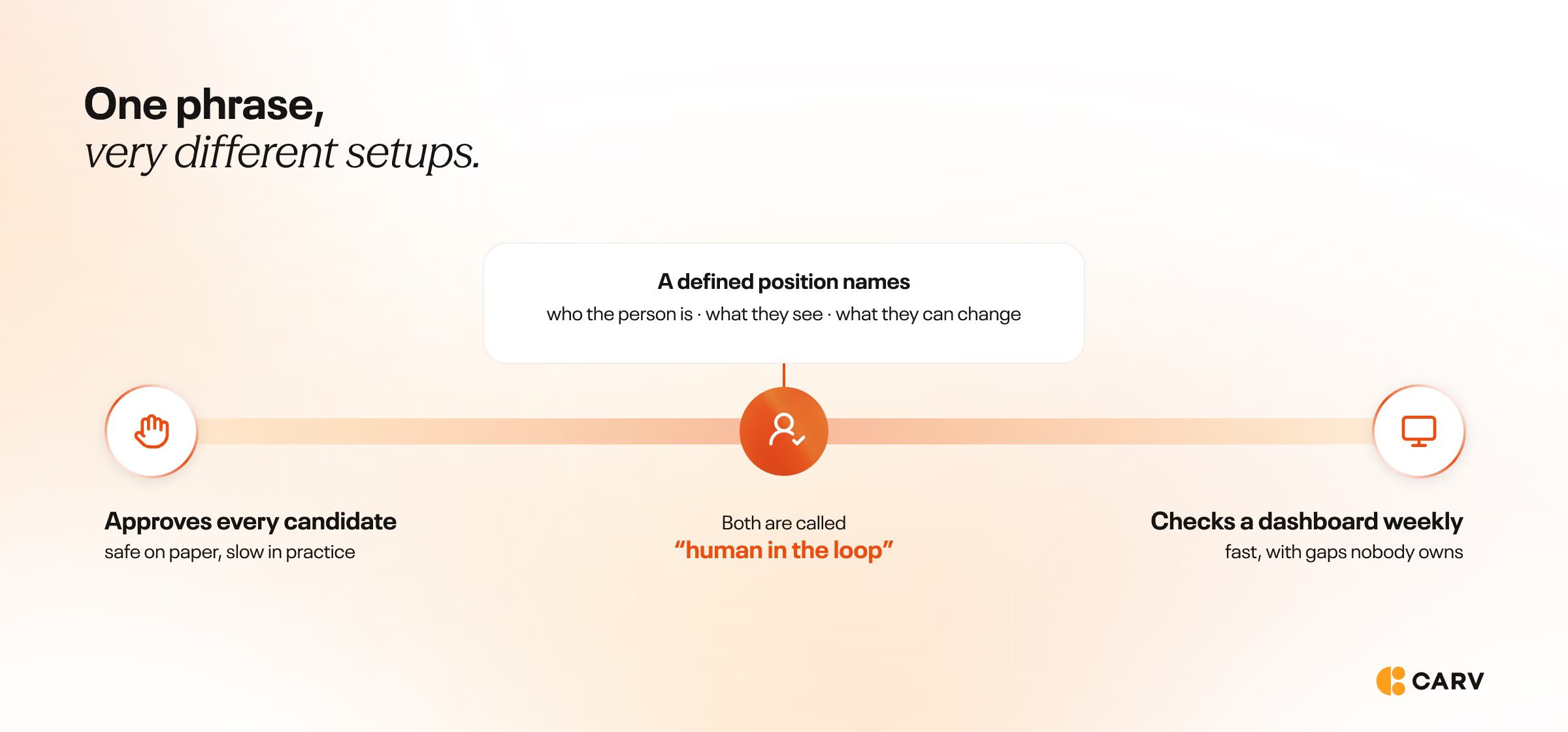
A recruiter who approves every candidate by hand is in the loop. So is a recruiter who checks a dashboard once a week. The two setups behave very differently. The first is slow and safe on paper; the second is fast and leaves gaps nobody owns.
A useful definition names three things for each step: who the person is, what they see, and what they can change. Without those, oversight turns into a checkbox.
The first of the three, who the person is, depends on where they sit relative to the work.
Three places a person can sit: in, on and over the loop
A person can relate to an agent's work in three ways:
- In the loop: the agent prepares the action and a person approves it before it happens. A final rejection waits for a recruiter to confirm it.
- On the loop: the agent acts on its own and a person watches the results and steps in when something looks wrong. Interview bookings go out, and a recruiter reviews the exceptions.
- Over the loop: a person sets the goals, rules and limits the agents work within, and reviews how the whole system performs. They rarely see individual candidates.
In the loop gives the most control and the most delay. On the loop keeps the speed and relies on good monitoring. Over the loop shapes every decision without touching any of them.
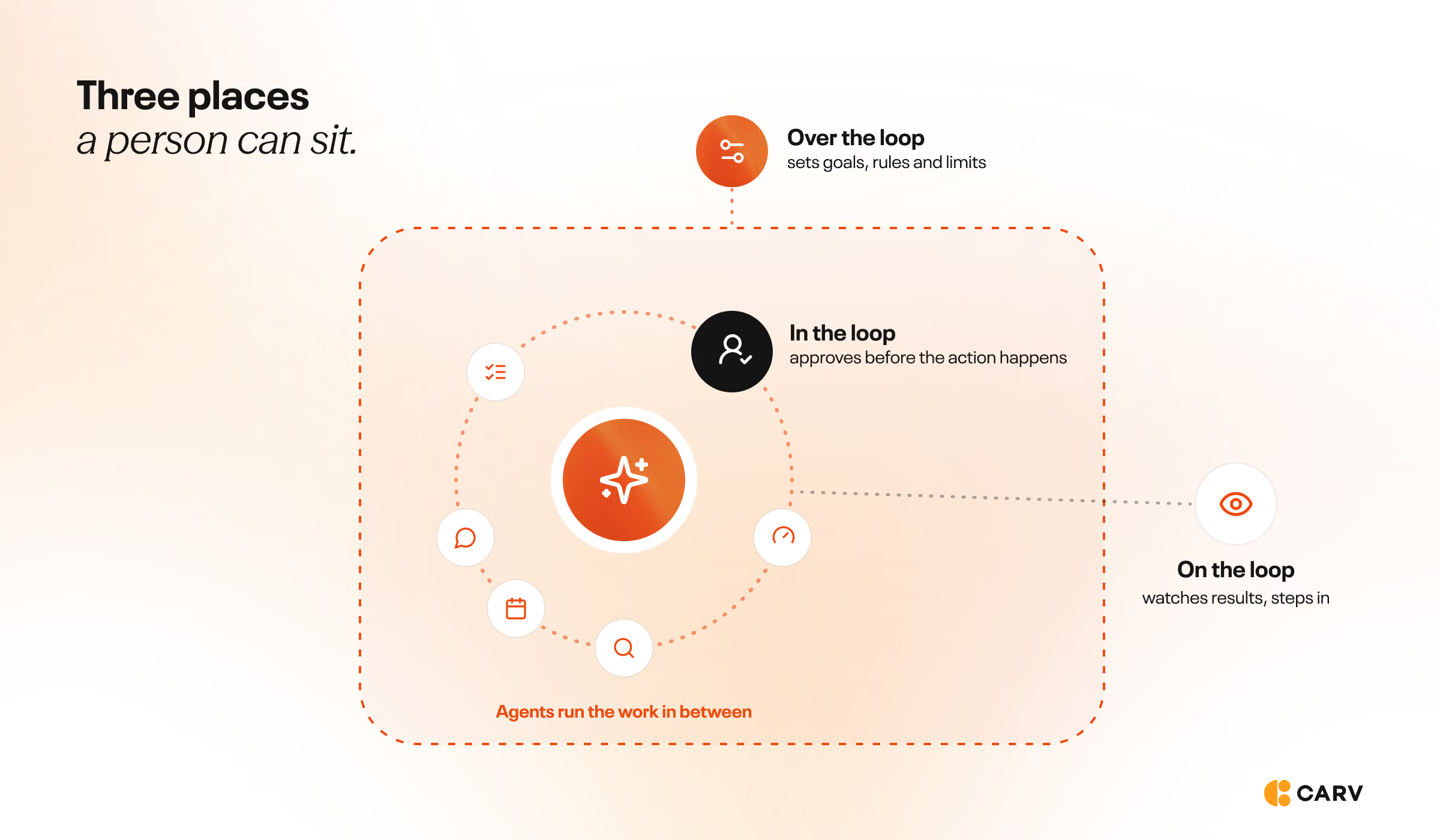
A working setup uses all three. In a well-run operating model, the head of TA and a talent engineer sit over the loop, recruiters sit on it for most steps, and someone sits in it for the decisions that matter most.
The hard part is deciding which steps those are.
Where people belong in the hiring process
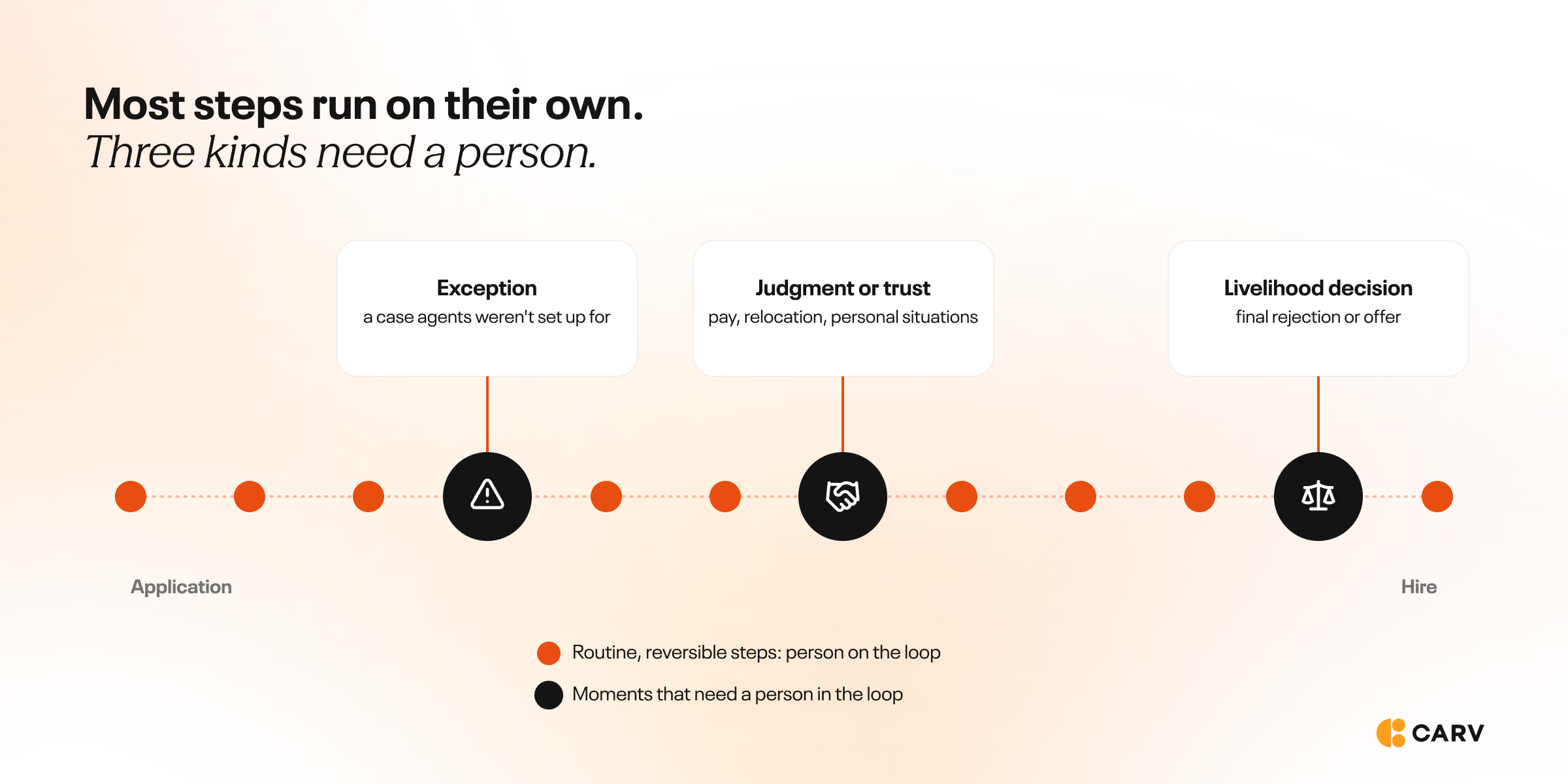
Most steps in a hiring process are routine and reversible. A screening question can be asked again and an interview can be rebooked. Those steps run well with a person on the loop.
Three kinds of moments call for a person in the loop.
Decisions that change someone's livelihood
A final rejection, an offer, or the decision to withdraw one changes a person's income and plans. These decisions are hard to reverse, and the candidate deserves to know a person made them.
Agents can prepare these decisions: gather the evidence, score against the criteria and draft the message. A person confirms them.
Moments that need judgment or trust
Some conversations depend on reading a situation: a salary negotiation, a candidate who is unsure about relocating, or someone sharing personal circumstances that affect their availability.
An agent can recognize these moments and hand them over. The value of a person here is the relationship, and a fast handover keeps it intact. More on the human side of hiring is in this post on human-AI synergy.
Exceptions the system hasn't seen before
Agents work well inside the situations they were configured for. A candidate with an unusual work history, a role with requirements nobody wrote down, or a question the agent has no answer to falls outside them.
The right behavior is to stop and escalate, with a clear reason. A system that guesses at exceptions creates the errors oversight is meant to prevent.
In all three cases, the quality of the handover decides whether the person can actually help.
What a good handover looks like
A handover is the point where work passes from an agent to a person. Done badly, the person starts from scratch and the candidate waits.
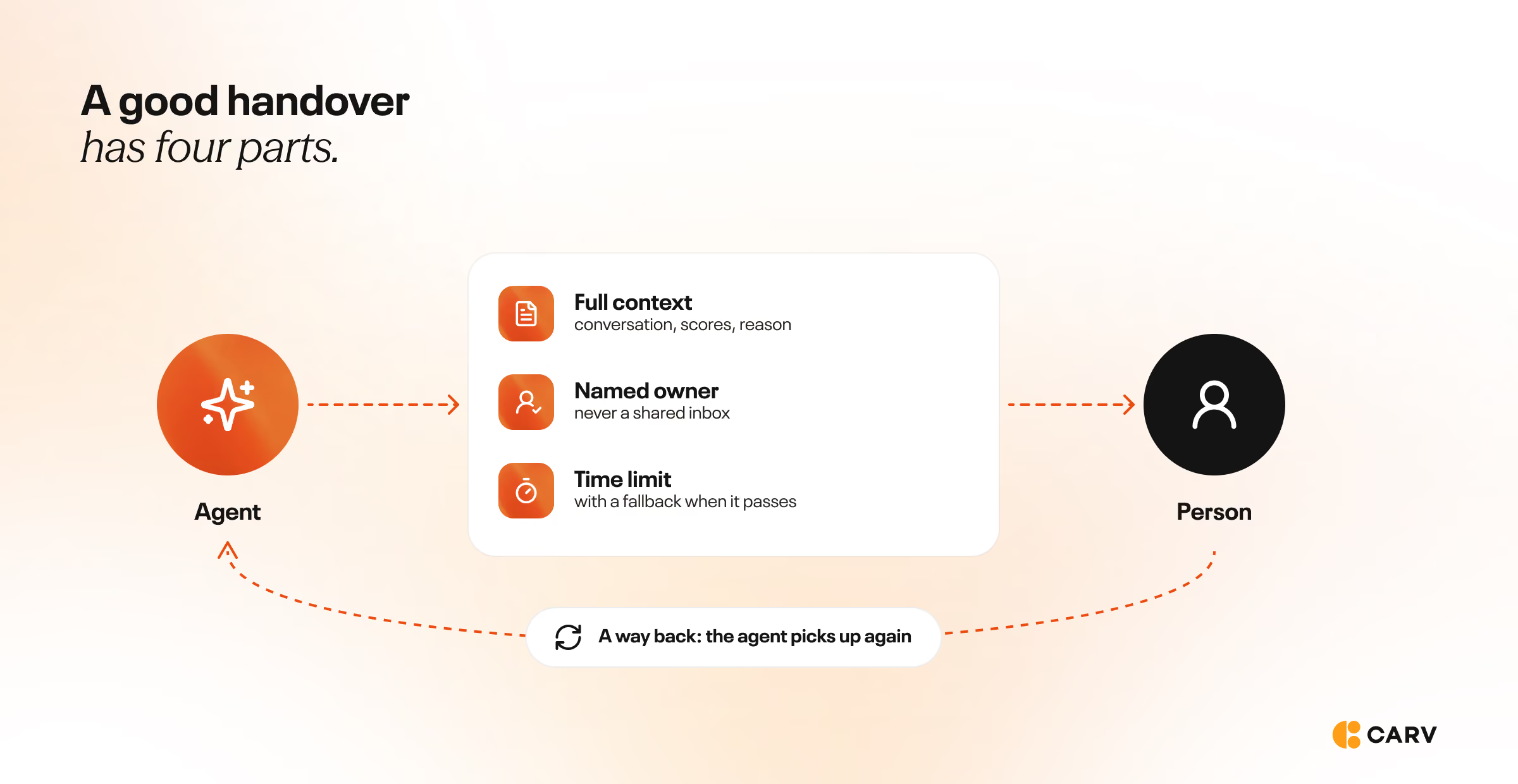
A good handover has four parts:
- The full context: the conversation so far, the scores and the reason for escalating, in one place.
- The right person: a named owner for each kind of handover, so nothing sits in a shared inbox.
- A time limit: an expected response time, with a fallback when it passes.
- A way back: once the person has decided, the agent picks the process up again and the candidate hears what happens next.
Candidates should notice handovers only as faster, better answers. If they notice a gap, the handover is the place to look.
Every handover also produces something useful: a human decision the system can learn from.
How human decisions make the loop better over time
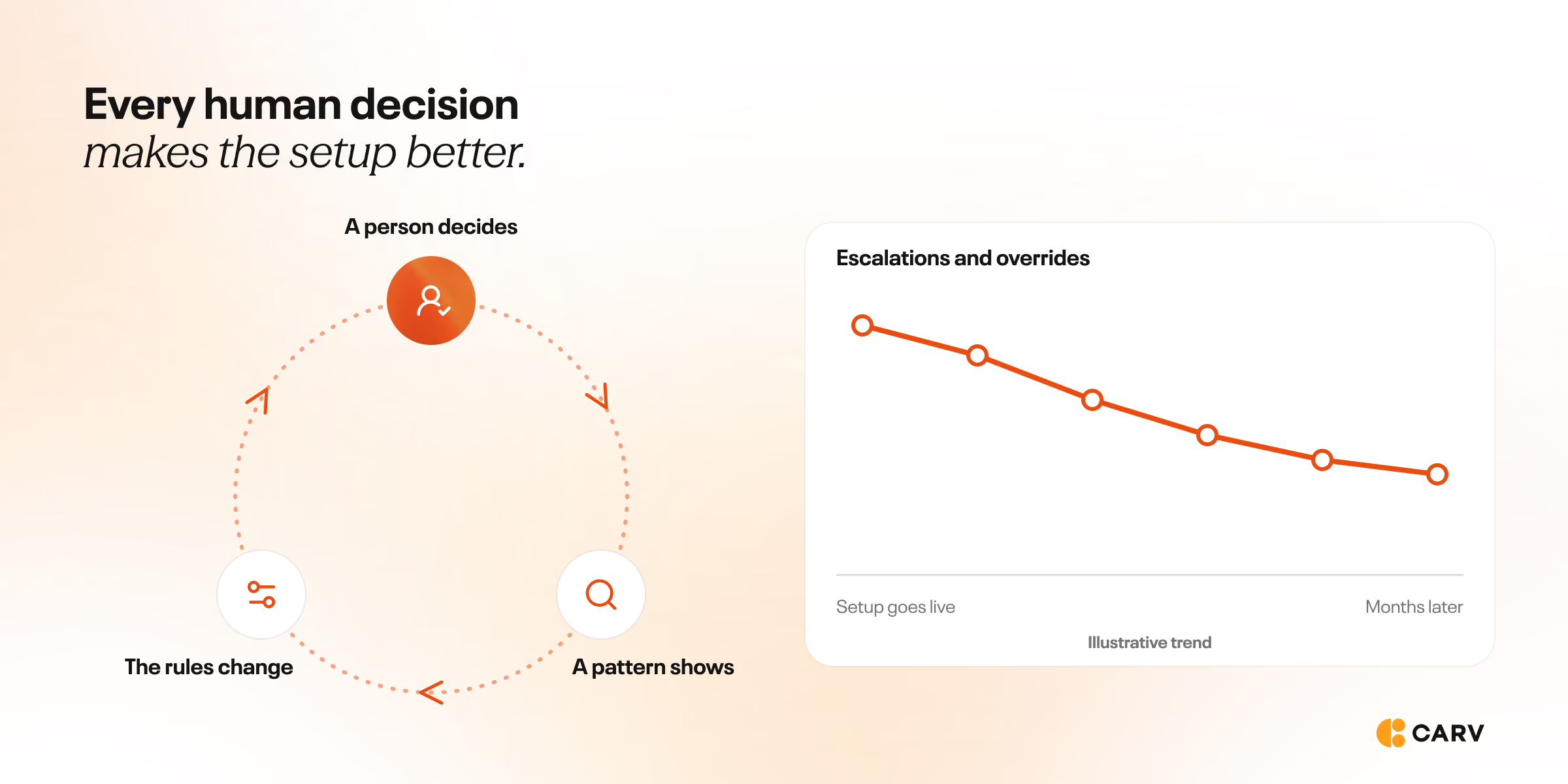
Each time a person overrides an agent, approves a borderline case or answers an escalation, they record a judgment. Those judgments are the best signal for improving the setup.
Patterns show up quickly. If recruiters keep overriding the same screening question, the question or its threshold is wrong. If the same exception keeps escalating, it belongs in the agent's instructions.
The people over the loop turn these patterns into changes: new rules, clearer criteria, updated knowledge. Over time the number of escalations falls, and people spend their time on the cases that need them. That is how outcome-led agents improve without losing control.
Two numbers track this: how often people override the agents, and how often agents escalate. Both should fall as the setup matures, and a sudden rise in either is a signal to look closer. More on measuring AI's impact is in this framework.
Regulators look at the same loop, from the outside.
What regulation requires
The rules on human oversight in hiring come in layers, and the list keeps growing:
- AI regulation: the EU AI Act classes AI used in recruitment as high-risk. Those systems must be designed so people can understand, monitor and override them, with obligations applying from 2 December 2027. More on the EU AI Act and recruitment.
- Data protection law: GDPR and similar laws elsewhere give candidates rights when a decision about them is made by automated means alone.
- State and city rules: in the US, places such as New York City, Illinois, California and Colorado add their own duties, from bias audits to candidate notices and anti-discrimination rules, with more on the way.
Which rules apply depends on where the candidate is. A company hiring in several markets works to the strictest rule that applies to each candidate.
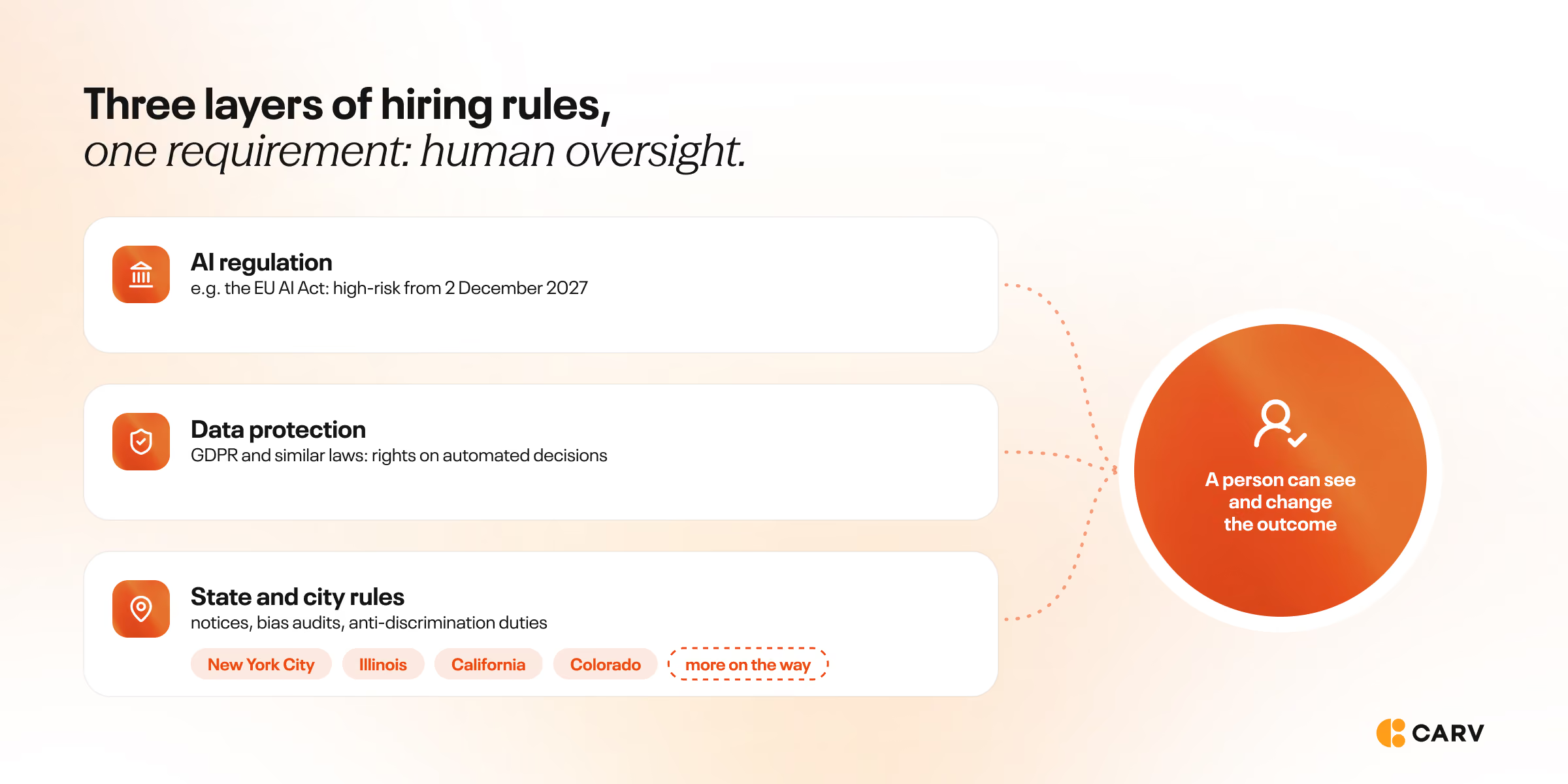
The rules share one idea: a person must be able to see what the system did and change the outcome. A complete action log makes that possible.
Setups built on the three positions above meet that idea by design.
Over to you
Human in the loop means something specific in practice: a named person, in a defined position, with the context to act. People sit over the loop to set the rules, on the loop to watch the work, and in the loop for the decisions that change someone's life.
Get the handovers right, feed human decisions back into the setup, and oversight becomes a source of speed and quality.
Request a demo to see how human oversight is built into an autonomous hiring process.