


A new role is emerging in talent acquisition.
Forward-thinking organizations are starting to hire Talent Engineers: professionals responsible for designing, building, and continuously improving the systems behind how their companies hire.
And these aren't simply recruiters with better technical skills.
Take Gong, for example. The company has advertised a Talent Engineer role focused on building AI-powered workflows, integrations, and data infrastructure for its recruiting operation. Recruiting experience isn't even a requirement. Glide has advertised a similar role, combining recruiting expertise with the ability to build software, automations, and data pipelines.
Different organizations, different backgrounds, but a common direction: hiring is becoming something that can be engineered.
AI is accelerating that shift. Where recruiting technology traditionally helped people execute individual tasks, AI agents can increasingly take responsibility for entire workflows. Combined with orchestration, integrations, and real-time intelligence, that creates an opportunity to fundamentally rethink how hiring gets done.
But these systems don't design, deploy, or improve themselves.
That's where the Talent Engineer comes in.
A Talent Engineer is a professional who designs, builds, deploys, operates, and continuously improves the technology and workflows that power modern hiring operations. They combine an understanding of hiring with the technical and operational capabilities to create more intelligent, connected, and increasingly autonomous processes.
Let's explore what Talent Engineers actually do, the skills they need, the technology they work with, and how they're helping organizations build an entirely new generation of hiring operations.
Why AI is creating the need for Talent Engineers
For decades, recruitment technology has largely been built around helping people execute hiring tasks.
Applicant tracking systems organized candidates and vacancies. Sourcing tools helped recruiters find talent. Scheduling software reduced the back-and-forth of booking interviews. Automation made repetitive tasks faster.
Each generation of technology improved parts of the process, but the underlying operating model remained largely the same: people were responsible for moving hiring forward.
Recruiters reviewed applications, decided who to contact, coordinated interviews, followed up with candidates, updated systems, and managed the handoffs between stages.
Even as technology stacks expanded, the responsibility for connecting everything often remained with people.
AI is beginning to change that operating model.
Unlike traditional automation, which generally follows predefined rules, AI agents can interpret information, execute tasks, interact with candidates, and coordinate multiple activities within defined boundaries.
An AI agent can screen an application, ask follow-up questions, evaluate responses against predefined criteria, update the ATS, and initiate the next step in the process.
More importantly, multiple agents and systems can work together to execute connected workflows without requiring a recruiter to manually coordinate every action.
This creates an entirely new opportunity.
Instead of asking how technology can help recruiters perform individual tasks faster, organizations can ask a much bigger question:
If we were designing our hiring operation from scratch today, with AI available, how would we build it?
Answering that question requires a different combination of expertise. Someone needs to understand the hiring process, translate business requirements into system designs, determine what can be automated, connect the necessary technologies, and continuously improve the resulting operation.
That's the emerging responsibility of the Talent Engineer.
What does a Talent Engineer actually do?
A Talent Engineer is responsible for turning hiring requirements into functioning systems.
Their work extends beyond selecting tools or configuring software. They look at the hiring operation as a whole and determine how its different components should work together.
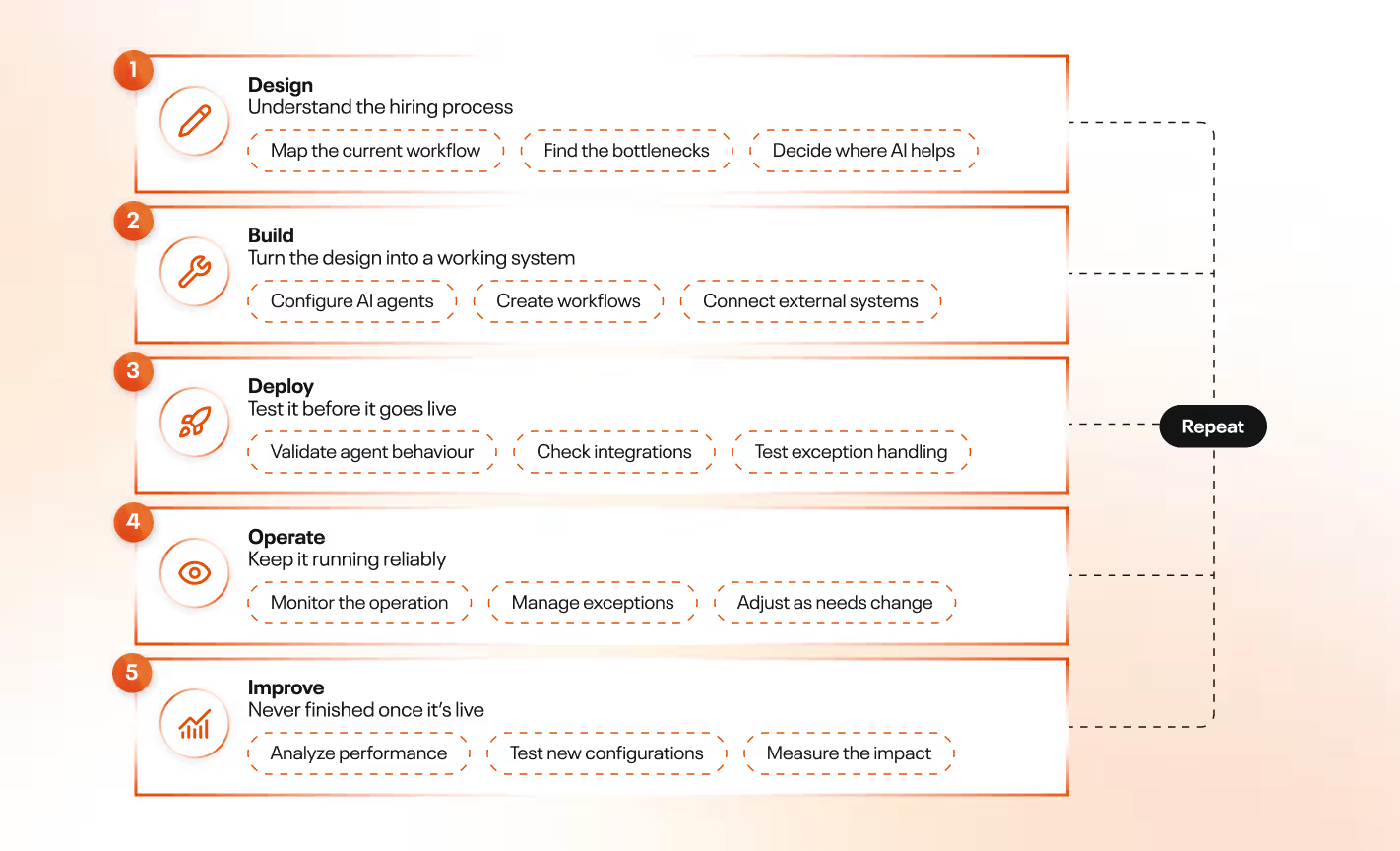
In practice, their responsibilities span five activities.
1. Design
Everything starts with understanding the hiring process.
A Talent Engineer maps the existing workflow, identifies bottlenecks, and determines where technology can improve performance.
Which activities require human judgment? Which tasks are repetitive? Where do candidates experience unnecessary delays? Which decisions could be supported or executed by AI?
The objective isn't to automate everything. It's to design the most effective combination of people, technology, and processes.
2. Build
Once the process has been designed, the Talent Engineer turns it into a working system.
That might involve configuring AI agents, defining their instructions and capabilities, creating workflows, connecting external systems, and establishing rules for how information and decisions move through the operation.
Importantly, building doesn't necessarily mean writing software from scratch.
Modern platforms increasingly allow Talent Engineers to configure sophisticated workflows and AI capabilities without extensive custom development.
3. Deploy
Before a new workflow becomes operational, it needs to be tested.
Talent Engineers validate how agents behave, whether integrations function correctly, how exceptions are handled, and whether the system produces the intended outcomes.
They also determine how new capabilities should be introduced into the existing hiring operation, including the people and processes affected.
4. Operate
Once deployed, AI-powered hiring systems require ongoing oversight.
Agents can encounter unexpected situations. Integrations can fail. Hiring requirements change. Processes that worked yesterday might need adjustments tomorrow.
Talent Engineers monitor the operation, manage exceptions, and ensure the system continues functioning reliably.
5. Improve
Perhaps the most important responsibility is continuous improvement.
A Talent Engineer doesn't consider a workflow finished once it's live.
They analyze performance, identify opportunities, experiment with different configurations, and measure whether changes improve hiring outcomes.
That's what distinguishes Talent Engineering from simply implementing recruitment technology. The goal isn't to deliver a working system once. It's to build an operation that keeps getting better.
What skills does a Talent Engineer need?
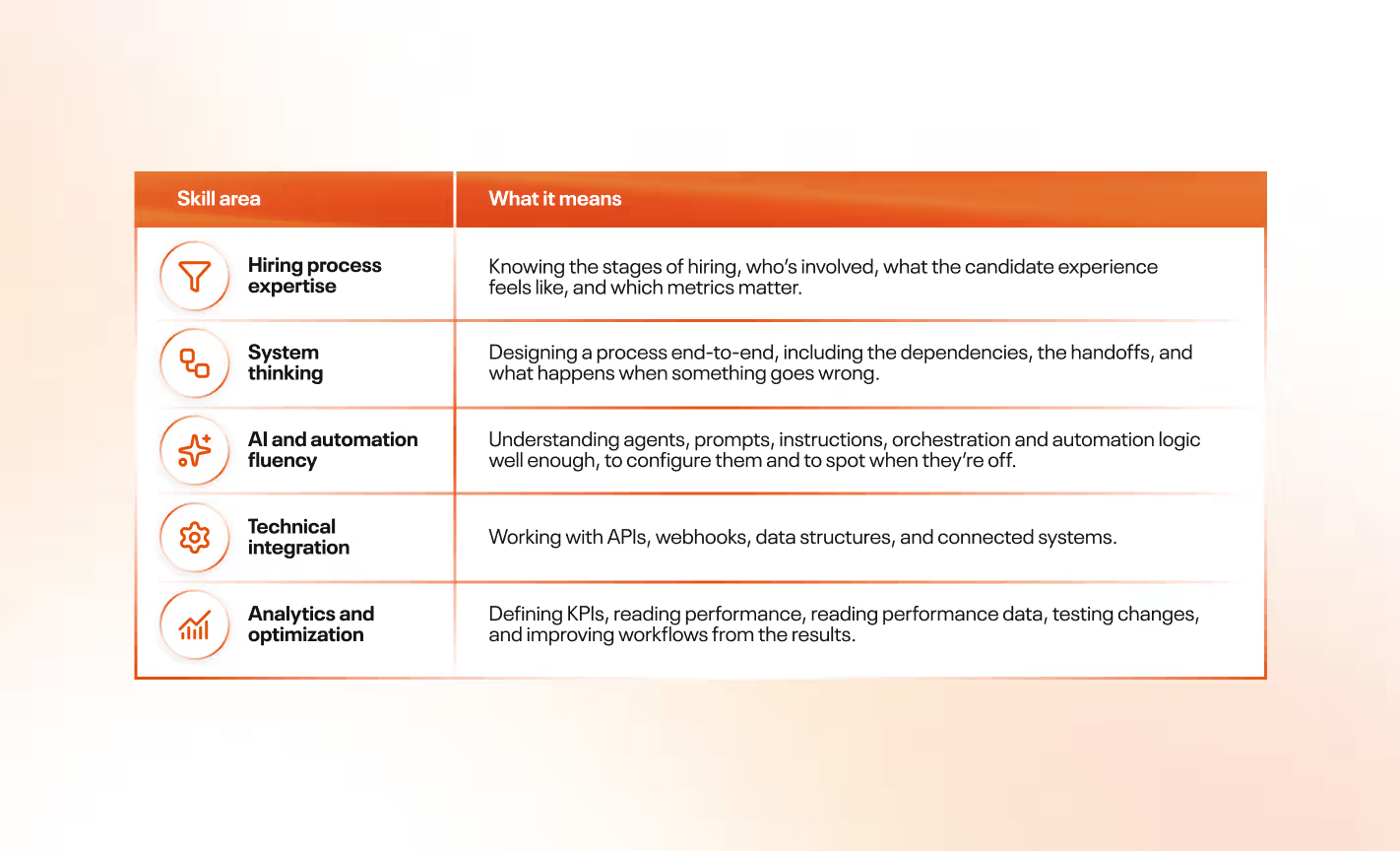
Talent Engineering combines knowledge from several disciplines. The exact skillset varies depending on the organization, but five capabilities are particularly important.
Hiring process expertise
Talent Engineers need to understand how hiring works.
That includes the different stages of recruitment, the responsibilities of recruiters and hiring managers, candidate expectations, and the metrics organizations use to evaluate performance.
They don't necessarily need to have worked as recruiters. Someone from technical operations or systems engineering can develop this knowledge.
But without understanding the process, it's difficult to engineer a better version of it.
Systems thinking
A Talent Engineer needs to see beyond individual tasks.
Automating interview scheduling might be straightforward. Understanding how scheduling interacts with candidate availability, assessment results, recruiter capacity, and hiring manager requirements is more complex.
Systems thinking means understanding dependencies, identifying potential failure points, and designing processes that function reliably from beginning to end.
AI and automation fluency
Talent Engineers need a practical understanding of what AI can and cannot do.
They should know how AI agents work, how to configure instructions and capabilities, how workflows are orchestrated, and how to establish boundaries around autonomous decisions.
Equally important is knowing when AI shouldn't be used.
Not every activity benefits from automation, and not every decision should be delegated to an agent.
Technical integration
Modern hiring operations depend on connected systems.
Talent Engineers should understand concepts such as APIs, webhooks, data structures, and system integrations.
They need to know how information moves between platforms, what happens when a connection fails, and how to maintain consistency across the operation.
That doesn't necessarily mean they need to be software developers.
Technical fluency is essential. Coding expertise depends on the environment.
Analytics and optimization
Finally, Talent Engineers need to be comfortable working with data.
They should be able to define performance indicators, interpret operational metrics, identify bottlenecks, and measure the impact of changes.
Without this capability, Talent Engineering risks becoming an exercise in deploying technology rather than improving hiring.
The strongest Talent Engineers combine technical curiosity with an understanding of business outcomes.
What does a Talent Engineer's tech stack look like?
Understanding the role is one thing. Understanding the technology required to perform it is another.
Traditional recruitment technology stacks are often collections of individual applications: an ATS, sourcing software, scheduling tools, assessment platforms, and reporting systems.
A Talent Engineer approaches technology differently.
Rather than thinking primarily in terms of individual applications, they think about the infrastructure required to build and operate a connected hiring system.
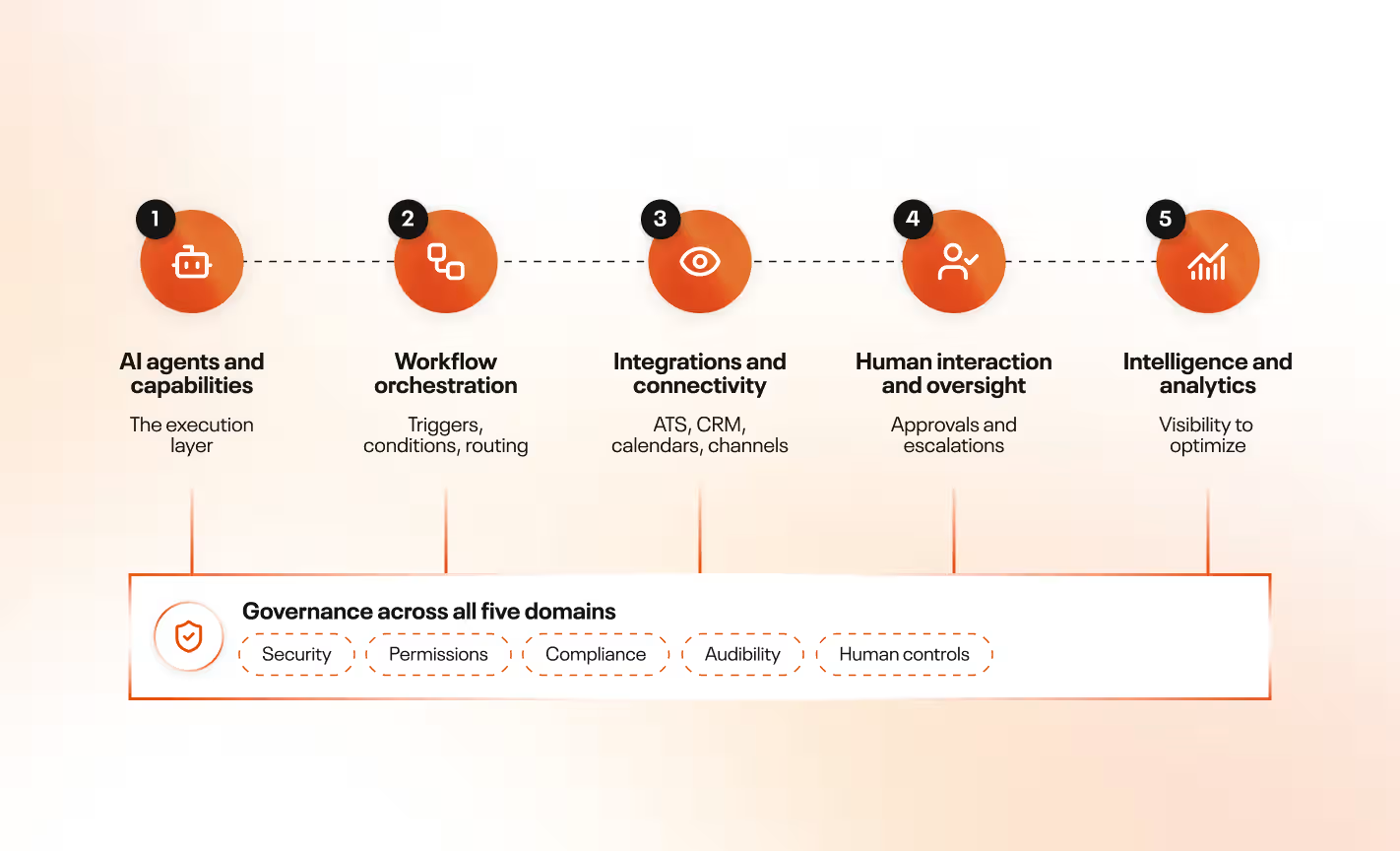
That infrastructure can be divided into five domains.
1. AI agents and capabilities
AI agents form the execution layer of the hiring operation.
Depending on their configuration, agents can support sourcing, candidate engagement, screening, interviewing, scheduling, administration, and other activities.
Talent Engineers determine which agents are needed, what skills they require, which instructions they follow, and what they're allowed to do.
2. Workflow orchestration
Individual agents become significantly more useful when they work together.
Orchestration connects agents, activities, decisions, and human handoffs into coordinated processes.
For example, completing an AI screening conversation might trigger an assessment, update a candidate record, or notify a recruiter.
Talent Engineers define the logic behind these interactions, including triggers, conditions, routing, and exceptions.
3. Integrations and connectivity
Hiring systems rarely operate in isolation.
A Talent Engineer needs infrastructure that connects AI capabilities with applicant tracking systems, CRMs, calendars, communication channels, assessment providers, and other business applications.
These integrations ensure information moves between systems without unnecessary manual intervention.
4. Human interaction and oversight
Even highly automated hiring operations need people.
Recruiters, hiring managers, and other stakeholders must be able to interact with agents, review their outputs, provide feedback, and intervene when necessary.
The Talent Engineer helps determine how that interaction works.
Which decisions require approval? When should an agent escalate a situation? What information does a recruiter need to make a decision?
Human oversight needs to be designed into the system, not added afterward.
5. Intelligence and analytics
The final layer provides visibility into how the operation performs.
This includes traditional recruitment metrics, such as time-to-hire, conversion rates, and cost-per-hire, alongside operational intelligence about AI agents.
Which agents are executing tasks successfully? Where do workflows stall? How often is human intervention required? Which configurations produce better outcomes?
This information allows Talent Engineers to continuously optimize the system.
Across all five domains, governance remains essential. Security, permissions, compliance, auditability, and appropriate human controls must be incorporated throughout the operation.
Together, these capabilities form the foundation of an intelligent hiring infrastructure.
From automation to autonomous hiring
One of the most significant opportunities created by Talent Engineering is the ability to make parts of the hiring process autonomous.
To understand what that means, it's useful to distinguish three levels of automation.
Task automation focuses on individual activities.
A scheduling tool books an interview. An AI assistant summarizes a conversation. A workflow sends an automated confirmation email.
These capabilities save time, but people generally remain responsible for coordinating the overall process.
Workflow automation connects several activities.
For example, when a candidate completes an assessment, the system updates their record, notifies a recruiter, and prepares the next communication.
The workflow is more connected, but human coordination may still be required at important stages.
Autonomous hiring workflows go further.
AI agents can execute connected activities, interpret information, make permitted decisions, and move work forward within predefined boundaries.
Consider a candidate applying for a position.
An AI agent receives the application and starts a screening conversation. Based on the candidate's responses and the organization's requirements, the system determines the appropriate next step.
If additional information is required, the agent asks follow-up questions. If the candidate meets the relevant criteria, the system can initiate an interview or assessment and coordinate scheduling.
Throughout the process, candidate information is captured, systems are updated, and recruiters can review the progress.
Human intervention remains available wherever the organization requires it, particularly for consequential decisions or situations that fall outside the agent's defined authority.
The Talent Engineer designs how all these components work together.
They decide which activities can operate autonomously, which decisions require human involvement, and how the system should respond when something unexpected happens.
And autonomy isn't an all-or-nothing decision.
One organization might automate candidate communication and scheduling while keeping screening decisions entirely human. Another might deploy a more autonomous screening process with defined review requirements.
The role of the Talent Engineer is to create the right operating model for each organization.
What Talent Engineering unlocks for organizations
The value of Talent Engineering isn't measured by the number of agents deployed or workflows automated.
It's measured by improvements in hiring performance.
Those improvements generally fall into five categories.
Speed: Connected workflows reduce waiting times, administrative delays, and unnecessary handoffs. Candidates can move through stages without depending on someone being available to initiate every next step.
Quality: Structured processes, consistent information capture, and better visibility can support more informed hiring decisions. Talent Engineers can also measure whether AI-assisted processes are actually improving outcomes rather than simply increasing throughput.
Efficiency: Automation reduces repetitive work, allowing recruiters and hiring teams to spend more time on activities requiring human expertise.
Cost: Better resource utilization, fewer manual activities, and more efficient workflows can reduce the operational cost of hiring.
Experience: Candidates benefit from faster responses, clearer communication, and fewer delays. Recruiters gain better information and more time for meaningful interactions.
But the bigger opportunity extends beyond incremental KPI improvements.
Talent Engineering makes entirely new operating models possible.
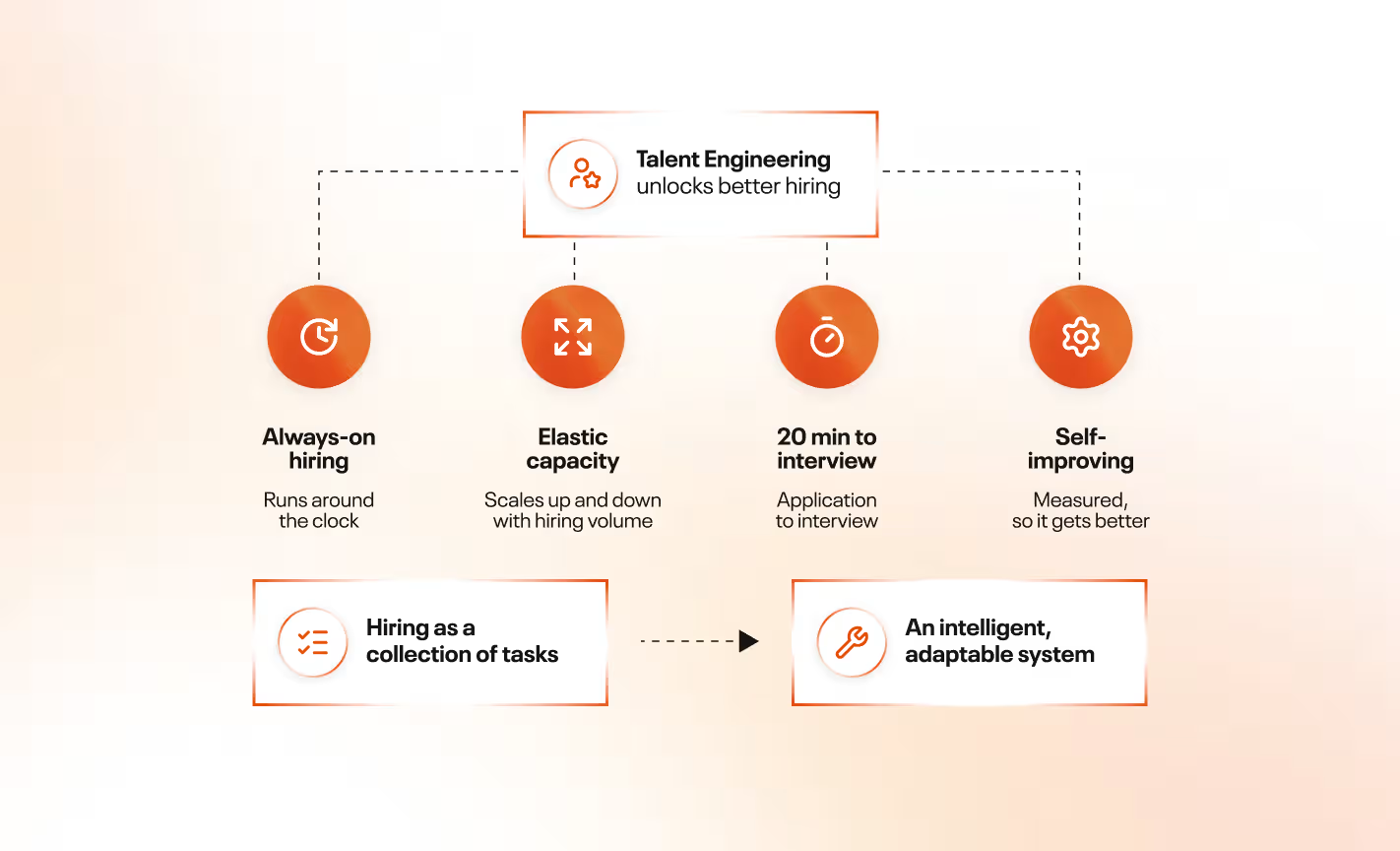
Hiring processes can operate around the clock. Organizations can increase automated capacity when demand rises. Multiple agents can coordinate activities that previously required extensive manual effort.
And because the operation is measurable, organizations can continuously improve how it performs.
The result is a shift from hiring as a collection of individual tasks toward hiring as an increasingly intelligent, adaptable system.
How to become or hire a Talent Engineer
Because Talent Engineering is still an emerging discipline, there isn't one established career path into the role.
Some Talent Engineers come from recruiting or talent operations. Others come from automation, IT, systems engineering, or technical operations.
What matters is the combination of skills.
If you're hiring a Talent Engineer
Start by identifying what you need them to build.
Are you trying to connect fragmented systems? Introduce AI agents? Redesign existing workflows? Improve visibility into hiring performance?
The answer should determine the skills you prioritize.
Look for candidates who can demonstrate systems thinking, technical fluency, and practical problem-solving.
Rather than relying exclusively on previous job titles, ask candidates to explain something they've built or improved.
What problem were they solving? How did they design the solution? What went wrong? How did they measure success?
Those answers often reveal more than a conventional recruiting résumé.
If you want to become a Talent Engineer
Start with a process, not a tool.
Find a hiring workflow that is inefficient, repetitive, or unnecessarily complicated.
Map the process from beginning to end. Identify the inputs, decisions, dependencies, and expected outcomes.
Then explore how technology could improve it.
That might mean connecting two existing applications, configuring an AI agent, creating an automated workflow, or building a simple internal tool.
Measure the results and improve what you've built.
Over time, these projects develop the combination of process knowledge, technical capability, and practical experience that Talent Engineering requires.
Frequently asked questions
Is a Talent Engineer the same as recruiting operations?
Not exactly. Recruiting operations typically focuses on managing and maintaining the processes and systems supporting recruitment. Talent Engineering emphasizes designing, building, and improving those systems. The responsibilities can overlap, and some organizations may combine them.
Does a Talent Engineer need to know how to code?
Not necessarily. Technical understanding is important, but modern platforms increasingly allow sophisticated hiring workflows to be configured without extensive custom coding. Some roles will require programming skills, while others focus more on systems design and orchestration.
Can someone without a recruiting background become a Talent Engineer?
Yes. Professionals from technical operations, IT, automation, and systems engineering can bring valuable skills to the role. They do, however, need to develop an understanding of hiring processes and their requirements.
What tools does a Talent Engineer use?
Talent Engineers work with AI agents, workflow orchestration platforms, integration tools, applicant tracking systems, communication systems, and analytics solutions. The specific tools depend on the organization's infrastructure.
How is Talent Engineering different from recruitment automation?
Recruitment automation focuses on automating hiring activities. Talent Engineering is broader: it involves designing, deploying, operating, and improving the connected systems in which those automations function.
Engineering the future of hiring
AI is changing what's possible in talent acquisition.
For years, recruitment technology primarily helped people execute existing processes more efficiently. Now, organizations have the opportunity to fundamentally redesign those processes around intelligent systems, connected workflows, and AI agents.
That creates a new responsibility.
Someone needs to decide how these systems should work, which activities can be automated, where human judgment remains essential, and how the operation can continuously improve.
That's the role of the Talent Engineer.
Not simply a technical recruiter. Not just an automation specialist. But someone responsible for engineering the systems that power modern hiring.
And as organizations move toward increasingly intelligent and autonomous hiring operations, that capability is likely to become an important part of how talent acquisition teams are built.