




You have a shortlist of qualified applicants, and your hiring manager knows exactly who they want to meet first. It sounds like a dream scenario, right? Except you still have to get top candidates into a room, onto a call, or otherwise on the calendar – and we all know how difficult that can be.
Automated interview scheduling turns good intentions and unruly email threads into real-world meetings. Even better, you won’t want to rip your hair out in the process.
Tools like Carv's Scheduling Agent coordinate booking so you don’t lose out on stellar applicants.
Why interview scheduling is where good candidates drop off
Tell me if this sounds familiar…
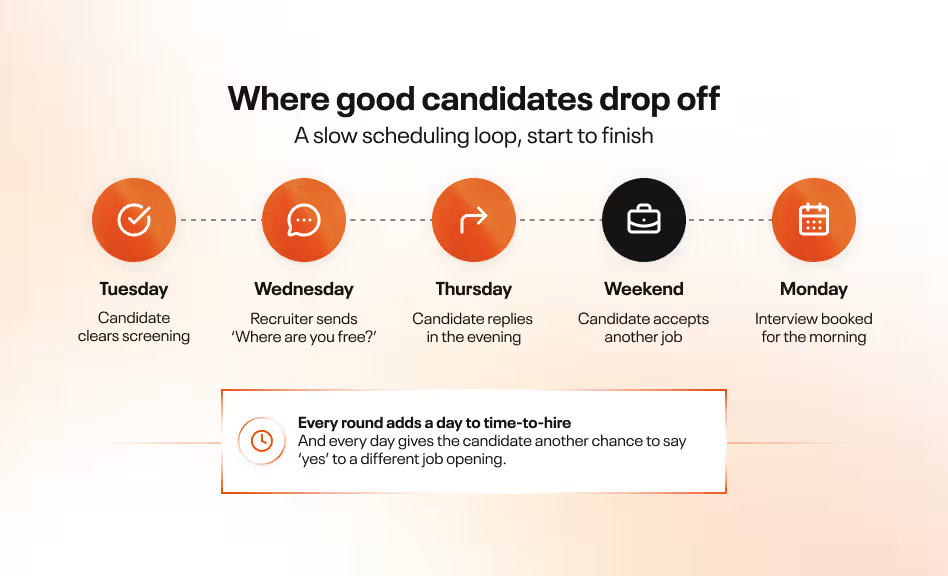
A quality candidate applies for an open role and clears screening on a Tuesday afternoon. One of your recruiters sends them a “When are you free?” message on Wednesday. The candidate replies Thursday evening. After checking the hiring manager’s schedule, the recruiter books an interview for Monday morning. The problem? The candidate accepted another job over the weekend.
Scheduling seems like the smallest administrative task in the recruitment process, but it often determines whether strong candidates ever reach the interview stage. Here’s why:
- Booking takes too long. To find a time and date that suits both the hiring manager and the candidate usually takes a string of emails or calls. Every round adds a day to time-to-hire, and every day gives the candidate another chance to say “yes” to a different job opening.
- Reminders slip through the cracks. Recruiters juggle dozens of open roles, so they don't always remember to send pre-interview reminders. Without a reminder, candidates are more likely to forget about the interview and no-show – or arrive unprepared and perform poorly.
- Conflicts mean starting over. Plans can change after both sides confirm an interview. Shift swaps, sick kids, missed buses, etc. If the candidate can’t easily reschedule, the interviewer wastes time waiting for someone who will never arrive. If the candidate does get in touch, the whole back-and-forth dance repeats itself. By the end, everyone is frustrated.
Every no-show burns interviewer time that could have gone to someone else.
Even when the interview happens, recruiters lose hours to calendar coordination when they could talk to candidates, run intake calls with hiring managers, or build candidate pipelines instead.
All of that time feeds straight into cost per hire, one of the core recruitment metrics that reveals whether your hiring operation is efficient or not. Plus, a slow, patchy booking process damages candidate experience at a crucial moment: when candidates decide how serious your company is.
What the Scheduling Agent actually does
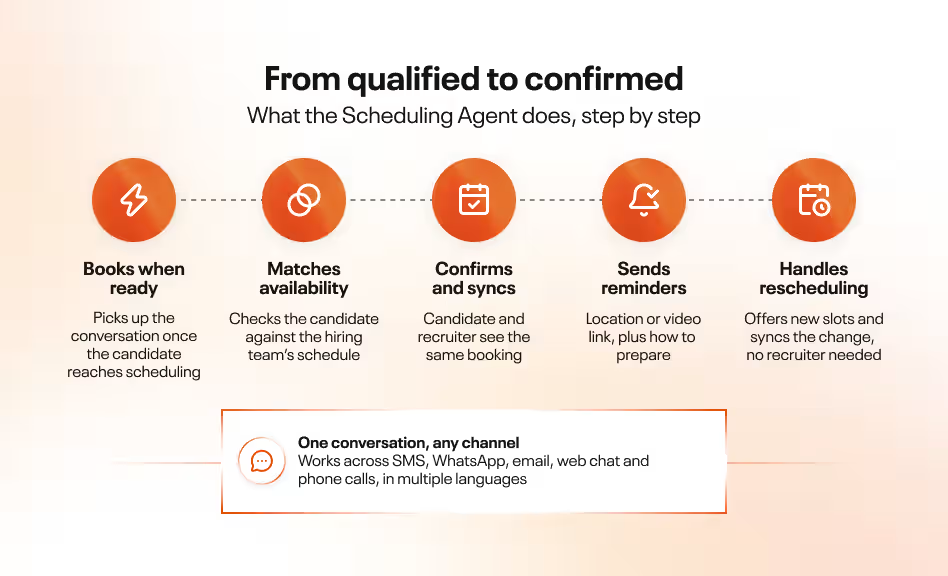
The Scheduling Agent turns qualified candidates into confirmed interviews, then makes sure the interviews actually happen when they’re supposed to. It works through a repeatable sequence:
- It books when the candidate is ready. Once a candidate reaches the scheduling step, the agent picks up the conversation. Nobody has to remember to send the first message.
- It matches availability. The agent checks the candidate's availability against the hiring team's schedule and finds a time and date that works for both sides.
- It confirms and syncs the slot. Once the candidate agrees to a date and time, the agent confirms and syncs it. That way, the candidate and recruiter see the same booking.
- It sends automated reminders with details. Before the interview, the candidate receives a reminder with the location of the interview or video conferencing link, and how to prepare. By addressing interview prep, the agent removes a reason for candidates to skip the interview.
- It handles rescheduling directly with the candidate. If plans change, the candidate tells the agent within the same conversation. The agent offers new slots, confirms a new time, and syncs the change without a recruiter having to step in.
One of the best things about the Carv Scheduling Agent is that it works across channels, from SMS and WhatsApp to email, web chat, and phone calls. Equally as important, the Scheduling Agent can hold conversations in multiple languages, so you can deploy it across the world if needed.
It’s also worth mentioning that the agent never pretends to be a person. It tells every candidate upfront that they’re speaking with an AI agent, and a recruiter is always one message away.
How the scheduling agent fits into the system
The Scheduling Agent doesn't work alone. It plays one part in Carv's complete agentic AI stack, where each agent owns a single step before handing the process to the next agent.
- The Host Agent engages candidates, answers questions, and captures intent.
- The Screening Agent runs pre-screening and determines if candidates can do the job.
- The Scoring Agent evaluates candidates against the role's competencies and gives recruiters a structured, comparable read on fit. This helps them make logical, unbiased hiring decisions.
- The Scheduling Agent turns progression into booked interviews without the back-and-forth.
Depending on how your team sets up its recruiting workflow, the Scheduling Agent can also book the interviews or assessments that the Scoring Agent later evaluates. Either way, its job is the same: Get qualified candidates to the next conversation with as little hassle as possible.
When you use Carv’s complete agentic stack, you get the benefit of context. By the time our Scheduling Agent reaches out to a candidate, it knows who they are and what they said in prior conversations. For example, a candidate who shared their shift preferences during screening won't have to repeat them to book an interview. With Carv, nobody answers the same question twice.
This level of connection is the difference between having a standalone AI assistant that only books meetings and a true AI agent that helps shepherd the entire candidate journey. The standalone tool only sees the calendar. The Scheduling Agent sees everything that led to the booking.
The agent also writes everything back to your applicant tracking system (ATS), so recruiters can review the full conversation history in one place. Speaking of the ATS, the Agent integrates with Bullhorn, JobAdder, Carerix, Avature, Workday, Greenhouse, SmartRecruiters, and Avionté.
3 ways to automate interview scheduling, and where an agent fits
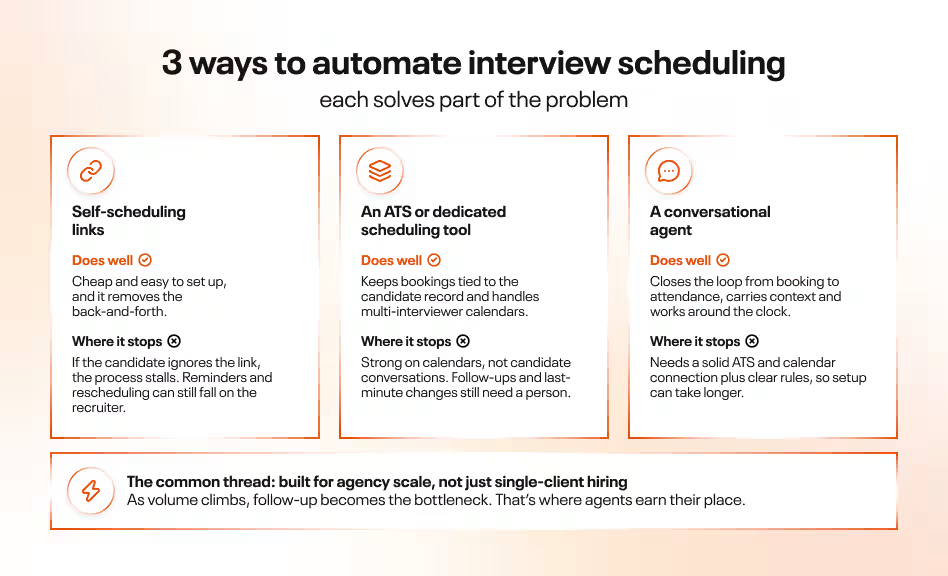
If you're comparing automated interview scheduling software, you’ll find that most options fall into one of three groups. Each solves part of the problem you face.
1. Self-scheduling links
The recruiter sends a booking link with available interview times, which a calendar integration pulls from the interviewer's calendar. Then, the candidate picks an open slot.
- What it does well: It’s cheap and easy to set up, and it removes the typical back-and-forth.
- Where it stops: The candidate has to open the link, choose a slot, and remember the time they chose. If they ignore the booking link, the entire process stalls until the recruiter notices. Depending on the tool, sending reminders and rescheduling might still fall on the recruiter.
2. An ATS or dedicated scheduling tool
Many applicant tracking systems include interview scheduling, and dedicated AI scheduling tools add features like panel scheduling and time-zone handling to the mix.
- What it does well: These tools keep bookings tied to the candidate record, while handling complex calendar coordination tasks across multiple interviewers.
- Where it stops: Most of these tools ace calendar management but not candidate conversations. So, follow-ups, questions, and last-minute changes still need a person.
3. A conversational agent
Conversational AI agents book interviews via each candidate's preferred channel, like WhatsApp or SMS, and handle the follow-up by sending reminders, answering questions, and rescheduling.
- What it does well: It closes the full loop from booking to attendance, carries context from earlier steps, and keeps working around the clock.
- Where it stops: It needs a solid connection to your ATS and calendars, plus clear rules and approved material to work from. Because of these things, setup might take longer.
For many teams, true interview scheduling automation combines multiple strategies. Self-scheduling links can work fine for some roles. As volume climbs and more candidates apply from their phones, the follow-up work becomes a bottleneck. This is where agents earn their place.
Why this matters at high volume
Recruiters can juggle calendars at low volume. If you only deal with 10 candidates a week, for example, you only deal with 10 threads and the occasional reschedule. It takes effort, but it works.
Everything changes with high-volume hiring. At hundreds of candidates a week, the scheduling queue grows much faster than you can clear it. Reminders slip through the cracks because nobody has time to send them. And two candidates in the same situation have different experiences: one gets a quick reply and a smooth reschedule, while the other waits two days to hear back.
AI agents apply the same logic to every candidate, so each gets the same booking flow, reminders, and options to reschedule. The agent also keeps working outside office hours, so a candidate who replies at 10 p.m. after a shift can book on the spot rather than waiting until the next morning.
If you’re evaluating AI recruitment tools, ask yourself this question: Does the tool treat candidate 400 the same way it treated candidate 10? This consistency test is valuable to every brand that hires at scale, from staffing agencies to retail and logistics companies to BPO and contact centers.
Where humans still matter
The Scheduling Agent books interviews and sends reminders. It does NOT run interviews or make hiring decisions. Recruiters and hiring managers still handle these tasks, whether they happen in person, by phone, or through video interviewing. And that’s the way it will always be.
Plus, the agent answers only from your own material, and when it doesn't know something, it says so instead of guessing. And candidates can ask to speak to a recruiter at any point in the process. When the recruiter steps in, they’ll see a full conversation thread, so they have complete context.
Think of the Scheduling Agent as an AI workmate that takes calendar coordination off your team's plate. That way, your people can focus on the complex conversations that need a real person.
When it comes to compliance, Carv captures consent within the conversation, keeps data in the EU, lets each customer set its own retention period, and meets ISO 27001 and SOC 2 standards.
What we typically get asked about automated interview scheduling
How does automated interview scheduling work?
Automated interview scheduling replaces manual back-and-forth messages with software that matches candidate and interviewer availability, confirms a time and date, and sends reminders. With Carv's Scheduling Agent, all of this happens in a conversation. The agent offers times, confirms the booking, syncs it with the ATS, and handles changes directly with the candidate.
Can candidates reschedule on their own?
Yes. Candidates reschedule directly with the Scheduling Agent in the same conversation they used to book the original interview. The agent offers new slots, confirms a new time, and syncs the change to the ATS. That way, nobody on your team has to coordinate it manually.
Which channels does the Scheduling Agent use?
The Scheduling Agent works across email, SMS, phone calls, web chat, and WhatsApp. It also speaks multiple languages, so candidates can book in the channel and language they prefer.
Does it work with my ATS?
Yes. The Scheduling Agent integrates with popular ATS platforms like Bullhorn, JobAdder, Carerix, Avature, Workday, Greenhouse, SmartRecruiters, and Avionté. It writes all data back to your ATS automatically, and recruiters can review the full conversation history from there.
Do candidates know they're talking to an AI?
Yes. Carv’s Scheduling Agent tells candidates upfront that they're talking to an AI agent. The agent never pretends to be a person, and a recruiter is always one message away.
What happens if a candidate wants to speak to a recruiter?
They ask for a recruiter, and they get one. The agent hands the conversation to a human on your team with the full thread attached, so the candidate doesn't have to repeat anything.
Turning shortlists into interviews
With a strong recruitment process, you’ll use the scheduling step to funnel top candidates into interviews. Our Scheduling Agent makes sure that happens with minimal effort on your end.
Want to see the Carv Scheduling Agent in action? Book a demo to see how it fits into your existing workflow, alongside your current ATS platform.
This is the fourth post in a series looking at each agent in Carv's stack and the specific problem it's built to solve. See earlier posts on the Host Agent, the Screening Agent, and the Scoring Agent.