

AI agents can take on a large part of the work on temp, contract and perm desks, including the ones you run for a client as an RPO provider, as long as they are configured for the desk they work on.
The desks hire on different timelines and judge candidates on different criteria. Agents set up for one desk ask the wrong questions on another, hand candidates over at the wrong moment and work toward the wrong outcome.
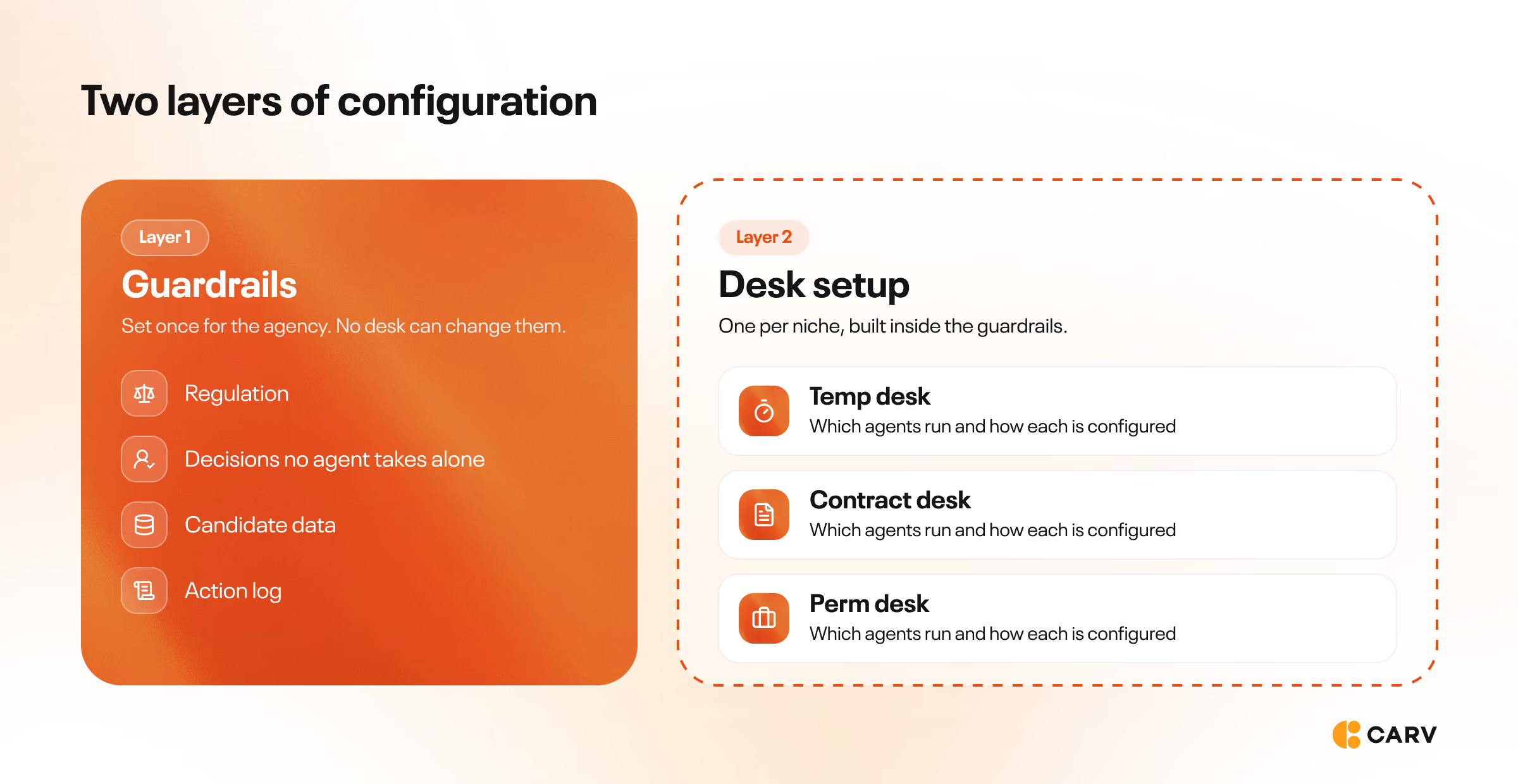
Getting it right means configuring agents in two layers:
- The first is a set of guardrails, set once for the whole agency, that no desk can change.
- The second is the desk setup, built inside those guardrails: which agents run on a desk and how each one is configured.
Let's dive in.
Guardrails: set once for every agent and desk
Guardrails are the limits every agent works within, on every desk. Set them once, at agency level, before you configure a single desk.
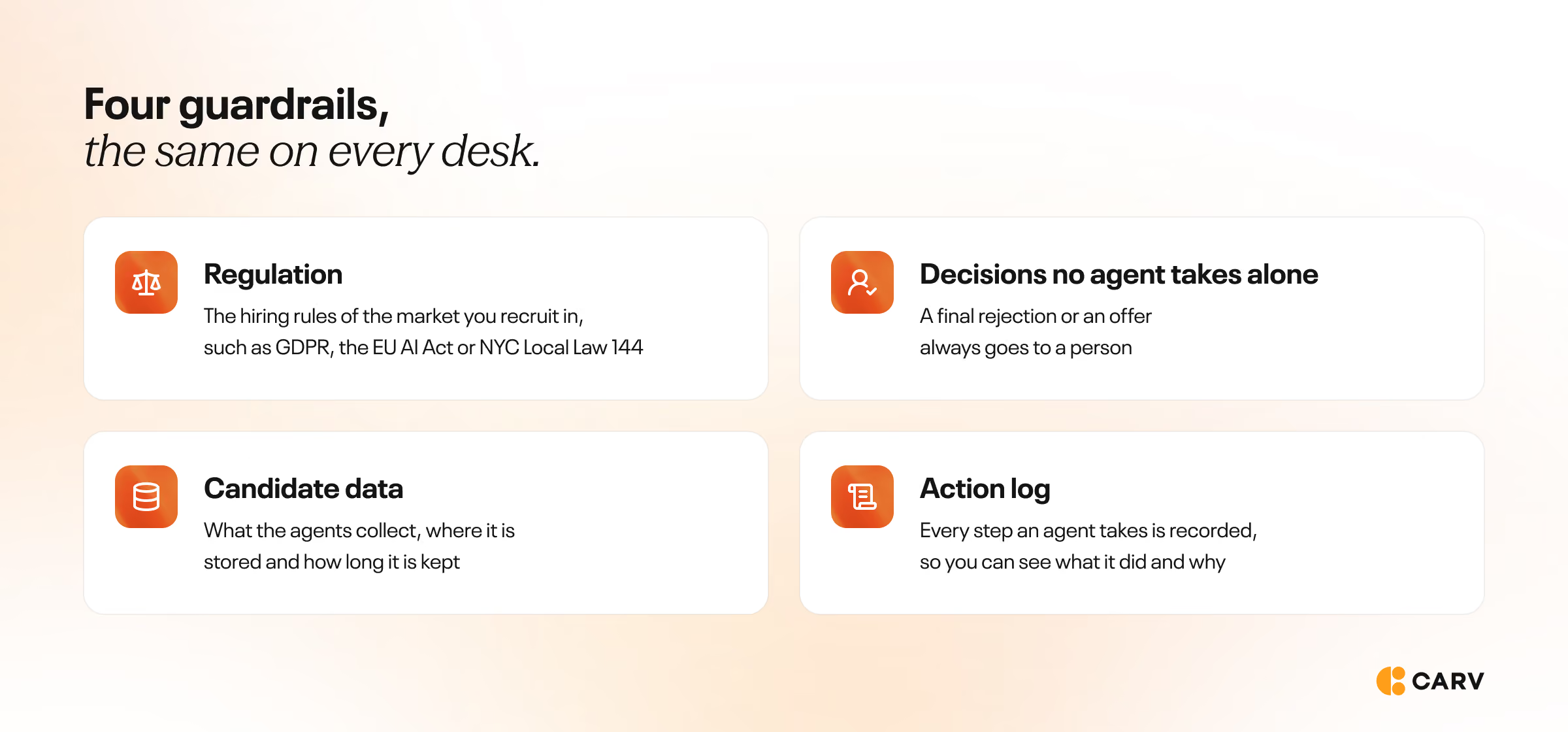
They cover four things:
- Regulation: the agents follow the hiring rules of the market you recruit in, such as GDPR and the EU AI Act in Europe or NYC Local Law 144 in New York.
- Decisions no agent takes alone: a final rejection or an offer, for example, always goes to a person.
- Candidate data: what the agents collect, where it is stored and how long it is kept.
- The action log: every step an agent takes is recorded, so you can see what it did and why.
Every desk setup is built inside these limits. No desk can loosen them.
What you configure on a desk
Every desk draws from the same set of AI recruitment agents: host, screening, assessment, scheduling, rescheduling, reactivation, rediscovery, reassignment and talent pool maintenance agents, plus custom agents built for a specific process. Each desk combines them into its own flow.
Configuring a desk happens at two levels. The first is the flow: which agents run, in what order, what triggers each one and where a recruiter steps in. An orchestration layer of triggers, routing and handoffs runs it.
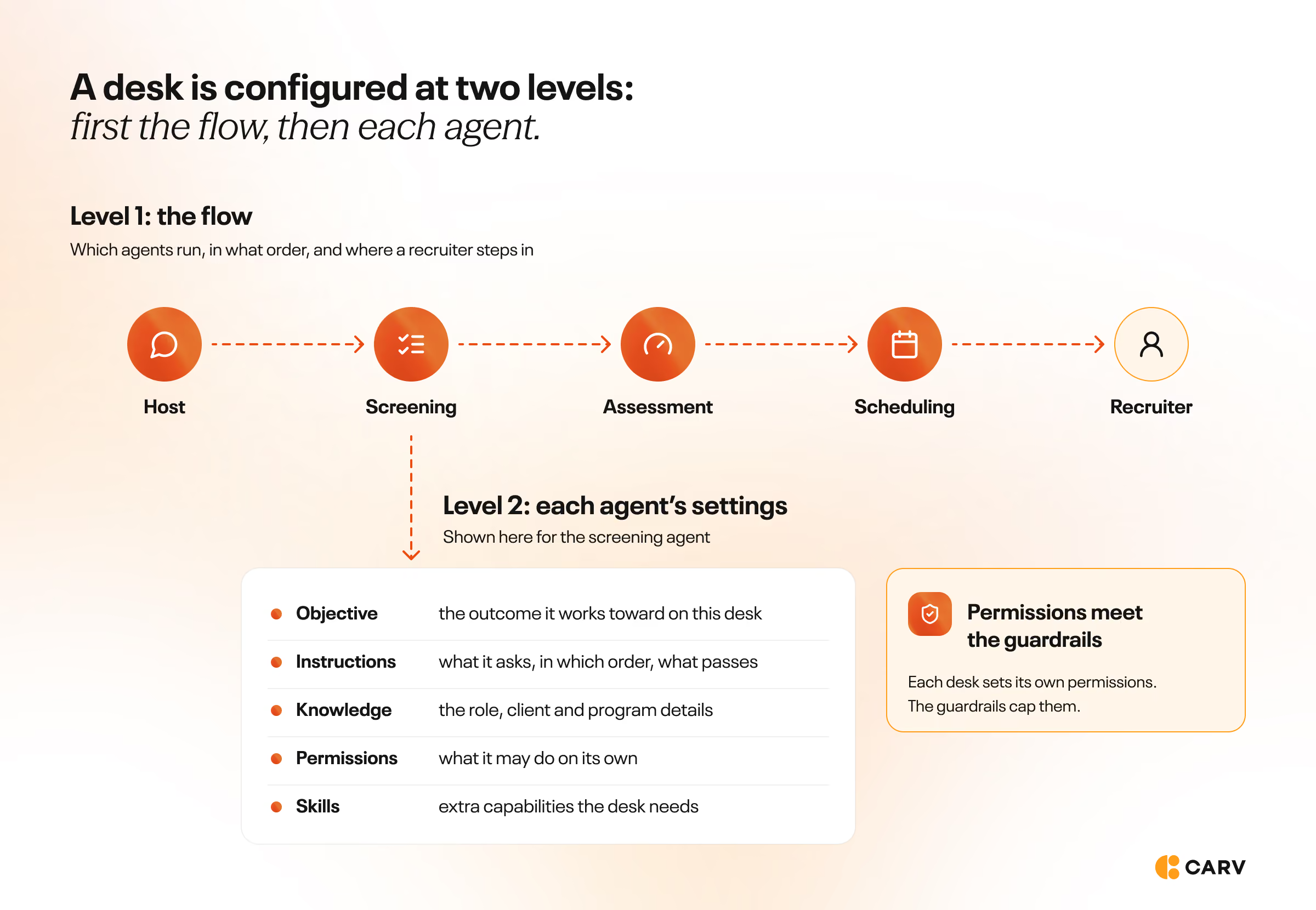
The second level is each agent's settings:
- Objective: the outcome it works toward on this desk, such as a filled shift or a shortlist.
- Instructions: what it asks, in which order, and what counts as a pass.
- Knowledge: the role, client and program details it uses to answer candidates.
- Permissions: what it may do on its own, such as booking an interview or updating the ATS, and what goes to a recruiter.
- Skills: extra capabilities a desk needs, such as a language test or a client-specific check.
The screening agent shows how far the settings move. It runs on every desk, and its instructions change with the niche. On a temp desk it checks availability for the open shift first, on a contract desk it focuses on skills fit, and on a perm desk on dealbreakers such as salary and location.
Permissions are where the two layers meet. Each desk sets its own, and the guardrails cap them.
AI agents for temp staffing: speed and redeployment
A temp flow runs on the host, screening, rediscovery and reassignment agents. The host agent answers applicants at any hour and moves them into screening. When a vacancy opens, the rediscovery agent searches your existing pools before any new sourcing starts.
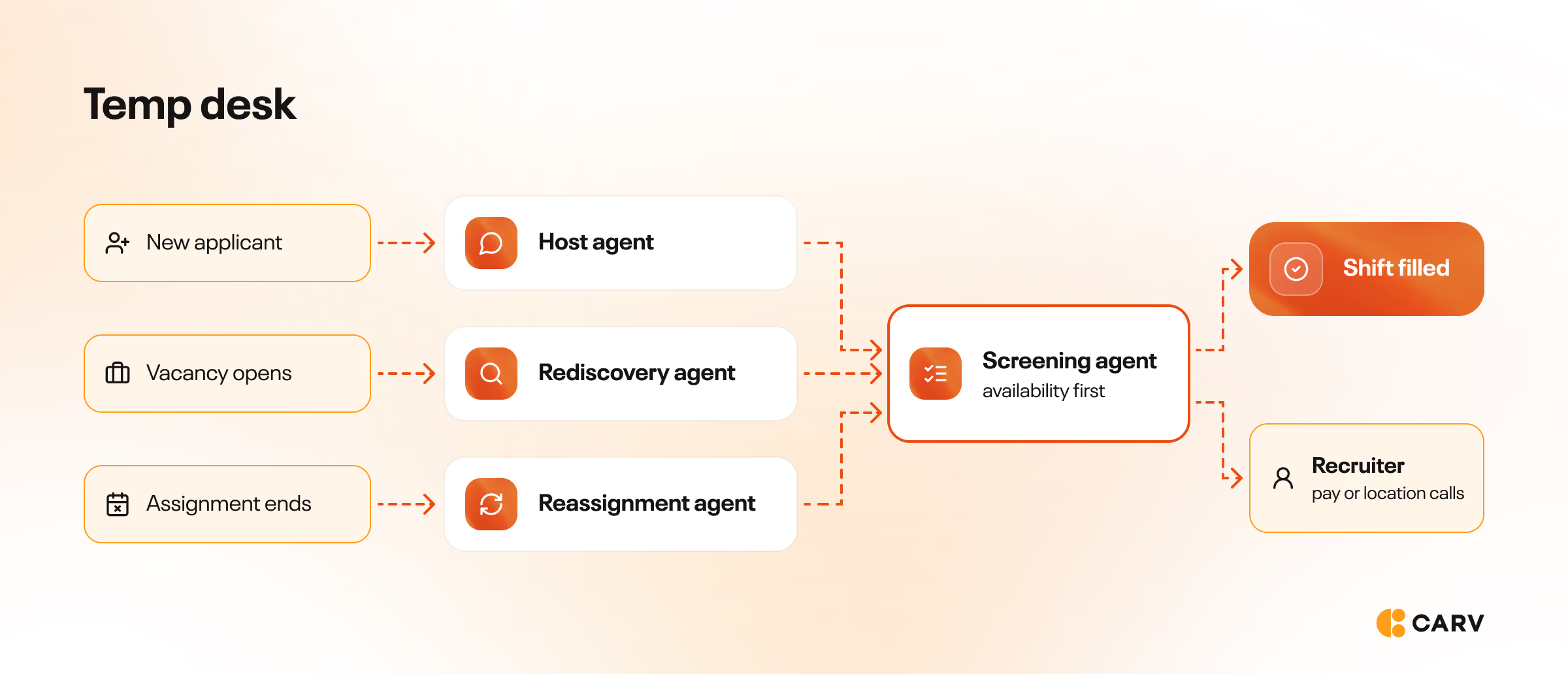
The reassignment agent is triggered as an assignment ends. It checks the candidate's availability and updates their preferences for the next role, while the rescheduling agent handles interview changes without a recruiter.
The setting that matters most is the screening agent's instructions. Availability for the open shift comes first, so the agent knows early whether the candidate can take it. Permissions can be wide for routine steps, such as confirming a start time.
Recruiters step in where a person is needed, such as questions about pay or location.
This flow depends on live assignment end dates from your ATS, and on a host agent that answers on every channel your candidates use, at any hour.
AI agents for contract staffing: match depth and end dates
A contract flow adds the assessment and talent pool maintenance agents. The rediscovery agent builds the first shortlist from candidates you have already vetted, and the talent pool maintenance agent keeps that pool current by confirming availability, updating profiles and checking interest.
The contract end date is the main trigger. It is known when the placement starts, and the reassignment agent uses it to open the next conversation.
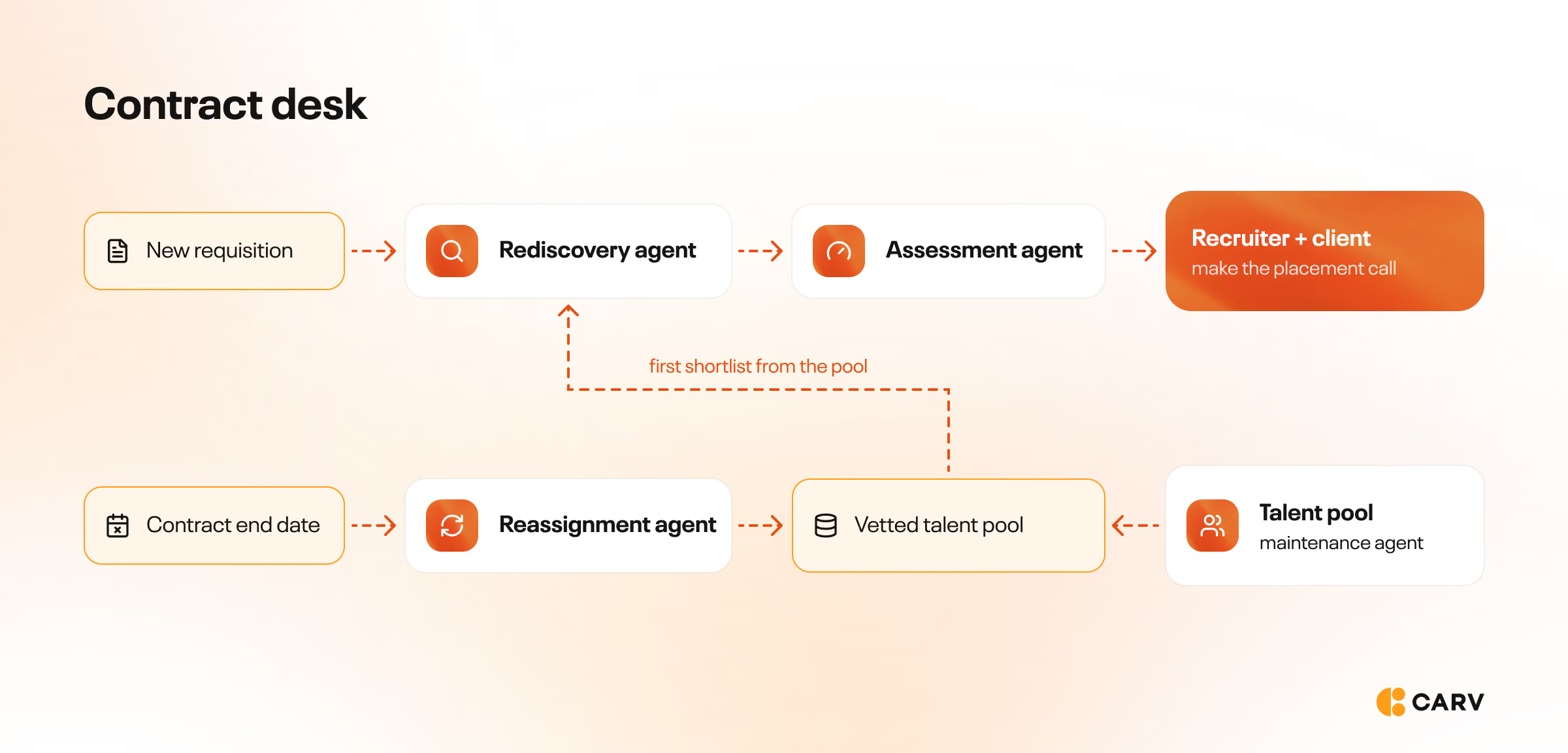
The settings that matter most sit in the assessment agent. You set the competencies each role requires, and the agent scores every candidate against them inside the recruiter's existing workflow.
The recruiter and the client make the placement call, with the score as one input.
The assessment criteria need updating for every role you place, and every conversation has to write back to your CRM so the pool stays usable.
AI agents for perm placement: interview rounds and the shortlist
A perm flow is built around interview rounds. The screening and assessment agents qualify candidates, and the scheduling agent coordinates each round between the candidate and the client's hiring team. The rescheduling agent handles changes when plans shift.
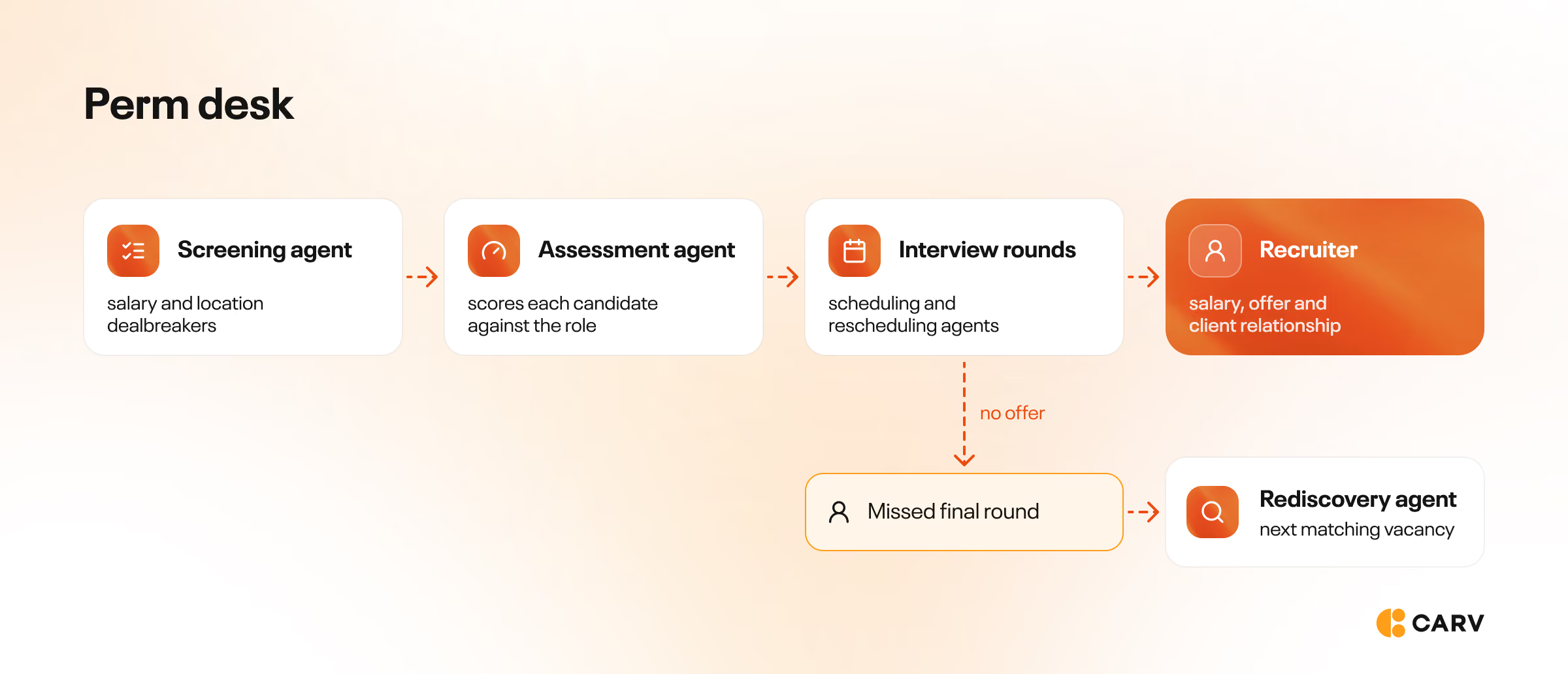
The assessment agent's criteria carry most of the niche. Every candidate is scored against the role's requirements, which gives the recruiter a consistent basis for the shortlist they present.
Candidates who reach the final round and miss out stay in your pool. The rediscovery agent surfaces them for the next matching vacancy.
Recruiters own salary conversations, offers and the client relationship. The agents handle the coordination around them.
For this to work, the scheduling agent needs access to every client hiring team’s calendar, and every change has to flow back into your ATS.
Hiring on a client's behalf: RPO
RPO runs across the niches above. An RPO team may hire perm or high-volume temp, so the flows stay the same. The client adds a layer between your guardrails and the desk setup.
That layer holds the client's process, ATS, hiring managers and the regulations of the market they hire in. Each client gets its own configuration on the same agents: the screening agent asks that client's questions, and the scheduling agent books into that client's calendars.
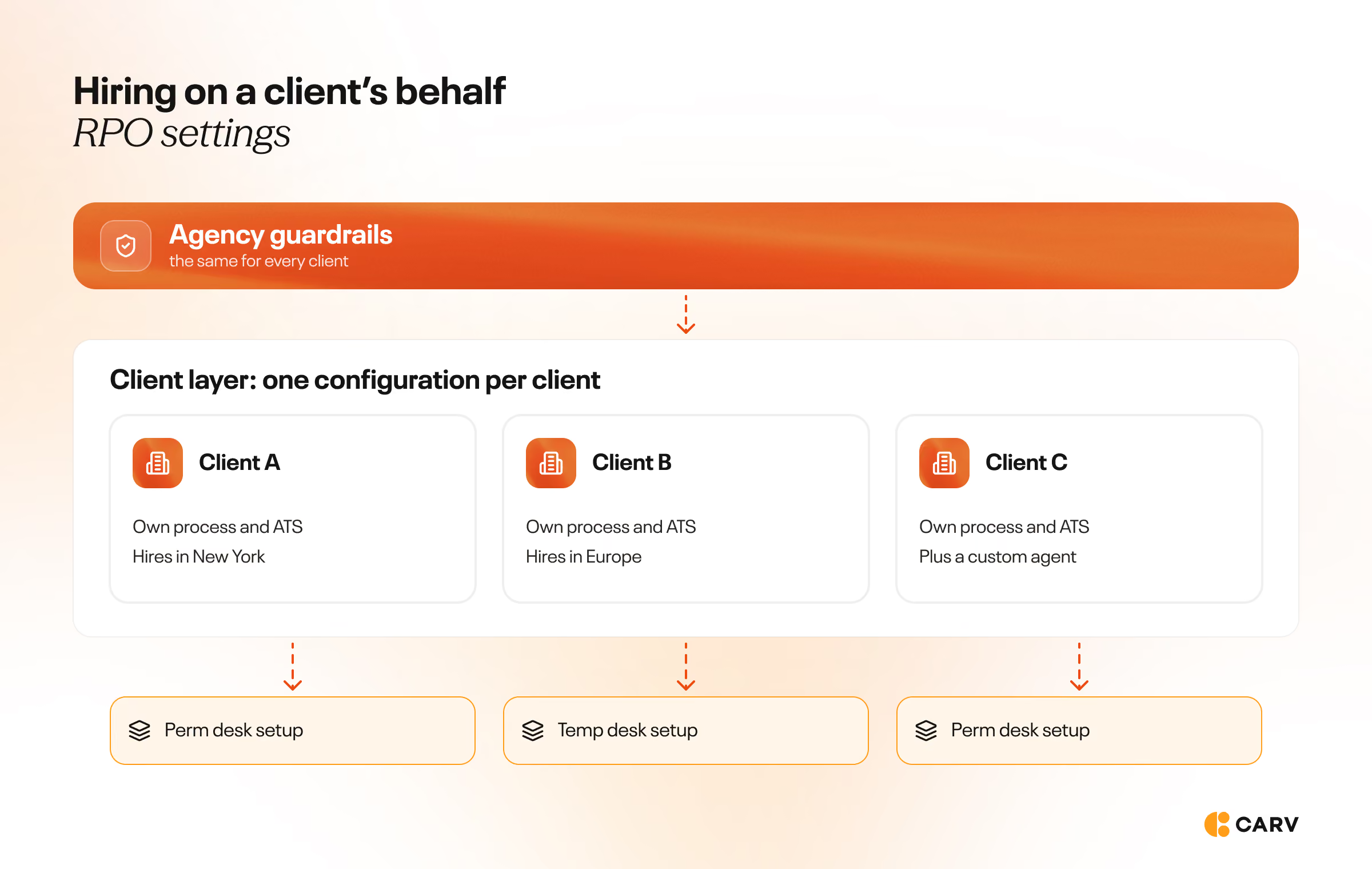
The client's ATS stays the system of record, and the agents keep it updated as candidates move through. When a client has a step no standard agent covers, a custom agent can be built around their requirements, processes and business rules.
The guardrails still apply to every client, and the market they point to changes per client. A client hiring in New York brings NYC Local Law 144 into scope, and one hiring in Europe brings GDPR and the EU AI Act.
Every new client means a new configuration, a new ATS connection and often a new set of regulations to cover.
Buy or build AI recruitment agents
Guardrails, flows and agent settings all have to be built, run and kept current, and that work grows with every desk and client you add.
Whether you buy a platform for that or build your own comes down to three things: how many desks and clients you run, how much volume you handle and how exposed you are to regulation.
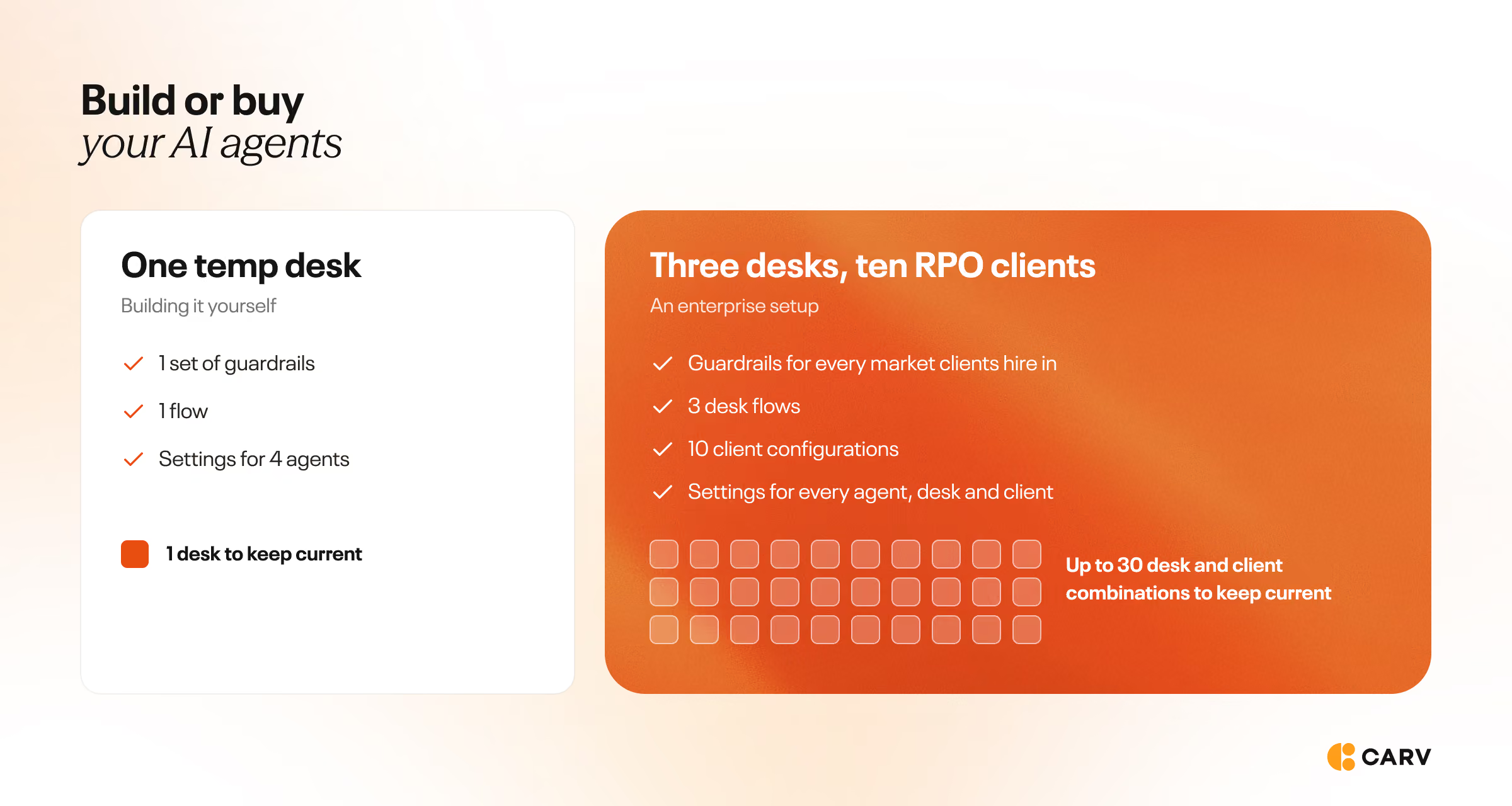
Take a single temp desk: one set of guardrails, one flow and settings for four agents.
Now take an agency with temp, contract and perm desks and ten RPO clients. The guardrails have to cover every market those clients hire in, each client needs its own configuration on top of the desk flows, and every agent's settings have to stay current as roles change.
When buying makes sense
Enterprise agencies and RPO providers usually get more from buying. Several desks or clients mean many flows on shared guardrails, and a platform runs orchestration, ATS integration and monitoring for all of them in one place.
Volume points the same way. Thousands of candidates across voice, WhatsApp, SMS and email need agents that hand work to each other without anyone triggering the next step.
Regulation adds to the case. Guardrails such as human review and the action log have to be in the system from the start, and a platform built for hiring comes with them.
When building makes sense
A small agency with one desk, one flow and a few recruiters can build something useful themselves. A general-purpose AI model connected to your ATS through its API can summarize incoming CVs or draft candidate follow-ups.
At that scale, one person can own it, and it is fast and cheap to start. The cost comes later. Models change, ATS APIs change and the person who built it eventually moves on.
Once agents talk to candidates over voice or messaging, or the work touches AI hiring regulation, building and maintaining the guardrails becomes your job too.
Mixing both
Many agencies end up in between. They build the desk-specific pieces, such as a screening script or a scoring rule for one client.
They buy the layer underneath: candidate channels, orchestration, ATS write-back and the guardrails. Whichever route you take, someone has to own the configuration and keep improving it. That is the job of a talent engineer.
Over to you
Tailoring agents to your staffing niche comes down to guardrails set once for the agency, a flow for each desk and settings for each agent in it. On RPO programs, the client's requirements sit between the guardrails and the desk.
Whether you buy, build or mix depends on how many desks and clients you run, how much volume you handle and how exposed you are to regulation.
Request a demo and we'll map the first flow across your desks with you.