

Most recruitment stacks were built one tool at a time around an ATS. Teams added a CRM for talent pools, then separate tools for sourcing, scheduling, interview AI, assessments, surveys and referrals. Each one closed a specific gap, but together they leave people carrying the work from one system to the next.
That is exactly what an autonomous recruiting operation has to remove.
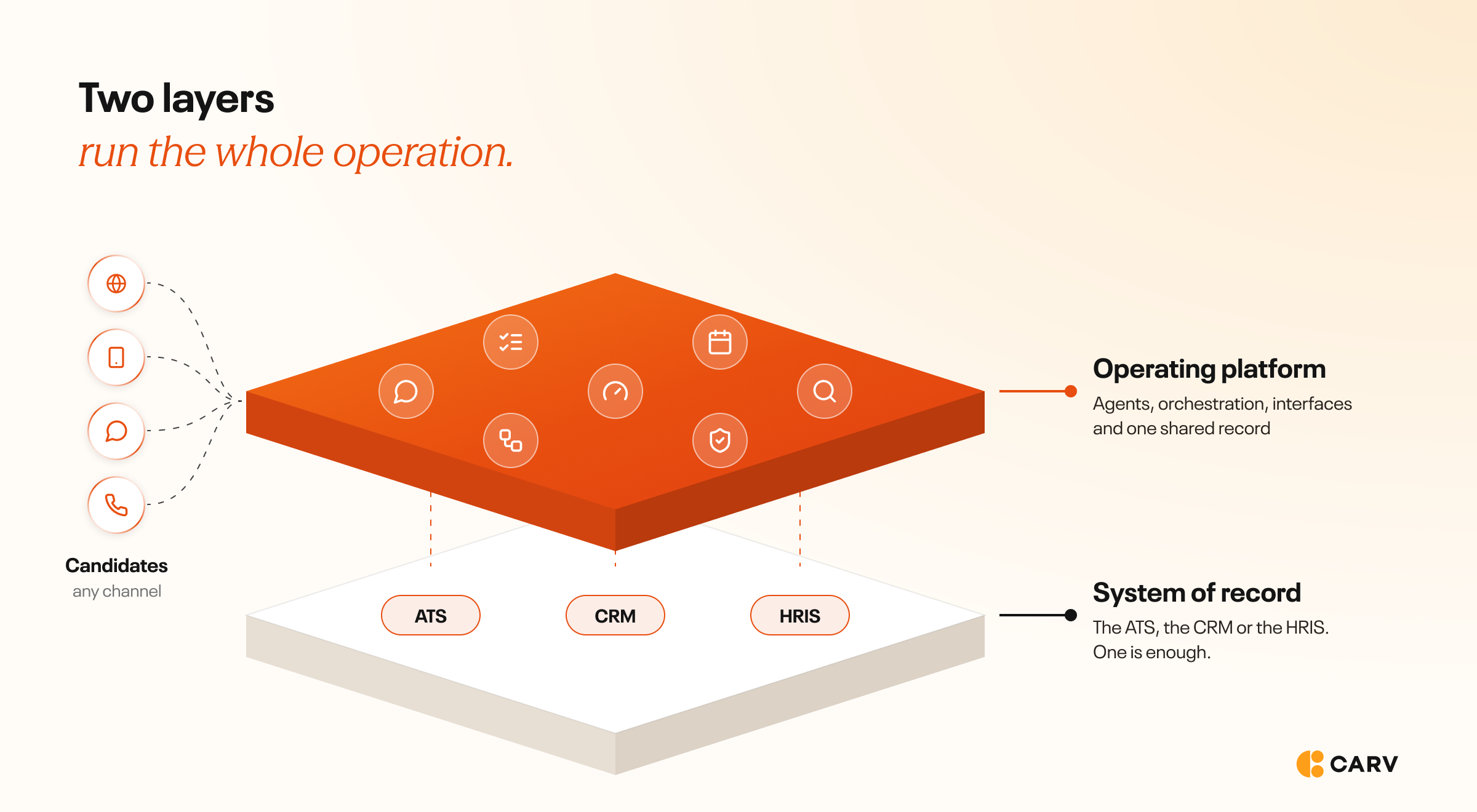
An autonomous stack is built the other way around: one AI-native recruitment operating platform runs the work from application to onboarding, and one system of record keeps the data, whether that is the ATS, the CRM or the HRIS. Agents execute, people decide, and candidates stay in one connected journey.
Let's start with why the current stack stops working.
Why a stack of tools can't run autonomously
In a fragmented stack, the work stops at every system boundary. A recruiter opens a record in the ATS, copies details into the scheduling tool, chases a status in the CRM and reconciles data at the end of the week.
Candidates feel the same boundaries. They get another login, type the same details again and open a new portal for the assessment.
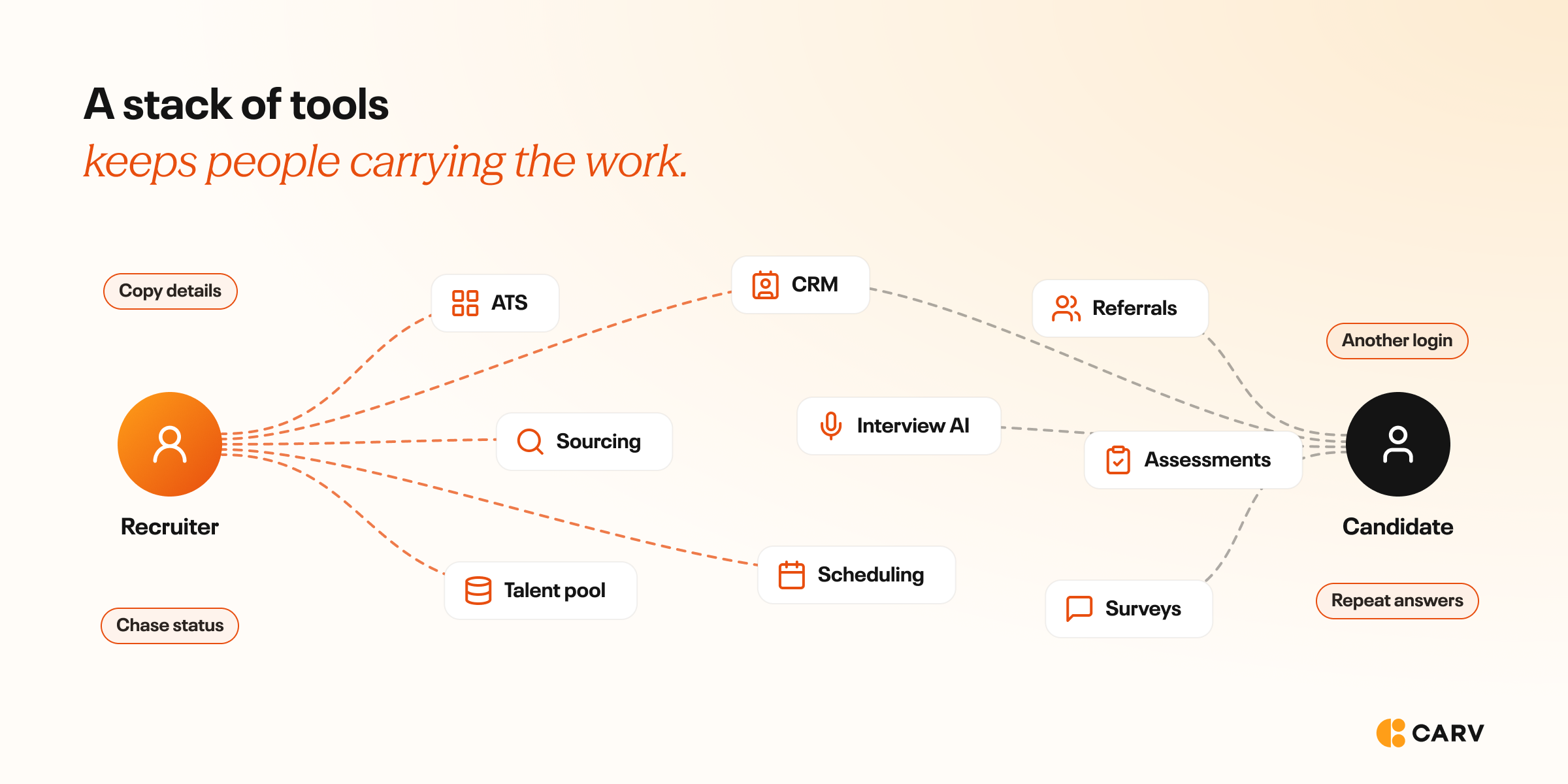
Adding AI to each tool leaves those boundaries in place. An agent inside one tool only sees what that tool holds, while the context it needs, the earlier conversations, the assessment results and the hiring manager's feedback, sits in the other systems. That is why stacking AI-enabled tools speeds up single steps and leaves the process as it was.
An autonomous operation needs that context in one place, and that changes what the stack is built around.
What an autonomous recruiting stack looks like
An autonomous stack has two layers:
- The operating platform runs the work: the agents, the orchestration that coordinates them, the interfaces people and candidates use, and one shared record of every conversation and decision.
- The system of record keeps the data. That can be the ATS, the CRM or the HRIS, and one is enough.
Everything between a new requisition and a new hire's first day runs on the platform. The system of record receives the hire.
That leaves most of today's tools with nothing to do:
- CRM and talent pool: the rediscovery agent and talent pool maintenance agent keep past candidates current and matched to new roles.
- Sourcing and job distribution: the platform publishes roles and steers spend based on what comes in.
- Chatbot and scheduling tool: the host agent engages applicants, and the scheduling agent books and rebooks interviews.
- Interview AI and assessments: the assessment agent runs screening calls, language tests and skills checks inside the same conversation.
The biggest change on that list is the ATS, so it's worth looking at what it actually does today.
What happens to the ATS
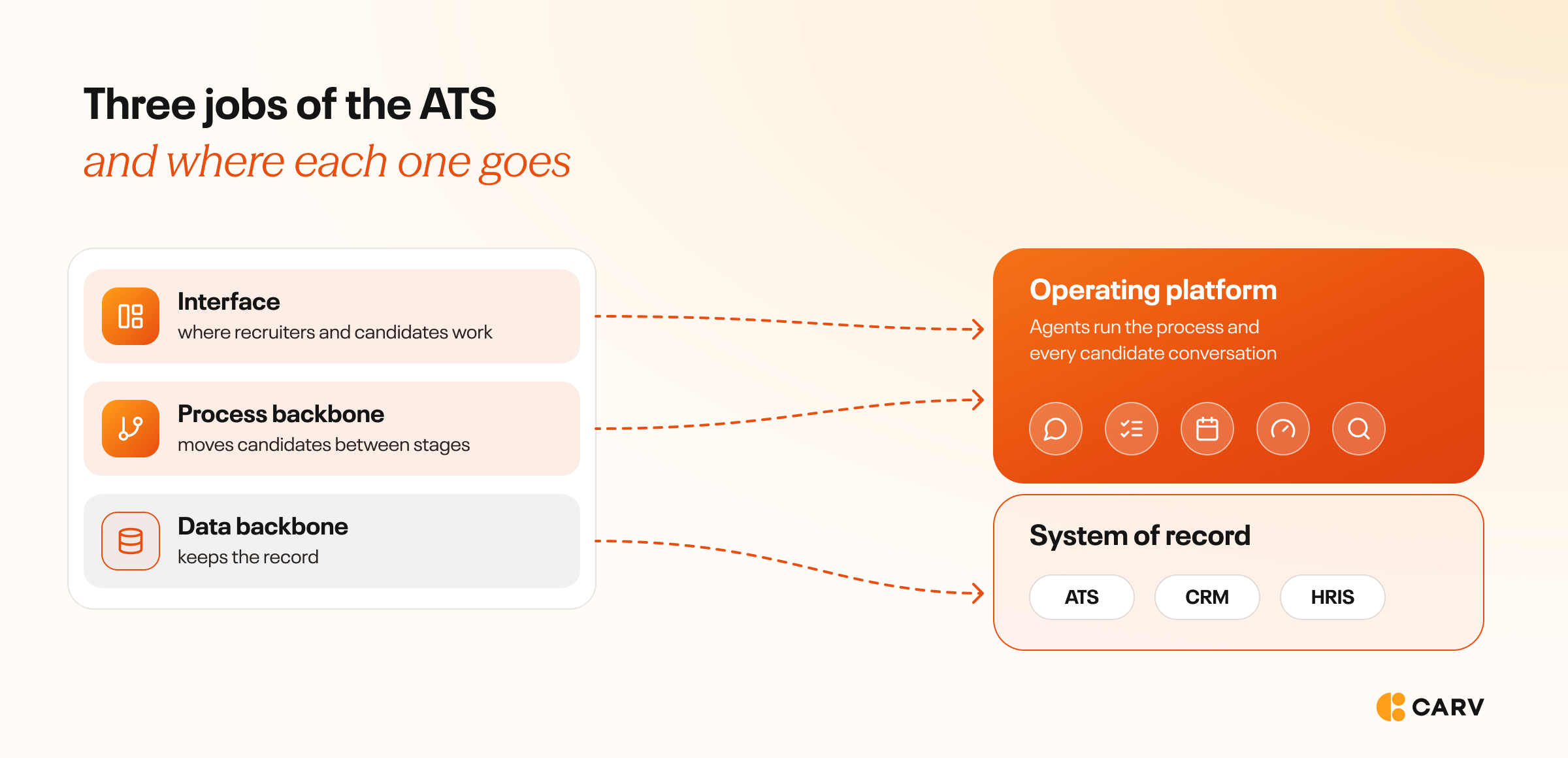
An ATS does three jobs. It is the data backbone, the process backbone and the interface recruiters and candidates work in.
All three were designed for a process people run. Recruiters move candidates through stages, and the ATS records each move.
In an autonomous operation, agents run the process. They move candidates between stages and handle every candidate conversation, on web, app, chat or phone. The process backbone and the interfaces move to the platform, and recruiters work from a queue of tasks that need them.
That leaves the data backbone. The ATS can stay as the system of record, which is where treating the ATS as infrastructure leads. If the CRM or the HRIS already holds that record, the ATS's only extra job was moving candidates between stages, and a second system of record adds upkeep without adding anything.
Swapping one ATS for another doesn't change this. A new ATS records the same human-run process as the old one, as covered in Before You Replace Your ATS, Read This.
What changes the picture is who runs the process. Once agents run it from application to onboarding, the question becomes how many systems of record you need, and one is enough.
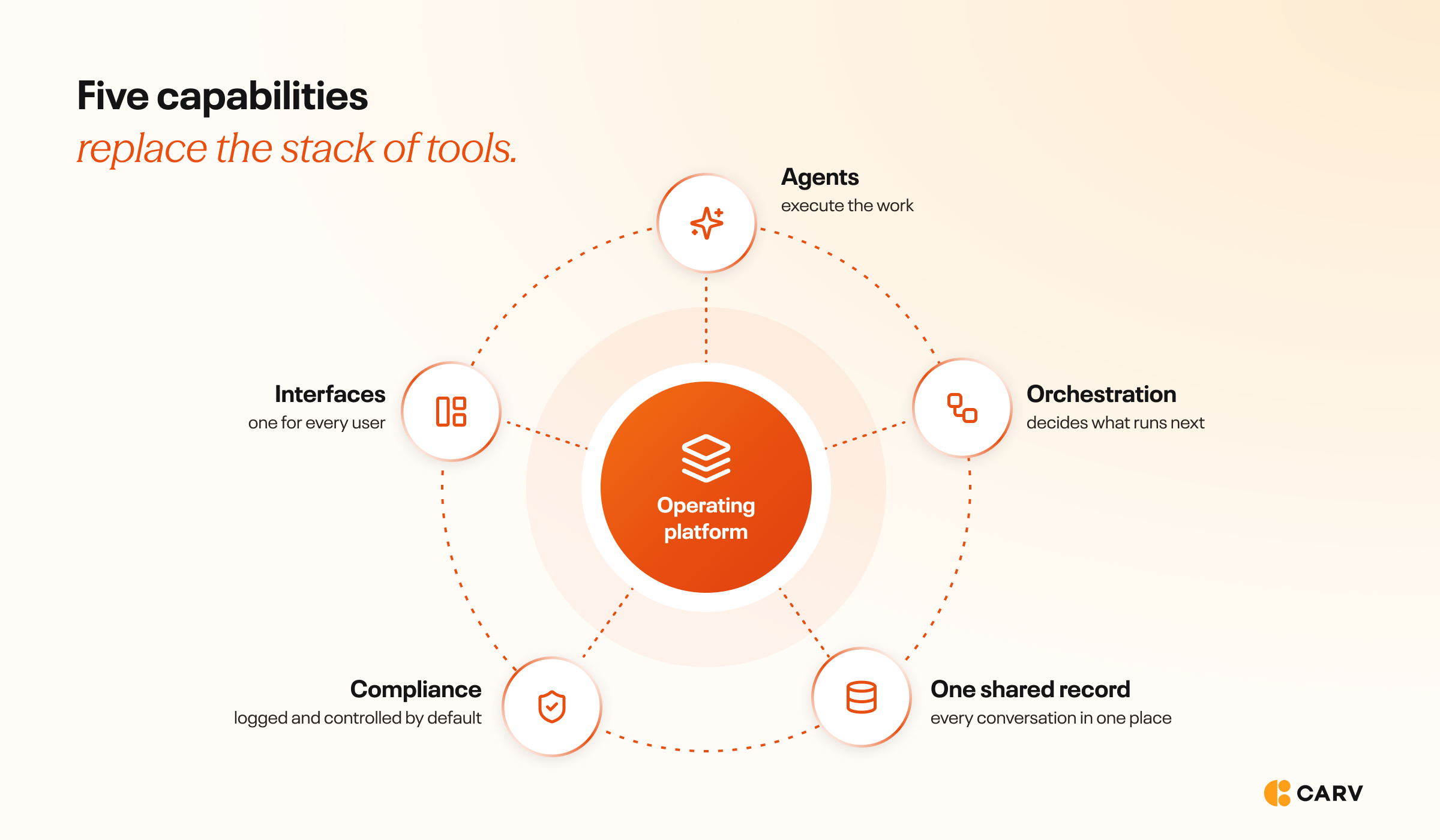
Taking over the ATS's process work and the point tools only works if the platform covers everything they did, which takes five capabilities.
Five capabilities the platform needs
Each of the five takes over work that used to sit in a separate tool or with a recruiter. Together they let one platform run the process from application to onboarding.
Agents that execute the work
Agents take on the tasks that used to land with recruiters: first contact, screening, assessment, scheduling, rediscovery and follow-up, around the clock and in the candidate's language.
They replace the chatbot, the scheduling tool, the assessment tools and most of the sourcing work.
Orchestration across the whole journey
Orchestration decides which agent acts next, what triggers it and when a person takes over. In a mission-led setup, it works toward a hiring outcome and coordinates the agents to reach it.
It replaces the workflow rules inside the ATS and the manual handoffs between tools.
An interface for every user
Recruiters, hiring managers and candidates each get tools built for their part of the work. Recruiters see what needs them, hiring managers see shortlists and interview slots, and candidates follow one journey in your brand.
It replaces the ATS screens, the separate portals and the extra logins.
One shared record
Every conversation, document, assessment and decision sits in one place, and each agent works from the full history. When a candidate is hired, the record passes to your system of record.
It replaces the duplicate records spread across the ATS, the CRM and the talent pool.
Compliance built in
Human oversight, traceability, fairness testing and data controls run inside the platform, with every action logged and rules such as the EU AI Act applied per market. The platform carries independent assurance such as ISO/IEC 27001, ISO/IEC 42001, ISO/IEC 27701 and SOC 2 Type II.
It replaces compliance documented around a set of separate tools.
No organization switches all five on at once, so the order of the move matters.
How to move to an autonomous stack
Start with the operating model: how work flows, who owns each decision and how the team is structured. The stack follows from those choices.
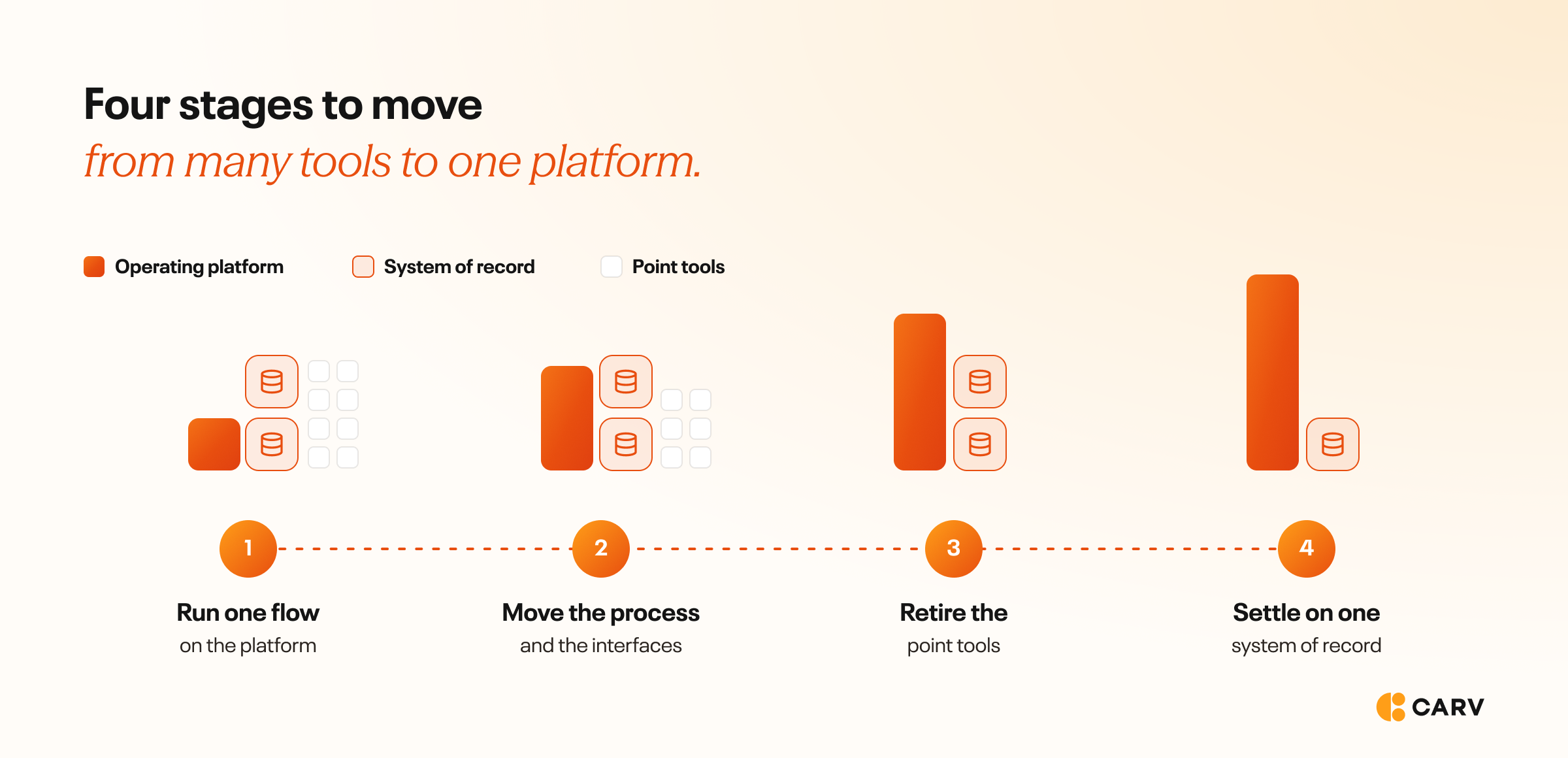
Then move in stages, in line with a phased deployment:
- Run one flow on the platform: one role type in one region, with the platform writing back to the ATS.
- Move the process and the interfaces: recruiters, hiring managers and candidates work in the platform, and the ATS only stores data.
- Consolidate the point tools: retire each tool once its work runs on agents.
- Settle on one system of record: keep the ATS for it, or retire the ATS and connect the platform to the CRM or HRIS you already run.
At every stage, a talent engineer owns the configuration and keeps improving it as more of the work moves over.
Over to you
An autonomous recruiting stack has two layers: one AI-native operating platform that runs the work from application to onboarding, and one system of record, whether that is the ATS, the CRM or the HRIS. The point tools are absorbed in stages, starting with a single flow, and the ATS stays only if it is the record you choose.
Request a demo and we'll map what your stack could look like on one platform.